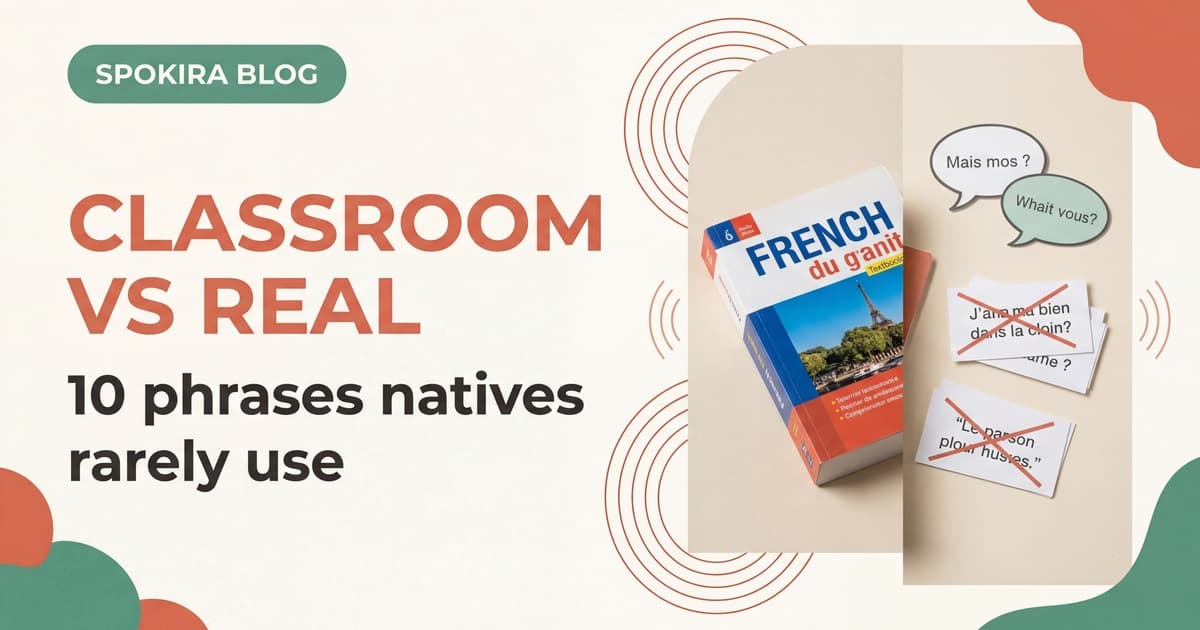
Every French learner has the same starter pack. Comment allez-vous. Je voudrais. Il fait beau. Comme ci, comme ça. These phrases live in textbooks, on flashcards, and in the minds of millions of people who studied French in school.
The problem: French speakers don't say most of them.
Not because they're wrong, they're grammatically perfect. But spoken French has evolved past what most curricula teach. Here are 10 phrases you probably learned and what you'll actually hear in France.
That gap is structural, not anecdotal. Core classroom verbs like aller and vouloir remain standard, but conversational French compresses them into shorter routines, and variation research on spoken negation shows the same pressure toward shorter oral forms outside the classroom (CNRTL, aller, CNRTL, vouloir, Journal of French Language Studies, 2010).
1. Comment allez-vous?
What you learned: The polite "How are you?"
What people say: Ça va?, or even just Ça va as a statement-question with rising intonation.
Comment allez-vous isn't dead. You'll hear it in formal settings, a job interview, meeting your partner's parents, a doctor's office. But in daily life, among anyone under 70, it's ça va and nothing else. Even comment vas-tu (the tu version) sounds slightly stiff in casual conversation.
2. Comme ci, comme ça
What you learned: "So-so."
What people say: Almost anything else. Bof. Pas mal. Couci-couça (the real French version, though also rare). Or just ça va with a flat tone and a shrug.
Comme ci, comme ça is understood but sounds quaint, like a phrase from a 1960s phrasebook. If you say it, French people will know you learned French from a textbook. Bof with a shrug communicates the same thing in one syllable.
3. Je ne sais pas
What you learned: "I don't know."
What people say: J'sais pas or Chais pas. The ne is dropped, je contracts into the s, and the whole thing becomes a single blurred syllable.
This is perhaps the biggest gap between classroom French and spoken French. The ne in negation is almost never pronounced in casual speech. Your teacher insisted on it. Real life doesn't.
The Spoken French Rule
In casual spoken French, the ne in negation is dropped about 95% of the time. Je ne sais pas → j'sais pas. Je ne veux pas → j'veux pas. Ce n'est pas → c'est pas. Learn the written form, but train your ear for the spoken one.
4. Il fait beau aujourd'hui
What you learned: "The weather is nice today."
What people say: Il fait bon or just Y fait beau (with the il swallowed). More often, people skip the weather formula entirely: On est bien dehors (it's nice out), Ça fait du bien (this feels good), or simply comment on it less formally.
The phrase isn't wrong, French people do talk about weather. But the textbook formula sounds like you're reading from a script. Real weather talk is more fragmentary: "Ah, il fait bon, non?"
5. Je m'appelle...
What you learned: "My name is..."
What people say: Moi c'est... In casual introductions, je m'appelle is perfectly fine but slightly formal. Among friends of friends, at a party, or in any relaxed setting, you'll hear "Moi c'est Marie" or just "Marie" with a handshake.
Je m'appelle still appears in formal introductions and when speaking to authority figures. But if you're at a bar and someone asks your name, "Moi c'est..." is the natural answer.
6. Excusez-moi
What you learned: "Excuse me."
What people say: Pardon. One word. Quick. No conjugation needed.
Excusez-moi is more formal and carries slightly more weight, like you're genuinely asking someone to excuse a real inconvenience. For getting past someone on the métro, getting a waiter's attention, or any small interruption, pardon is the default.
7. Je voudrais
What you learned: "I would like", the polite way to order.
What people say: Je vais prendre... (I'll have...) or Je prendrai... This one deserves its own post in this series, but the short version: je voudrais isn't wrong, it's just one option among many, and not always the most natural one.
8. Répétez, s'il vous plaît
What you learned: "Please repeat."
What people say: Pardon? or Comment? with a confused expression. Or Quoi? among friends (technically rude, universally used).
Saying répétez s'il vous plaît in conversation sounds like you're a student asking a teacher. French people just say pardon? or comment?, the equivalent of "sorry?" or "what was that?"
9. Qu'est-ce que c'est?
What you learned: "What is this?"
What people say: C'est quoi? or C'est quoi, ça? The inversion construction qu'est-ce que does appear in speech, but for simple questions, the inverted word order sounds unnecessarily complex. C'est quoi is faster and more natural.
This extends to most question forms: Où est-ce que tu vas? becomes Tu vas où? The classroom teaches formal question structures. The street uses informal ones.
10. Au revoir
What you learned: "Goodbye."
What people say: Salut. Allez, ciao. Bonne journée. À plus. The list goes on.
Au revoir is fine, it's polite and universally appropriate. But it's also the most formal goodbye. Leaving a friend's house, you'd say salut or à plus (see ya). Leaving a shop, the shopkeeper might say bonne journée (have a nice day). Au revoir is reserved for situations with some formality or finality.
The Pattern
Notice what's happening across all ten: the classroom teaches the formal, complete, grammatically pristine version. Real French compresses, contracts, and casualizes everything.
This isn't slang. It's not bad French. It's just how the language actually works when it's not being performed for a textbook. The spoken language moved on; the curriculum didn't.
The good news: you already know the formal versions, which means you can handle any professional or formal situation. The gap to fill is casual, everyday speech; which is what you'll actually use 90% of the time.
For training your ear and mouth on real spoken French (not textbook French), Spokira's conversation drills use native-speed delivery so you hear, and practice, what French actually sounds like.