You studied French for years. You can conjugate in the passé composé and the imparfait. You know the subjunctive exists. You can write a paragraph about your weekend.
Then you arrive in France and understand about 40% of what people say.
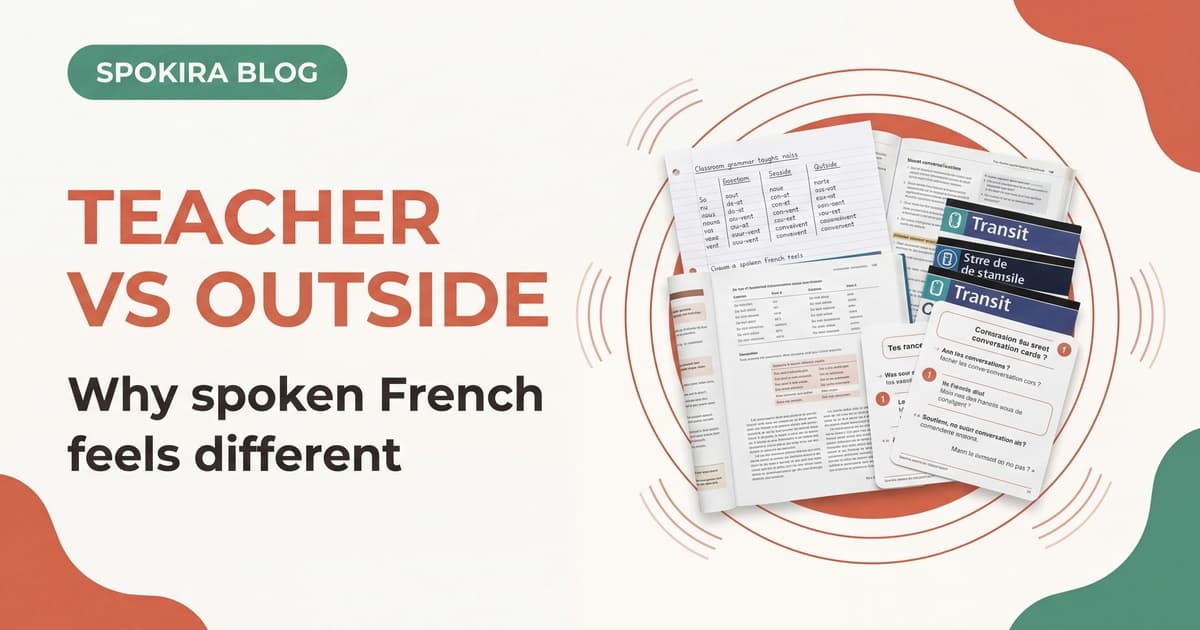
This is normal. Classroom French and spoken French are so different they're practically two registers of the same language. The grammar doesn't change, but almost everything about how it's delivered does.
Linguistics work on conversational French backs up that feeling. Studies in the Journal of French Language Studies describe extremely low realization rates for spoken ne in conversation and treat question and negation patterns as register-sensitive variables rather than learner mistakes (Fonseca-Greber, 2007, Rehner, 2010).
The Big Differences
1. Dropped Sounds
This is the single biggest shock for classroom learners. Spoken French deletes syllables aggressively:
| Written/Classroom | Spoken | What disappeared |
|---|---|---|
| Je ne sais pas | J'sais pas / Chais pas | ne + half of je |
| Il n'y a pas | Y'a pas | il + ne |
| Tu es où? | T'es où? | vowel in tu |
| Il y a | Ya | il |
| Je suis | J'suis / Chuis | vowel in je |
| Elle a dit | È l'a dit | lle reduces |
| Ce n'est pas | C'est pas | ne |
Your teacher spoke clearly because clarity is the point of teaching. Native speakers speak efficiently because speed is the point of conversation. The result is a language that sounds completely different from what you practiced.
The Core Rule
In casual spoken French, the ne in negation is almost always dropped. This single fact will unlock more listening comprehension than any vocabulary list. Je ne veux pas → j'veux pas. On ne peut pas → on peut pas. Train your ear for this and everything gets easier.
2. Question Structure
Classroom French teaches three question forms: inversion, est-ce que, and intonation. Real French uses almost exclusively the third.
| Classroom | Real speech |
|---|---|
| Où allez-vous? | Vous allez où? |
| Qu'est-ce que tu fais? | Tu fais quoi? |
| Est-ce que tu viens? | Tu viens? |
| Comment est-ce que ça marche? | Ça marche comment? |
| Pourquoi est-ce qu'il est parti? | Il est parti pourquoi? / Pourquoi il est parti? |
The pattern: put the question word at the end (or beginning), use normal word order, and let intonation do the work. Inversion (allez-vous) sounds literary or formal in conversation. Est-ce que is fine but longer than necessary.
3. On Replaces Nous
This one surprises learners because nous gets so much classroom time:
| Classroom | Real speech |
|---|---|
| Nous allons au cinéma | On va au ciné |
| Nous sommes arrivés | On est arrivés |
| Nous avons mangé | On a mangé |
| Nous devons partir | On doit partir |
Nous isn't extinct, you'll see it in writing, hear it in formal speech, and encounter it in certain fixed expressions. But in casual conversation, on is the default first-person plural. It's shorter, easier to conjugate (third person singular), and completely standard.
4. Filler Words and Connectors
Classroom French teaches clean, filler-free sentences. Real French is held together by verbal glue:
| Filler | Function | Example |
|---|---|---|
| Enfin | "well" / self-correction | C'est bien, enfin, ça dépend |
| Quoi | sentence-ending emphasis | C'est compliqué, quoi |
| Du coup | "so" / "as a result" | Du coup, on fait quoi? |
| Genre | "like" / "sort of" | C'était genre super bizarre |
| En fait | "actually" | En fait, j'ai changé d'avis |
| Bah | hesitation / "well" | Bah, j'sais pas trop |
| Tu vois | "you know" | C'est pas facile, tu vois |
| Voilà | wrapping up a thought | Et voilà, c'est comme ça |
Du coup and en fait are the most useful. Du coup has become the universal French connector for cause and effect. En fait reframes or corrects, it's "actually" without the confrontational edge.
5. Vocabulary Swaps
Some words are classroom standard but rarely heard in conversation. Their replacements are simpler:
| Classroom word | Real speech | Meaning |
|---|---|---|
| Automobile | Voiture / Caisse (slang) | Car |
| Réfrigérateur | Frigo | Fridge |
| Cinéma | Ciné | Movies |
| Petit déjeuner | P'tit déj | Breakfast |
| Téléphone portable | Portable / Tel | Phone |
| Photographie | Photo | Photo |
| Restaurant | Resto | Restaurant |
| Appartement | Appart | Apartment |
| Sympathique | Sympa | Nice/cool |
French loves abbreviation. If a word can be shortened, spoken French has shortened it.
6. C'est Does Everything
In classroom French, you learn il est vs c'est with specific rules. In spoken French, c'est wins almost every time:
| Classroom | Real speech |
|---|---|
| Il est médecin | C'est un médecin |
| Il est important de... | C'est important de... |
| Elle est belle, cette ville | C'est beau, cette ville |
The grammatical distinction still matters in writing. In speech, c'est is the default and il est sounds formal.
Why the Gap Exists
This isn't a failure of French education. Every language has a gap between its written/formal register and its spoken/casual one. French just has a particularly wide gap because:
-
French has strong prescriptive traditions. The Académie française, school grammar, and written culture maintain a formal standard. Teaching that standard is the school's job.
-
Spoken French evolved fast. Sound deletions, vocabulary shifts, and grammatical simplifications accelerated in the 20th century, but curricula didn't keep pace.
-
Foreign language classes teach safe French. It's easier (and less controversial) to teach nous allons than on va. The formal version is never wrong.
The result: you can pass a French exam and still struggle at a Paris dinner party. The knowledge is there. The exposure isn't.
How to Bridge the Gap
The fix isn't to unlearn classroom French, it's to add spoken French on top:
-
Listen to unscripted French. Podcasts, YouTube vlogs, reality TV, Twitch streams. Anything where people aren't reading from a script.
-
Practice speaking, not just writing. The gap only matters in spoken interaction. Reading and writing use the register you already know.
-
Drill common contractions. Get j'sais pas, y'a, t'es, and c'est pas into your muscle memory. These aren't shortcuts, they're how the language works.
-
Use on by default. Start saying on va, on a, on fait instead of nous. It'll feel wrong for a week and then completely natural.
-
Add filler words. Drop a du coup or en fait into your sentences. It immediately sounds more natural.
For training specifically on how French actually sounds (not how textbooks say it should), Spokira's speaking practice uses native-speed, casual French so you build reflexes for the language people really speak.