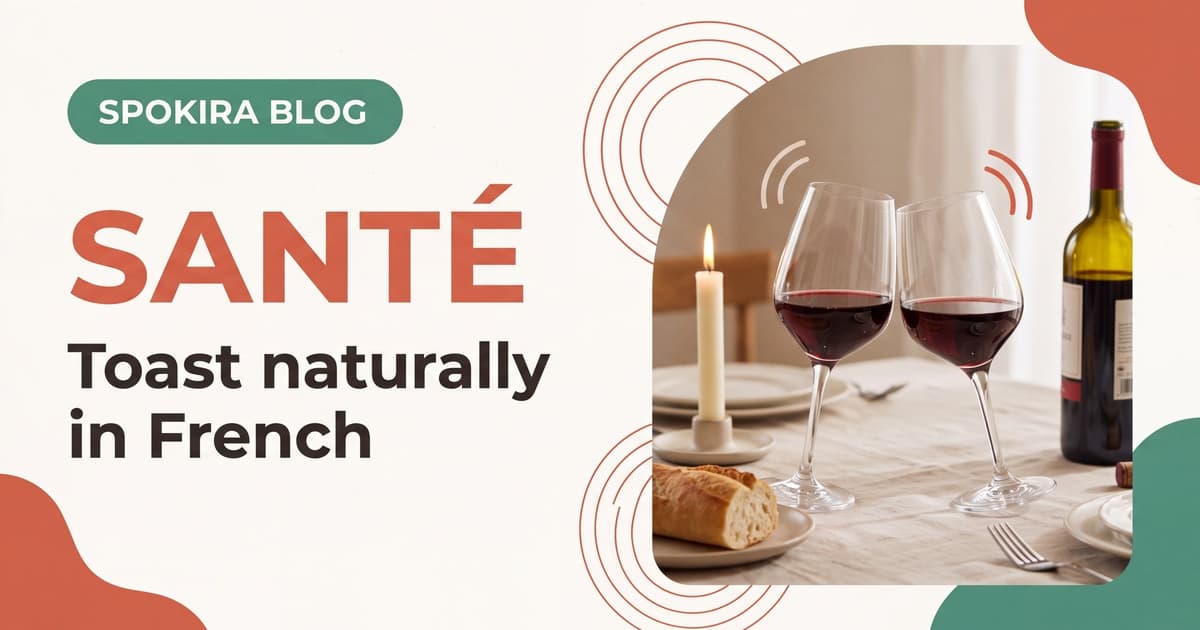
The everyday way to say cheers in French is santé! Say it when you raise your glass with friends, colleagues you know well, or people at a relaxed meal. If you want a slightly fuller and more personal phrase, say à la vôtre!. Both are useful. Neither requires a speech.
This is one of those moments where learners can overprepare. You do not need a dozen drinking expressions before dinner. You need one phrase you can say at the right moment, with clear rhythm and enough ease to look up at the people around you. Start with santé, learn the polite alternatives, and practice a few complete toasts so the phrase is there when glasses go up.
Quick answer: what do French people say for cheers?
Use santé! /sɑ̃.te/ for a simple “cheers.” You can also say à ta santé! to one person you address as tu, à votre santé! to several people or someone you address as vous, or à la vôtre! as a warm, compact toast.
| French phrase | Meaning in context | Best situation |
|---|---|---|
| Santé! | Cheers! | Casual shared drink |
| À ta santé! | To your health! | One friend or close peer |
| À votre santé! | To your health! | A group or formal vous situation |
| À la vôtre! | Cheers / to yours! | Friendly table toast |
| Tchin-tchin! | Cheers! | Playful, informal moment |
| À nos retrouvailles! | To seeing each other again! | Reunion or farewell meal |
The word toast itself is standard French. CNRTL defines it as raising a glass in honor of a person, event, or success (CNRTL, toast). So you may hear porter un toast, especially at a wedding, retirement dinner, or formal gathering. For the quick clink before the first sip, though, santé is the safe choice.
Cheers in French: what santé means and why it works
Literally, santé means health. Saying santé! is an abbreviated wish: “to health.” English does the same thing with “cheers,” but French makes the wish more visible.
The phrase is flexible because the unspoken subject can be shared. At a table, you may say santé to everyone. Looking at one friend, à ta santé makes the wish specific. When the group includes people you do not know well, à votre santé avoids any awkward choice between singular and plural.
There is a difference between meaning and social weight. A fast santé! before a glass of wine is ordinary. À votre santé! can be more deliberate, as if you are marking an occasion. Both are friendly. Use the shorter form when the moment is small; use the longer form when you want to make the toast about someone.
The dictionary evidence matches this use. CNRTL lists lever son verre à la santé de quelqu'un under verre and gives à la vôtre! as an example of raising a glass (CNRTL, verre). That gives you a natural model: the glass goes up, the phrase comes out, then you drink.
The five useful ways to say cheers in French
1. Santé!: the everyday default
Choose santé! when the group is casual and you want the French equivalent of “cheers.” It works at an aperitif, a restaurant, a picnic, or a friend's kitchen.
Friend: On boit quelque chose?
You: Avec plaisir. Santé!
The phrase is short. Do not stretch it into sahn-TAY with heavy English stress. French gives both syllables a fairly even flow, with a nasal first vowel and a clean final /e/.
2. À ta santé!: one person, informal
Use this with one person you call tu: a friend, sibling, partner, or peer. It is especially good for a birthday, good news, or a private celebratory moment.
À ta santé, Camille!
Do not worry that it sounds too intimate. The grammar simply matches the relationship. If you would say tu es to that person, à ta santé is available to you.
3. À votre santé!: the polite or group version
This is the useful version when you are speaking to more than one person or using formal singular vous. A family dinner with new relatives, a work meal, or a table of people you have just met are all good places for it.
À votre santé, et merci de m'accueillir.
It can sound gracious without being stiff. The added sentence makes it feel less like a memorized tourist phrase and more like a real response to hospitality.
4. À la vôtre!: natural, warm, compact
À la vôtre! literally points back to “your health,” but you do not need to translate it word by word. Learn it as a friendly whole. It is a good option when someone says à votre santé to you and you want to respond, or when you want a toast with a little more flavor than santé.
The pronoun agrees with the person or group you are addressing, not with the number of glasses. That is why vôtre keeps the vous form. You will hear à la tienne! in informal singular contexts, but it is less essential for a learner than à la vôtre.
5. Tchin-tchin!: playful, not universal
Tchin-tchin is a cheerful phrase for clinking glasses. CNRTL labels it a formula used to drink or offer a toast and gives à ta/votre santé as a synonym (CNRTL, tchin-tchin).
It is fun with friends. It can sound a bit childlike or performative in a solemn toast, so do not make it your only phrase. At a relaxed birthday drink, it is completely fine. At your manager's retirement speech, choose à votre santé instead.
A French toast is more than one word
When people ask about cheers in French, they often mean two different things: the quick phrase at a clink, and the little speech before a special meal. French has room for both.
For a formal toast, start with a clear reason, name the people you are honoring, then finish with a phrase everyone can repeat. Keep it shorter than you think. A sincere 30-second toast is easier to follow than three minutes of translated compliments.
A simple birthday toast
Je voudrais lever mon verre à la santé de Léa. Merci pour ta générosité et pour cette belle soirée. Joyeux anniversaire, Léa! À ta santé!
You do not need perfect vocabulary here. Merci pour cette belle soirée is a strong, usable line. It credits the host and gives the room a place to join in.
A thank-you toast at a meal
Merci de nous recevoir. Nous sommes très heureux d'être ici. À votre santé!
This is useful for travelers invited to someone's home. Speak more slowly than usual. The pause after recevoir lets you breathe and gives the words their weight.
A reunion toast
À nos retrouvailles! Ça fait plaisir de vous revoir.
Retrouvailles is the gathering after people have been apart. It gives a toast a natural French feel without sounding grand.
A professional dinner toast
À notre équipe, et à la suite du projet. Santé!
Keep professional language modest. You are making a small social gesture, not delivering a campaign speech. If you are unsure about the register, a plain à l'équipe or merci à tous is better than a complicated sentence.
What to do when you clink glasses
There are plenty of regional habits, family habits, and stories about toasting. Do not treat any one of them as a universal rule. The reliable social sequence is simple: make eye contact if it feels natural, raise your glass, say the phrase, clink gently if others are clinking, and take a sip.
The glass does not need to collide loudly. You are not proving enthusiasm with force. In a crowded restaurant, a small lift of the glass and santé may be all that happens.
If you do not drink alcohol, you can still participate. Raise sparkling water, juice, or an empty glass. The social gesture belongs to the group, not to the contents of the glass. You can say santé with confidence and drink what you prefer.
Eye contact and the “seven years” myth
You may hear the claim that failing to make eye contact during a toast brings seven years of bad sex or bad luck. Treat that as a joke, not an etiquette law. Some French people repeat it, many do not. Use normal attention and warmth; do not turn dinner into a cultural test.
Do you say cheers in France?
French speakers may use the English word in some international settings, just as English speakers sometimes use santé. But when you want to sound naturally French, say santé. It is short, clear, and recognized everywhere French is spoken.
Pronunciation: make the toast easy to hear
Santé /sɑ̃.te/
The first vowel is nasal. Do not say san-tay with a full /n/. Start with an open a quality, let air pass through your nose, and move directly to té. The final syllable is /te/, like a clean “tay” without a diphthong.
Break it down:
sɑ̃ | te
Your pitch can rise slightly if you are inviting the group in: Santé! At the end of a longer toast, a firm falling pitch can feel more conclusive.
À la vôtre /a la vɔtʁ/
The practical challenge is the French r in vôtre. Keep it brief. You do not need to growl. A light back-of-the-mouth friction is enough. More important is not adding an English r after the vowel.
Tchin-tchin /tʃɛ̃.tʃɛ̃/
This one has two identical nasal syllables. Make the tch sound like the beginning of “church,” then close each syllable with the nasal vowel. It is punchy and playful, so do not draw it out.
For work on nasal vowels and rhythm beyond one phrase, try French pronunciation practice for English speakers. Pair the audio work with French rhythm and intonation practice, because a clear toast depends more on vowel shape and timing than a flawless accent.
Toast on the exhale
Before you raise your glass, breathe out once. Then say santé in one relaxed breath. It keeps your voice steady and stops the phrase from sounding clipped.
A five-minute cheers-in-French drill
Minute 1: say the core phrase
Repeat santé! ten times. On the final five repetitions, imagine someone across the table and let your eyes lift from the text. A toast is social, so train the body movement with the sound.
Minutes 2 and 3: switch the pronoun
Say each pair out loud, then say it again from the English cue.
- One friend: À ta santé!
- A group: À votre santé!
- A friendly reply: À la vôtre!
- Casual shared drink: Santé!
Now mix the cues: friend, colleagues, host, everyone. Your job is to choose the phrase before you speak, not to recite a fixed list.
Minute 4: practice a complete toast
Shadow this three times:
Merci de nous recevoir. Nous sommes très heureux d'être ici. À votre santé!
First, read slowly. Next, speak at comfortable conversation speed. Last, record one take without looking. Listen for smooth groups of words: merci de nous recevoir and très heureux d'être ici.
Minute 5: improvise a 20-second toast
Pick one occasion: birthday, reunion, new job, last night of a trip. Say who the toast is for, one reason, and one closing phrase. Keep it human. A small specific detail is more memorable than a complicated adjective.
Make short French phrases ready when the moment arrives
Spokira pairs native-speaker audio with recording and feedback so you can practice the rhythm of real French, one useful scenario at a time.
Common mistakes to avoid
Using à ta santé with everyone
Ta is singular informal. It is right for one friend, not for a group of new colleagues. When unsure, santé avoids the choice; à votre santé is the polite group-safe version.
Thinking tchin-tchin is mandatory
It is optional. It has charm, but santé is the everyday foundation. Learn the word because you will hear it, not because you must perform it at every drink.
Drinking before the group finishes the toast
At a formal occasion, wait for the toast to land before drinking. At a casual aperitif, follow the room. Mirroring is a good social skill in any language.
Memorizing a speech you cannot retrieve
If a toast matters, prepare three anchors: who, why, closing phrase. Do not memorize a paragraph that collapses when someone interrupts. This is the same skill behind relaxed conversation. The French speaking practice guide can help you build cue-based recall rather than word-for-word dependence. When the occasion is part of a trip, rehearse the meal context with French for travel too.
The takeaway
For cheers in French, start with santé!. Use à ta santé for one friend, à votre santé for a group or formal situation, and à la vôtre when you want a warm toast response.
Then say it out loud in a complete scene. Raise the glass, look up, and let the phrase arrive in one easy breath. Real French is not a vocabulary test at the table. It is a small shared moment, and a practiced santé is enough to join it.
Continue the series with bonne nuit, bonsoir, and good night in French.