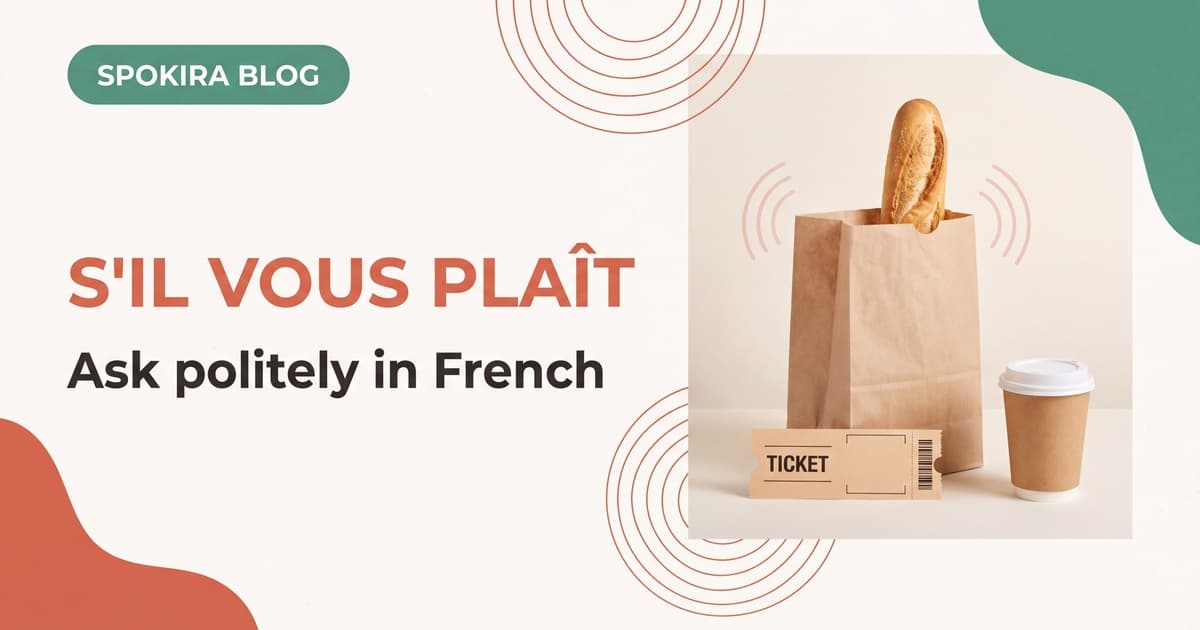
The standard way to say please in French is s'il vous plaît. Use it with strangers, staff, a group of people, and anyone you address as vous. With one friend, child, or close peer, use s'il te plaît instead.
It is tempting to file both phrases under “polite words” and move on. But s'il vous plaît is more useful than that. It gives you a dependable shape for ordering, asking directions, clarifying, and asking someone to repeat themselves. Once your mouth can say it smoothly, you can build dozens of real requests around it.
Quick answer: how do you say please in French?
Say s'il vous plaît /sil vu plɛ/ in polite or plural situations. Say s'il te plaît /sil tə plɛ/ with one person you use tu with. Both literally mean something like “if it pleases you,” but learn them as complete request phrases, not as a puzzle to translate in the moment.
| French | Natural English | Use it with |
|---|---|---|
| S'il vous plaît | Please | Strangers, staff, groups, formal singular |
| S'il te plaît | Please | One friend, close peer, child |
| S'il vous plaît,...? | Could you please...? | Polite question or request |
| Un café, s'il vous plaît. | A coffee, please. | Order at a counter |
| Répétez, s'il vous plaît. | Please repeat. | Asking for help understanding |
The phrase comes from the verb plaire, “to please.” CNRTL records s'il vous plaît as a politeness formula (CNRTL, plaire). The Académie française entry for plaire also uses it in conventional polite formulas. You do not need to explain the grammar to use it, but knowing the origin helps the phrase feel less random.
S'il vous plaît or s'il te plaît?
The choice follows the same social distinction that runs through French: vous for formality or more than one person; tu for familiar singular relationships.
Use s'il vous plaît when in doubt
Choose it with a shopkeeper, server, receptionist, teacher, older person you do not know, new colleague, or a group. It is never rude to be slightly more formal at the start. If someone invites you to use tu, you can shift later.
Bonjour, où sont les toilettes, s'il vous plaît?
Je voudrais deux billets, s'il vous plaît.
Vous pouvez parler un peu plus lentement, s'il vous plaît?
These are not stiff phrases. They are everyday French. The small words make the request easier to receive.
Use s'il te plaît with one familiar person
Use it with someone you call tu: a friend, partner, sibling, classmate, or child. The request can be small or important; the relationship, not the size of the favor, chooses the phrase.
Tu peux m'aider, s'il te plaît?
Passe-moi le sel, s'il te plaît.
Attends-moi deux minutes, s'il te plaît.
With close friends, you may hear requests that omit s'il te plaît. That does not mean you need to drop it. Keeping it is kind and very natural, especially when you are asking for time or effort.
Why vous has two jobs
French vous can address one person formally or several people. That is why s'il vous plaît works for both “Could you please?” to a receptionist and “Please” to a group of friends.
The Académie's treatment of vous reflects this dual singular-polite and plural role. For a learner, the practical rule is easy: if there is more than one person, use vous; if there is one person and you are unsure, use vous.
Put s'il vous plaît in the right place
French is flexible about where s'il vous plaît appears. Put it where you can say it comfortably. You do not have to force it into exactly the same position as English “please.”
At the end: the easiest starting point
Un billet pour Lyon, s'il vous plaît.
Une table pour deux, s'il vous plaît.
L'addition, s'il vous plaît.
This pattern is perfect for travel. You say the thing you need first, then add politeness. It gives you time to retrieve the noun before you speak the full request.
At the beginning: a softer request
S'il vous plaît, vous avez l'heure?
S'il vous plaît, où est la sortie?
Starting with the phrase can gently get attention. It is particularly useful if someone is busy or you are approaching a stranger. Keep your tone calm; the phrase is an opener, not an alarm bell.
In the middle: natural with questions
Vous pouvez, s'il vous plaît, m'indiquer le chemin?
Vous pouvez parler plus lentement, s'il vous plaît?
This version is useful once you have more French, but do not make it your first pattern. End placement is easier under pressure and is fully natural.
Essential requests you can use today
The quickest way to make please in French active is to attach it to common scenes. Keep these phrases short enough to say without translating each word.
| Situation | French request | Key point |
|---|---|---|
| Ordering coffee | Un café, s'il vous plaît. | The phrase can be simple |
| Buying a ticket | Deux billets, s'il vous plaît. | State quantity first |
| Asking directions | La gare, s'il vous plaît? | A short prompt is acceptable |
| Asking for repetition | Vous pouvez répéter, s'il vous plaît? | Useful when you freeze |
| Asking for slower speech | Plus lentement, s'il vous plaît. | Clear and direct |
| Asking to pay | L'addition, s'il vous plaît. | Standard restaurant request |
| Asking a friend | Tu peux m'aider, s'il te plaît? | Match tu with te |
Notice what these requests have in common: none is grammatically ornate. The goal is not to make French sound like a formal letter. The goal is to get the interaction moving politely.
If ordering is the situation that makes you blank, work through the French cafe conversation practice script. It teaches the whole exchange, including how to respond when the other person asks a follow-up question.
Merci and s'il vous plaît: use both, but at different moments
Learners sometimes mix up “please” and “thank you” because both soften an interaction. In French, they do different work.
- S'il vous plaît comes with the request.
- Merci comes after someone helps, serves, answers, or hands you something.
Bonjour, un croissant, s'il vous plaît.
Voilà.
Merci.
This compact sequence is worth rehearsing exactly as shown. It starts politely and closes politely. You do not need an extra apology or a long explanation unless the situation calls for one.
What about je voudrais?
Je voudrais means “I would like” and makes an order or request gentler. Pair it with s'il vous plaît when you can:
Je voudrais un café, s'il vous plaît.
At a busy counter, un café, s'il vous plaît is already polite. Do not wait until you can build a conditional tense sentence before you order breakfast.
What about pardon and excusez-moi?
Use pardon or excusez-moi to get attention, apologize for a small interruption, or ask someone to repeat. Then make the request with s'il vous plaît.
Excusez-moi, la station de métro, s'il vous plaît?
Pardon, vous pouvez répéter, s'il vous plaît?
This is one of the most valuable repair moves in spoken French. You do not need to understand everything immediately. You need a way to keep the conversation open. For more of those moves, see how to ask follow-up questions in French.
Pronunciation: make the phrase one smooth unit
The usual pronunciation is /sil vu plɛ/. The written apostrophe in s'il is not a pause. The phrase should feel like three linked groups: sil | vous | plaît.
S'il /sil/
The first part is short. Do not say “see ill.” Blend it into one light syllable.
Vous /vu/
Round your lips for the French /u/, like holding a small straw. It is not the vowel in English “you,” which often begins with a glide. Keep it pure and brief.
Plaît /plɛ/
The vowel is open, close to the vowel in “bet” for many English speakers. The final t is silent. Do not pronounce plait like the English word for braided hair.
Try this rhythm:
s'il vous plaît | merci
The two phrases form a useful politeness pair. Say them without pushing stress onto vous. French requests often sound calm because the rhythm stays connected.
For a larger pronunciation plan, French speaking practice and French for travel give you short routines that put phrases inside real scenarios.
Use the phrase as a reset button
When you cannot remember the perfect sentence, say s'il vous plaît after the useful word you do know: la gare, s'il vous plaît? It buys you a polite, intelligible next step.
A five-minute s'il vous plaît speaking drill
Minute 1: train the sound
Say s'il vous plaît ten times at a relaxed pace. On repetitions six through ten, add merci. Keep the final t silent.
S'il vous plaît. Merci.
Minutes 2 and 3: switch between vous and te
Say the English cue first, then the French line without looking:
- Stranger, train station: La gare, s'il vous plaît?
- Friend, salt: Passe-moi le sel, s'il te plaît.
- Server, bill: L'addition, s'il vous plaît.
- Friend, wait: Attends-moi, s'il te plaît.
This is not a grammar test. You are training the social cue that selects the form.
Minute 4: rehearse a repair line
Shadow these three times:
Pardon, vous pouvez répéter, s'il vous plaît?
Plus lentement, s'il vous plaît.
Je n'ai pas compris. Vous pouvez répéter?
These lines protect you when listening gets difficult. Practice them before your trip, not after you have frozen.
Minute 5: record a three-request scene
Record yourself entering a cafe, ordering, and asking one follow-up question. Use bonjour, s'il vous plaît, and merci. Tomorrow, change the scene to a station or pharmacy. The polite frame stays the same, which lets you focus on the new vocabulary.
Turn polite French into an automatic speaking habit
Spokira uses native-speaker shadowing, recording, and clear feedback to help you practice short real-life exchanges until they feel ready.
Common mistakes with please in French
Mixing te and vous
S'il te plaît is for one tu relationship. S'il vous plaît is for plural or formal vous. If you hesitate, choose vous. Polite distance is easy to relax later; accidental informality can be harder to repair.
Treating the phrase as optional in every request
French can be direct, especially in quick service interactions, but adding s'il vous plaît is a safe default when you are learning. It makes a short request sound complete.
Pronouncing the final t
The final t in plaît is silent. Let the phrase end on the vowel /ɛ/.
Waiting for perfect grammar
“Two tickets, please” is a functional French request: deux billets, s'il vous plaît. Build from useful nouns and use the politeness frame. You can add more grammar as your confidence grows.
The takeaway
For please in French, use s'il vous plaît with strangers, staff, groups, and formal situations. Use s'il te plaît with one person you know well. Then pair the phrase with a concrete need: a coffee, directions, the bill, or a repetition.
Say it as one smooth unit, not three English words. A calm bonjour, un café, s'il vous plaît gives you a real opening in French. Practice that opening until your mouth reaches for it before your nerves do.
A simple way to sound less rehearsed
Vary the object, not the polite frame. One day ask for un café, the next for un billet, un renseignement, or l'addition. Your mouth learns the same connected s'il vous plaît while your vocabulary changes. That is more useful than repeating a perfect coffee order twenty times and having no way to adapt it.