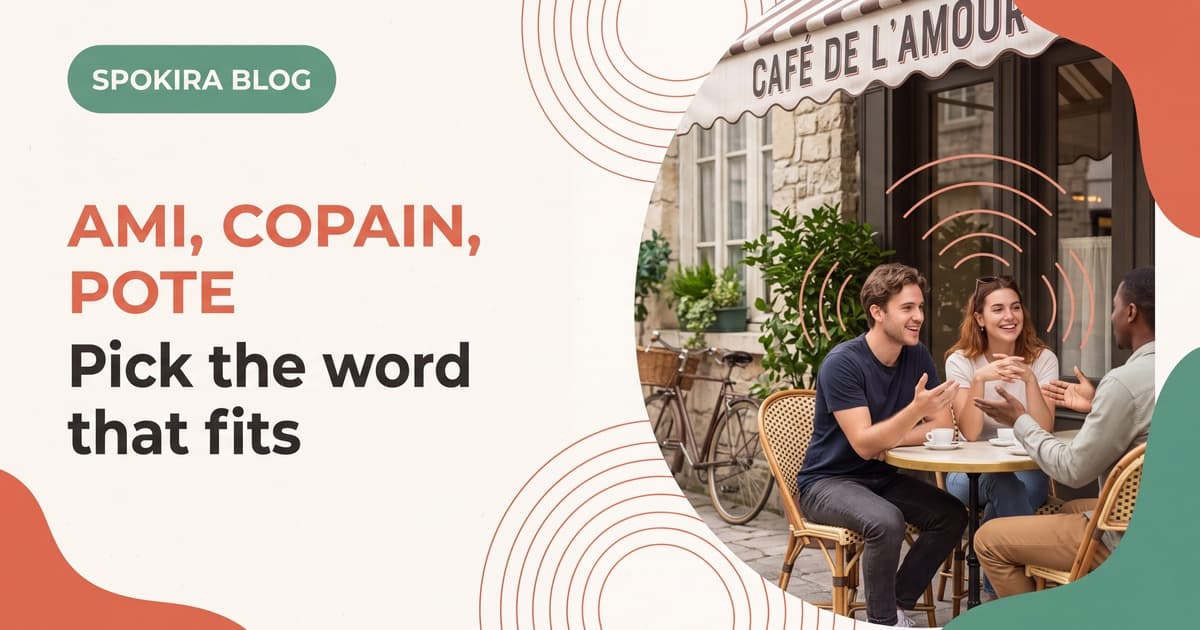
"Friend" looks like it should be one easy French word. Then you hear ami, copain, pote, camarade, and petit ami, and the simple answer becomes slippery. The right friend in French depends less on dictionary precision than on the relationship you are describing and how casual you want to sound.
Start with this: ami is the reliable general word for a friend. Copain is often a friend, buddy, or classmate, but can also mean boyfriend or girlfriend in some contexts. Pote is a very informal mate. None is a direct replacement in every sentence.
This third entry in Spokira’s Practical French Expressions series keeps you out of the most awkward traps, especially the moment when you mean "my friend" and accidentally suggest "my boyfriend." More importantly, it gives you phrases to use when introducing people and talking about your social life.
Quick answer: how do you say friend in French?
Use un ami or une amie for a friend. Add context when the relationship could be misunderstood.
| French word | Closest English idea | Register | Watch out for |
|---|---|---|---|
| ami / amie | friend | neutral | mon ami / mon amie can sound close or romantic without context |
| copain / copine | friend, buddy, classmate | casual | can mean boyfriend/girlfriend |
| pote | mate, pal | very casual | not for a formal introduction |
| camarade | classmate, teammate, comrade | context-specific | not the everyday catch-all |
| petit ami / petite amie | boyfriend/girlfriend | neutral | clearly romantic |
The Académie française defines ami first as a person joined to another by mutual affection, then notes a broader use for camaraderie, sympathy, or shared interests (Académie française, ami). That broad range is why ami is correct, but context does real social work.
Ami and amie: the safest general choice
Use un ami for a male friend and une amie for a female friend. The final consonant is pronounced in both forms: ami sounds /a.mi/, and amie also has two syllables.
C’est un ami du travail. He’s a friend from work.
Je retrouve une amie ce soir. I’m meeting a friend tonight.
Mes amis arrivent demain. My friends arrive tomorrow.
Add a little context when it matters: un ami d’enfance (a childhood friend), une amie de fac (a university friend), un ami de mon frère (my brother’s friend). This makes the relationship clear and gives you something real to say about the person.
Why does mon amie sometimes sound romantic?
French can use un ami or une amie for a partner, particularly when a speaker does not want to label the relationship too precisely. The Académie’s entry includes the familiar sense of a lover and gives petit ami and petite amie as clearer relationship language (Académie française, ami).
That does not mean you should avoid amie. "C’est mon amie Sarah" is normal when you give a name. "Je sors avec une amie" could simply mean you are going out with a friend, but context and tone may leave room for a question. If you want zero ambiguity, add une amie à moi, une amie du travail, or the person’s name.
Copain and copine: friendly, casual, and sometimes romantic
Copain has a looser, more everyday feel than ami. It can describe somebody you know through school, sports, work, or a group. Children often talk about mes copains. Adults do too, especially about old school friends or a familiar group.
Je prends un verre avec des copains. I’m having a drink with some friends.
C’est une copine de lycée. She’s a friend from high school.
The ambiguity arrives when you use a possessive singular. Mon copain often means "my boyfriend"; ma copine often means "my girlfriend." It can still mean a friend, especially depending on region, age, and context, but a beginner should not depend on the listener guessing correctly.
| What you mean | Clear French |
|---|---|
| my male friend | un ami à moi / un copain de travail |
| my female friend | une amie à moi / une copine de classe |
| my boyfriend | mon petit ami or often mon copain |
| my girlfriend | ma petite amie or often ma copine |
CNRTL’s examples for copain include the sense of a companion and old friend, which is the everyday center of the word (CNRTL, copain). Think "someone in my circle," rather than "my deepest friend."
Pote: when "mate" is exactly the tone you want
Pote is informal. It is the word you might use with people your own age in a relaxed conversation: "a mate," "a pal," "a buddy."
C’est un pote à moi. He’s a mate of mine.
Je vais voir mes potes. I’m going to see my mates.
The word is friendly but not automatically intimate. You can call a close friend un pote, and you can call someone you know from football un pote. It is about register, not a score for emotional closeness.
CNRTL labels poté (the older form related to today’s pote) as familiar and glosses it as "friend, comrade" (CNRTL, poté). That label is your cue: use it among peers, not in a job interview, a formal email, or an introduction to your host’s grandparents.
Do not overdo slang
You may hear poto, frérot, or regional slang. It is fine to understand them. You do not need them to sound natural. A calm un pote is far more useful than borrowing slang you cannot place socially.
Camarade, connaissance, and other useful distinctions
French gives you more precise words when "friend" is not quite right.
- un camarade de classe: a classmate
- un collègue: a colleague
- une connaissance: an acquaintance
- un voisin / une voisine: a neighbour
- un compagnon / une compagne: partner, often adult and long-term
If you met someone once at a conference, do not inflate the relationship to un ami. Une connaissance is polite and accurate: C’est une connaissance de Paris. If you are a learner trying to make conversation, this distinction can take pressure off. You do not have to claim a close bond before it exists.
How to pronounce the words naturally
| Word | IPA | Learner cue |
|---|---|---|
| ami | /a.mi/ | ah-mee |
| amie | /a.mi/ | ah-mee |
| copain | /kɔ.pɛ̃/ | koh-pah(n) |
| copine | /kɔ.pin/ | koh-peen |
| pote | /pɔt/ | poht |
The important sound in copain is the final nasal vowel. It is one syllable after co, not "co-pain" with an English n. Say pa with the mouth open, let air move through your nose, then stop. For help isolating that sound, use the drills in French nasal vowel practice.
When you introduce a person by pointing to them in a group, voilà gives you a simple bridge: Voilà Camille, c'est une amie du travail. The sound and use guide in what voilà means helps you practice that presenting rhythm.
A useful speaking drill: introduce three people
Choose three real people, then say each line aloud ten times with a natural pause after c’est.
- C’est une amie du travail.
- C’est un copain de lycée.
- C’est un pote de mon frère.
Now switch the reason you know them: de cours, du sport, du quartier. Record one round. Do not chase a perfect accent; listen for the difference between the nasal ending in copain and the clear ending in copine. Your mouth learns faster when the contrast appears inside a sentence.
Add context instead of worrying about ambiguity
If mon copain or ma copine might sound romantic, say where you know the person: un copain de travail, une amie de fac, or simply give their name.
The same context clue protects your tone with strangers and older people. Start with bonjour and choose vous until the other person signals otherwise; polite vs rude French explains that social default without turning it into a scary rulebook.
Real conversations you can borrow
Introducing someone at a dinner
You: Je te présente Léa. C’est une amie d’enfance. Léa: Enchantée. Other person: Enchanté(e), moi c’est Max.
Amie d’enfance clearly signals a long, non-romantic friendship. It also opens a conversation: where did you grow up?
For travel, this detail is useful when you meet someone through a host, tour, or shared activity: C'est un ami de Paris is clearer than an isolated label. Pair it with a short introduction so you can say who someone is and why you know them.
Talking about weekend plans
Friend: Tu fais quoi ce week-end? You: Je vais voir des copains à Lyon. Friend: Ah, sympa!
Plural des copains is comfortable. No one will assume you are dating several people.
Clearing up a relationship label
Person: C’est ton copain? You: Non, c’est juste un ami du travail.
That is a useful repair. You do not need a long explanation. Juste means "just" here and keeps the tone light.
Turn vocabulary into an introduction you can say
Spokira helps you rehearse short, real-life French scripts with native audio and recording feedback, so the next introduction does not begin with a blank mind.
A five-minute routine for social vocabulary
- Say the five words in the pronunciation table once.
- Pick one real person for each category: friend, classmate, colleague, acquaintance.
- Build four sentences with c’est or je vois.
- Ask yourself one follow-up question: Tu le connais depuis longtemps? or Vous vous êtes rencontrés où?
- Record the mini-dialogue, then repeat it more slowly if the nasal vowel disappears.
This turns vocabulary into conversation. If you freeze after the first introduction, keep two follow-up questions ready with the help of how to keep a French conversation going.
Common mistakes
Using mon ami for every English "my friend." It is grammatical, but context may make it sound weightier or more romantic than you intend. Add a name or source of the friendship.
Assuming copain always means boyfriend. It does not. In plural or with a clear qualifier, it commonly means friends.
Using pote with everyone. It is relaxed speech. Save it for an informal peer setting.
Forgetting the feminine forms. Une amie, une copine, and une camarade matter. Listen for the extra consonant sound in copine compared with nasal copain.
Calling every person you know an ami. Connaissance is not cold. It is accurate for an acquaintance.
FAQ
What is the most natural way to say "my friend" in French?
Un ami à moi or une amie à moi is a safe spoken choice, especially when you add context: une amie à moi du travail. With a name, mon amie Clara is also clear.
Does copine always mean girlfriend?
No. It can mean a female friend, often in a casual context. But ma copine can mean "my girlfriend," so add de classe, du travail, or another clue if romance is not intended.
Is pote rude?
No, but it is informal. It is like "mate" or "pal," so it belongs with friends and peers, not formal introductions.
What does petit ami mean?
Petit ami means boyfriend and petite amie means girlfriend. They are much less ambiguous than singular copain or copine.
The useful rule
Learn ami first. Use copain when the setting is casual and the context is clear. Use pote only when you would comfortably say "mate." Then practice the complete sentence, not just the label: C’est une amie du travail.
That is how "friend in French" becomes a phrase you can use at a dinner, on a trip, or in your next conversation. A small bit of context lets you sound more natural and prevents one very avoidable misunderstanding.
Extra friend-in-French practice
Make a tiny social map before your next lesson. Write four names, then describe each person with one accurate phrase: C'est un ami d'enfance, c'est une collègue, c'est un copain de sport, c'est une connaissance. Say the lines once slowly, then answer a likely question: Vous vous connaissez depuis quand? This is a useful upgrade because French conversations often move immediately from a label to the story behind it. You do not need a dramatic answer. Depuis le lycée or depuis deux ans is enough.
A small story makes the word clear
Imagine you arrive at a birthday dinner with Hugo. When the host asks who he is, C'est un ami du travail settles it immediately: you know each other through work. If you say c'est mon copain without more context, the host may reasonably assume he is your partner. Neither phrase is bad French. The difference is simply the picture it creates for the listener.
That is why a useful friendship label usually contains two pieces: the relationship word and where it comes from. Keep a few ready: une amie de Paris, un copain de sport, une connaissance de ma sœur. They are easy to adapt and sound more personal than a bare translation. Then practice introducing one person without reading.