The first French word most people learn is oui. Then a French speaker asks, Tu n’as pas faim? and someone answers si. Then you hear ouais from a friend and wonder whether it is lazy, rude, or a different word entirely. Saying yes in French is easy only until the question changes shape.
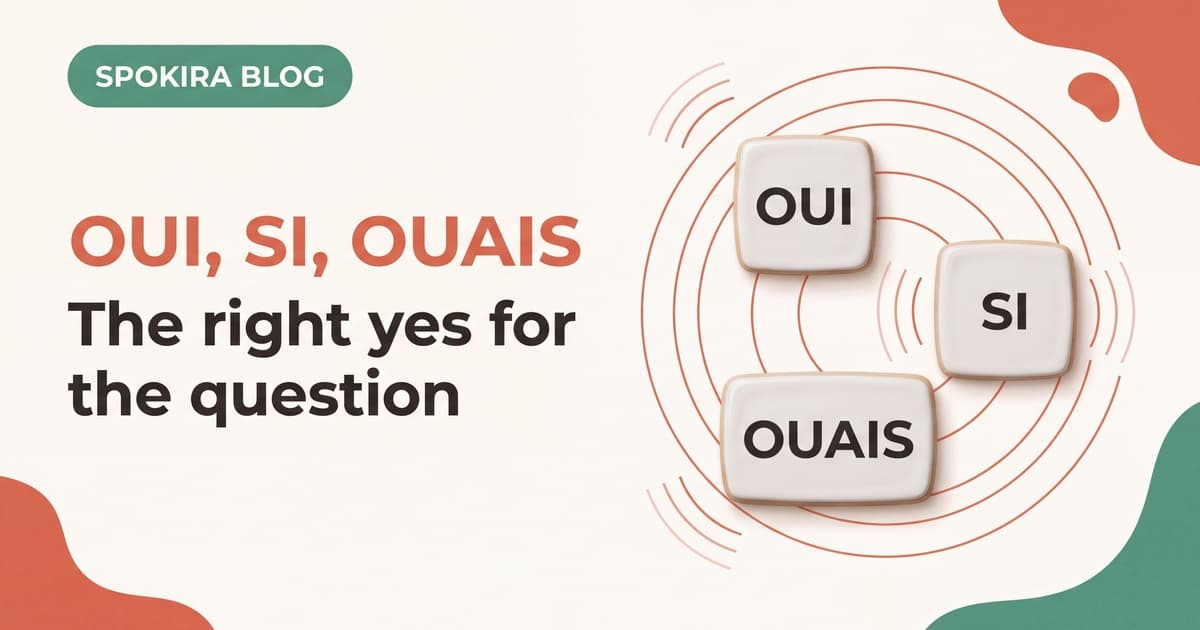
Here is the useful version: oui is your normal yes. Si is the yes you use to contradict a negative question or negative statement. Ouais is a casual, sometimes skeptical version you should understand before you copy. Learn the response pattern and you will stop translating every yes/no exchange in your head.
This fourth Practical French Expressions guide gives you the rule, the sound, and drills for the moment that causes the most confusion: negative questions.
Quick answer: which “yes” should you use?
| French word | Use it when | English feel |
|---|---|---|
| oui | answering a positive question | yes |
| si | contradicting a negative question or statement | yes, actually |
| ouais | talking casually with peers | yeah / yep |
| bien sûr | agreeing strongly or reassuringly | of course |
| mais oui! | correcting doubt with feeling | of course I do! |
The Académie française defines oui as the adverb of agreement and explicitly notes si for an affirmative answer to a negative question: Ne le connaissez-vous pas?, Si (Académie française, oui). That is the one grammar fact worth keeping.
Oui: the normal, neutral answer
Use oui after a positive question, request, or suggestion.
Tu viens demain?, Oui. Are you coming tomorrow?, Yes.
Vous avez une réservation?, Oui, à 19 heures. Do you have a reservation?, Yes, at 7 p.m.
IPA: /wi/ Cue: like English “we,” but shorter and without a heavy stress.
Round your lips first, then move quickly into ee. Do not make two syllables: not “oo-ee.” A short oui can sound abrupt in English translation, but in French it is completely normal. Add a sentence when the situation needs warmth: Oui, merci; oui, volontiers; oui, bien sûr.
The Académie also cautions against replacing every simple oui with weighty words such as absolument or effectivement when oui does the job (Académie française, “Oui”). Learners often sound more natural by choosing the ordinary response.
Si: the answer that corrects a negative question
Use si when someone asks a negative question and the truthful answer is affirmative. It means “yes, I do,” “yes, it is,” or “yes, actually.”
Tu n’aimes pas le café?, Si, j’aime ça. You don’t like coffee?, Yes, I do.
Vous n’avez pas votre passeport?, Si, le voilà. You don’t have your passport?, Yes, here it is.
Il ne vient pas?, Si, il arrive. He isn’t coming?, Yes, he is.
If you say oui here, many speakers will understand from your face or longer answer. But si is the neat French signal that you are pushing back against the negative idea. It prevents a small exchange from becoming confusing.
The two-question test
Say these pairs out loud:
- Tu as faim?, Oui.
- Tu n’as pas faim?, Si, j’ai faim.
- Tu es prêt(e)?, Oui.
- Tu n’es pas prêt(e)?, Si, je suis prêt(e).
The answer changes because the question has ne...pas. Your second sentence can be fuller than a bare si, which is reassuring when you are still learning.
Hear the negative before answering
When you hear ne...pas, pause for half a beat. If you want to contradict it, begin with si and repeat the positive fact: Si, j’ai compris.
Ouais: casual “yeah,” with tone built in
Ouais is familiar. It may be a relaxed “yeah,” but its intonation can also express surprise, doubt, or skepticism. CNRTL calls it familiar and notes those shades directly (CNRTL, ouais).
Tu veux venir?, Ouais, pourquoi pas. Want to come?, Yeah, why not.
Il dit qu’il a fini en dix minutes., Ouais... He says he finished in ten minutes., Yeah... right.
The written word is /wɛ/, close to “way” without the final glide. It is not a more elegant way to say oui. Use it with friends when you already hear it around you. Do not open a formal appointment, customer exchange, or conversation with an older stranger with ouais.
Other natural ways to agree
You do not need dozens, but a few complete chunks are helpful.
| Phrase | Meaning | Register |
|---|---|---|
| oui, bien sûr | yes, of course | neutral |
| oui, volontiers | yes, gladly | polite |
| d’accord | okay / agreed | neutral |
| tout à fait | exactly / absolutely | stronger agreement |
| mais oui! | yes, of course! | expressive |
| si, bien sûr! | yes, of course I do! | contradiction |
Notice that d’accord does not always answer a factual yes/no question. It often means “okay, agreed.” If someone asks Tu viens?, oui is direct. If they propose On se retrouve à huit heures?, d’accord is a natural agreement.
A pronunciation drill for three different answers
Practice the sounds in a small dialogue. Make the tone change, not just the word.
A: Tu as le temps? B: Oui, cinq minutes.
A: Tu n’as pas le temps? B: Si, j’ai cinq minutes.
A: Tu veux vraiment regarder ce film? B: Ouais... pourquoi pas.
Record each answer. Oui should be a quick /wi/. Si is a clean /si/ without stretching it. In ouais, let your voice trail down if you mean “I’m not convinced.” This is speaking practice, not a spelling quiz. The melody carries social meaning.
Everyday scenes
At a restaurant
Server: Vous avez choisi? You: Oui, je vais prendre le plat du jour.
Correcting a mistaken assumption
Friend: Tu n’as jamais visité Lyon? You: Si, j’y suis allé(e) l’année dernière.
With a friend
Friend: On prend un café? You: Ouais, bonne idée.
The settings show the register better than labels do. In the first, oui is professional and simple. In the second, si clears up the meaning. In the third, ouais belongs because the exchange is relaxed.
Practice French replies that arrive on time
Spokira uses short native clips and record-and-repeat practice to help useful response patterns become automatic in conversation.
A five-minute response routine
- Read five positive questions and answer each with oui plus two words.
- Turn the same questions negative and answer with si plus the positive fact.
- Say one casual invitation with ouais, pourquoi pas.
- Make one recording and listen for the short oui sound.
- Use one pattern in a longer role-play. If you need extra time, borrow a phrase from how to buy time in French.
Try not to memorize si as a rare exception. Treat it as a conversational repair button. You hear a negative claim, then you press si and correct it.
Common mistakes
Answering every question with oui. It is understandable, but negative questions are exactly where si makes your meaning clean.
Using ouais to sound French. Register matters more than imitation. Oui is never dull.
Saying “oo-ee.” Oui has one quick syllable.
Giving only a one-word answer under pressure. A full answer gives you insurance: Si, j’ai déjà payé. It is harder to misunderstand.
Translating English negative-question logic word for word. French has its own response tool. Listen for the negative and answer the French structure.
FAQ
Is si rude?
No. It is standard French. Tone decides whether a correction feels sharp. Si, désolé(e), je l’ai déjà envoyé is calm and clear.
Can oui answer a negative question?
People may understand you if you add a full positive sentence, but si is the conventional answer when you contradict the negative premise. Use it to avoid ambiguity.
Is ouais bad French?
No. It is a familiar word, not bad French. It just belongs with casual peers and can carry skepticism.
What is the easiest rule to remember?
Positive question: oui. Negative question that you are correcting: si. Casual “yeah”: ouais.
The answer you want ready
You do not have to sound formal to sound clear. Keep oui as your dependable yes. Use si when a negative question needs correcting. Let ouais wait until the social setting is casual.
Practice the pair Tu viens?, Oui. / Tu ne viens pas?, Si, je viens. Ten spoken repetitions will do more for your next conversation than another hour of silently reading the rule.
More yes-in-French scenarios to rehearse
Negative questions often arrive when somebody thinks they already know the answer. That is why si is so useful in travel and daily life. Imagine these exchanges and say the complete answer, not only the first word.
| Question | Clear answer |
|---|---|
| Vous n'avez pas de bagage? | Si, j'ai un petit sac. |
| Tu ne connais personne ici? | Si, je connais Camille. |
| Vous n'avez pas réservé? | Si, j'ai réservé en ligne. |
| Tu ne veux pas sortir? | Si, mais plus tard. |
Notice what the second clause does: it removes doubt. A person at a hotel does not have to guess whether your si means yes to the wording or yes to the reality. Si, j'ai réservé en ligne makes the reality explicit.
Build your own question pairs
Choose three facts about your day: you have coffee, you know the route, you are free tomorrow. Ask each fact once positively and once negatively. Answer aloud both times.
Tu as du café? - Oui, j'en ai. Tu n'as pas de café? - Si, j'en ai.
Tu connais le chemin? - Oui, je le connais. Tu ne connais pas le chemin? - Si, je le connais.
This may feel mechanical for five minutes. In a real conversation, it feels like relief: you have already trained the switch.
Tone changes the meaning of ouais
Say ouais three times: first with a quick rise for agreement, then with a long falling tone for doubt, then followed by mais bon to show reluctant acceptance. The word does not carry one fixed English translation. It borrows its meaning from voice and context. That is one reason beginners can safely keep oui as the default while they learn to hear casual French.
When you need a polite yes, add the useful follow-up rather than making the first word grander: Oui, volontiers; oui, bien sûr; oui, je peux vous aider. A complete answer is both clearer and friendlier.
Yes in French when you need to be polite
In a shop, office, or conversation with someone you do not know, the simple word stays the same: oui. Politeness comes from the rest of the reply. Try Oui, bien sûr, oui, volontiers, or oui, je peux vous montrer. If you are responding to a negative question, keep the same pattern with si: Si, bien sûr, je peux vous aider.
This is a good place to slow down. A rushed one-word answer can feel flat in any language. A small follow-up gives the listener a clear next step and gives you a second of breathing room. That is especially helpful when you understand the question but need time to build the rest of your French sentence.
Practice these polite exchanges aloud:
Staff member: Vous avez une pièce d'identité? You: Oui, la voilà.
Staff member: Vous n'avez pas reçu le message? You: Si, je l'ai reçu ce matin.
Friend: Tu peux m'attendre? You: Oui, bien sûr.
The words are short, but the pattern is strong: answer, clarify, continue. When you can do that without translating, French yes/no questions stop feeling like a trap.
A quick listening check
Before you answer, repeat the core of the question silently: il vient or il ne vient pas. Then choose your response. This half-second check prevents the familiar mistake of agreeing with the negative wording when you meant to confirm the positive fact. It is a small habit, but it gives oui and si distinct jobs in your mind.
Try it with a partner or a recording: hear ten questions, answer aloud, then explain one answer in a full sentence. That final sentence is your confirmation that you heard the negation correctly.
Keep the reply connected to the conversation
The casual choice depends on who is listening. Ouais fits a relaxed exchange with a close friend or un pote, while oui is safer with a new acquaintance; friend in French: ami, copain, or pote? gives you those labels in context.
If you are unsure whether a casual answer will land well, start with oui and add a full sentence. That follows the same principle as polite vs rude French: a neutral default gives the other person room.
For longer replies, keep the answer attached to the words around it instead of separating every syllable. French connected speech rules will help you hear how a quick si, j'ai... joins into a natural rhythm. Then practice choosing oui or si from spoken prompts.
Continue the series with natural ways to say goodbye in French.