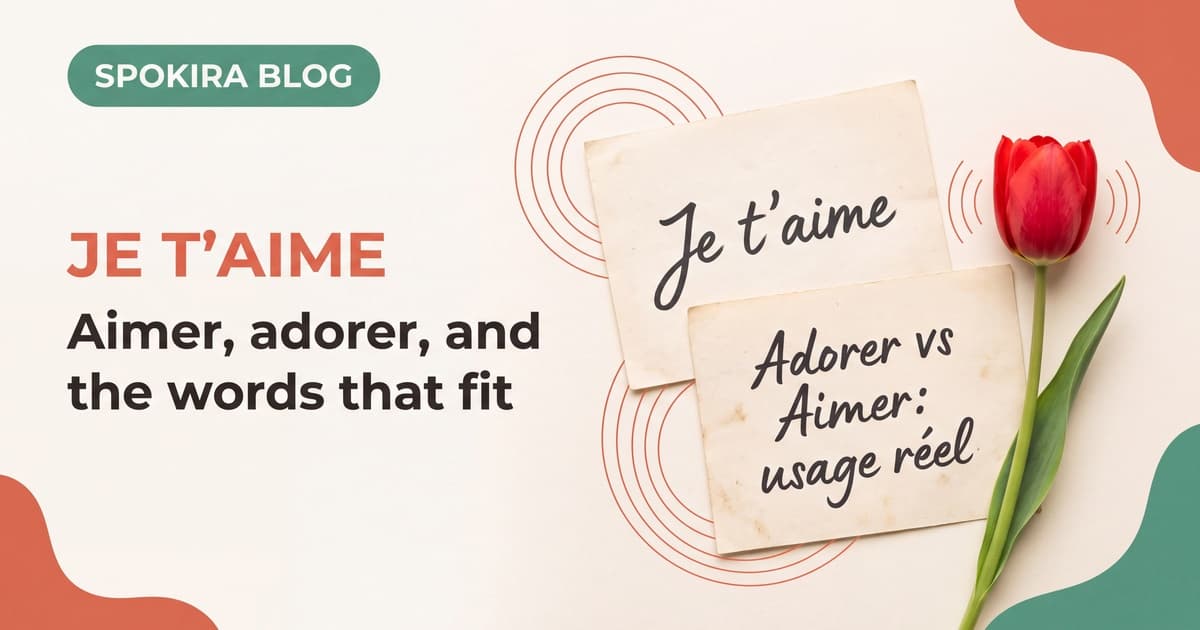
You probably learned I love you in French early: je t'aime. It is short, memorable, and easy to turn into a postcard line. The real challenge arrives five minutes later. What do you say about a friend, a parent, a favourite coffee shop, or a film you loved? Is j'adore stronger? Does j'aime beaucoup sound romantic? French makes a few distinctions that English does not make in exactly the same way.
The simple rule is this: je t'aime is a direct declaration of love. J'aime can mean love or like, depending on its object and context. J'adore often means “I love” in an enthusiastic, everyday sense, especially for things, but it can sound intense about a person. This guide gives you the scenes, the sound, and a drill so you can say the right amount, not just the right dictionary word.
I love you in French: the quick answer
Say je t'aime to a romantic partner, close family member, or someone with whom you genuinely share that level of affection. Say j'aime for “I like” or “I love” when talking about people, food, places, and activities. Say j'adore when you are enthusiastic: j'adore ce film, “I love this film.”
| French | Closest English | Typical use |
|---|---|---|
| Je t'aime. | I love you. | partner, family, deep affection |
| Je t'aime bien. | I like you. | friend, classmate, friendly person |
| J'aime beaucoup ce café. | I really like this café. | positive but measured |
| J'adore ce café. | I love this café. | enthusiastic, everyday |
| Je t'adore. | I adore you. | affectionate, playful, sometimes intense |
The Académie's dictionary entry for aimer covers affection and strong attachment to people as well as liking things, work, places, and ideas. That wide range is why context matters. French speakers do not stop to calculate an emotional score; they hear the relationship and the rest of the sentence.
Je t'aime: direct, simple, and not automatically casual
Je t'aime literally has three linked parts: je (I), te (you), and aime (love/like). Before a vowel, te becomes t' in writing. That is called elision, and French does it to keep speech flowing: je t'aime, je t'écoute, je t'attends.
With a partner, je t'aime is normal and direct. It may be said quietly, at the end of a call, or as a response to a caring act. It is not inherently more poetic than English “I love you,” but it carries the same weight when the relationship is new or uncertain.
With close family, it is also natural:
Bonne nuit, maman. Je t'aime.
With a friend, it depends. Some friend groups say je t'aime warmly, especially after a big moment. Others prefer je t'adore, je t'aime fort, or a less direct phrase. Do not assume every French friendship treats declarations the same way. Watch how the people around you speak.
The word aimer can also be romantic without je t'aime. Ils s'aiment means “they love each other.” Elle aime Paul usually implies romantic love if there is no other context. To avoid ambiguity, French can add bien for friendly liking: je l'aime bien.
How to pronounce je t'aime without sounding word-by-word
The standard pronunciation is /ʒə tɛm/. A loose cue is “zhuh tem,” but the goal is a connected two-beat phrase, not three English syllables.
| Part | IPA | Common slip | Better cue |
|---|---|---|---|
| je | /ʒə/ | “jay” | make a short, relaxed schwa after /ʒ/ |
| t'aime | /tɛm/ | “taym” | use the open /ɛ/ vowel, then a light /m/ |
| full phrase | /ʒə tɛm/ | pausing after je | connect je t' as one movement |
French j is the sound in the middle of English “measure,” not the start of “jump.” The vowel in aime is close to the vowel in French mère, not English “aim.” You can hear and feel the elision: je t'aime has no spoken vowel for the e in te.
Say je t'aime, mais je suis fatigué(e). The phrase keeps moving into the next word. That connected speech is more natural than slowing down to make every letter visible. For the wider pattern, use this guide to French elision and pronunciation rules.
Aimer can mean like or love: how context does the work
English usually separates “like” and “love.” French uses aimer across a wider field. The object tells listeners a lot.
J'aime le chocolat.
I like / love chocolate.
J'aime cette ville.
I like / love this city.
J'aime mon frère.
I love my brother.
For people, j'aime bien often softens the statement to “I like.” It can be useful when you mean friendship, appreciation, or a positive first impression.
Ta collègue est sympa, je l'aime bien.
Be careful: je t'aime bien said to someone who has just declared romantic feelings can sound like a gentle boundary. It says “I like you,” not “I am in love with you.” That is not rude. It is simply more limited than je t'aime.
For preferences, French also offers plaire: ce film me plaît means “I like this film,” literally “this film pleases me.” It sounds a little more formal or deliberate than j'aime ce film. Learn it for recognition; j'aime will cover most early conversations.
“I love you in French” in texts and everyday messages
Written French gives you the same choices, but messages can feel more compressed. Je t'aime is still direct. Je pense à toi (“I'm thinking of you”) can add warmth without making a declaration. Do not assume an emoji removes the emotional weight of je t'aime.
For a close friend, je t'adore and gros bisous can be affectionate in a way that does not map neatly onto English. Their tone depends on age, region, friendship, and how people normally write to one another. When in doubt, match the level of warmth already present in the conversation.
If you are sending a thank-you message, love vocabulary may not be needed at all. Merci, ça m'a fait très plaisir is genuine and clear. Use a phrase because it says what you mean, not because French needs to sound more romantic than your real voice.
Adorer: enthusiastic, common, and sometimes stronger than you expect
Adorer once had a religious sense, and it still means “worship” in that context. But ordinary French uses it loosely and often: j'adore cette chanson, j'adore les vacances, j'adore ton idée. The CNRTL entry for adorer records both the religious origin and the developed sense of passionate affection; its etymology traces the word to Latin adorare.
In daily speech, j'adore is often much less solemn than English “I adore.” Think “I absolutely love it” or “I am really into it.” It is a natural choice for food, music, clothes, places, and plans.
Tu aimes ce restaurant?
Oui, j'adore. Les desserts sont excellents.
With a person, je t'adore can be affectionate and lively. Parents say it to children, friends say it after a kind gesture, and couples say it too. It may carry less romantic finality than je t'aime, but tone changes everything.
Tu as pensé à mon anniversaire? Je t'adore!
Do not use a chart as if it were a legal contract. The practical pattern is easier: aimer is broad and grounded; adorer adds enthusiasm; je t'aime is the direct love declaration.
Choose the phrase by the person and the moment
| Situation | A useful phrase | What it communicates |
|---|---|---|
| Partner at the end of a call | Je t'aime. | direct love |
| Parent or close family | Je t'aime fort. | warm, affectionate love |
| New friend you enjoy | Je t'aime bien. | I like you, friendly |
| Friend does something thoughtful | Je t'adore! | warm delight |
| You love a song | J'adore cette chanson. | strong enthusiasm |
| You mildly like a place | J'aime bien ce quartier. | pleasant, not overdone |
Fort literally means “strongly.” Je t'aime fort is common in warm family language and sometimes in romantic messaging. It can sound childlike or tender depending on who says it, so borrow it from people you know rather than forcing it into every adult conversation.
Another useful possibility is je tiens à toi: “I care about you” or “you matter to me.” It is not a direct replacement for je t'aime. It is more about attachment and importance, and can be helpful when you want to be caring without performing a movie declaration.
What not to say when you mean something smaller
Learners often overcorrect. They hear that je t'aime can be strong, so they avoid aimer completely and call every pleasant thing génial. That leaves you with less French, not more.
Say j'aime bien when you mean friendly liking. Say j'aime beaucoup when you want an enthusiastic but measured opinion. Say j'adore when you are genuinely delighted. None of those forms promises a relationship.
J'aime beaucoup ton accent en anglais.
This can sound like a compliment. But compliments about a person's body, voice, or appearance can carry flirtation depending on context. If you are unsure, praise a choice or an effort: j'aime beaucoup ta présentation or j'adore cette idée. It is easier to receive.
In a professional setting, j'aime beaucoup votre travail is possible, but j'apprécie beaucoup votre travail may be more precise and respectful. You are not trying to sound distant; you are choosing the word that matches the relationship. For a broader guide to those boundaries, see polite versus rude French.
A three-minute aimer and adorer speaking drill
Train the contrast with real objects first. It is easier to get the sound right when you are not performing emotion.
- Make the two verb shapes. Say: j'aime, j'adore, j'aime, j'adore six times. Hear that j'aime ends /ɛm/ and j'adore has the open /a/ then /dɔʁ/.
- Use things you actually like. Say three true lines: J'aime le café. J'adore les marchés. J'aime bien ce quartier.
- Add a person safely. Say: J'aime bien ma nouvelle collègue. Then say: J'adore mon frère. The relationship changes the reading of the verb.
- Practice the direct line once. Say je t'aime slowly, then normally, then inside a sentence: Je t'aime, à demain. Keep je t' connected.
- Record one mini-dialogue. Ask yourself: Tu aimes ce film? Answer: Oui, je l'adore. Listen for the elision in je l'adore.
Let the relationship choose the intensity
Do not search for a universal “stronger” word. Start with the person, the setting, and the message you truly want to send. French will sound more natural when the phrase has a real social job.
For a broader tune-up on the vowel in aime and the rhythm around short sentences, use French pronunciation for English speakers. A clean, calm line is more convincing than a perfect-looking phrase delivered one syllable at a time.
Common mistakes with “I love you” in French
Using je t'aime casually with every new friend. It can be warm in the right friendship, but je t'aime bien or je t'adore is safer until you understand the group’s tone.
Thinking adorer is always romantic. J'adore ce gâteau is ordinary enthusiasm. It does not make you melodramatic.
Saying “jay taym.” Keep the vowel in aime open: /tɛm/, not /teɪm/. Connect the elided words.
Using je t'aime bien when you intend a love declaration. Adding bien usually lowers the intensity. It can sound like “I like you” after a romantic moment.
Copying a film line without a scene. Practice a full exchange and a normal follow-up. Emotion sounds more convincing when the rest of your French can carry it.
Train the phrases that matter in your own voice
Spokira lets you shadow short, natural French lines, record privately, and work on the rhythm before you use them with someone you care about.
For a quiet way to rehearse a line before you send or say it, practice French speaking with Spokira.
The takeaway
Je t'aime is the direct way to say “I love you” in French. Aimer also covers ordinary liking, while adorer adds everyday enthusiasm and can be affectionate with people. The word alone does not decide the feeling. The relationship, tone, and full sentence do.
Choose one honest practice line today: J'adore cette chanson, j'aime bien ce quartier, or je t'aime. Say it in a complete scene, at a normal pace. Your mouth will learn more from one real message than from ten dramatic translations.
Continue the series with the modern meaning and etiquette of mademoiselle.