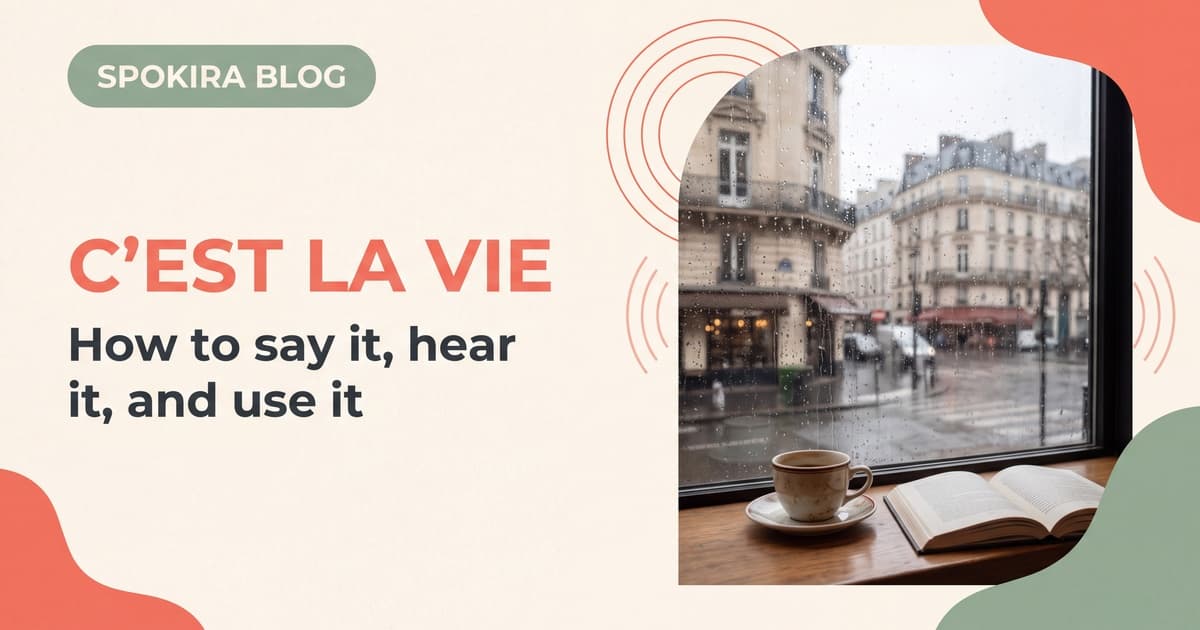
You miss a train, spill coffee on a clean shirt, or discover that the restaurant has stopped serving food. Someone shrugs and says c'est la vie. You probably know the English gloss: “that's life.” But the c'est la vie meaning is more specific than a cheerful French label for anything unfortunate. It is a compact way to accept something you cannot change, and its tone can be gentle, dry, funny, or a little dismissive.
That makes it useful, but not automatic. This guide gives you the real structure, the sound, scenes where it fits, and better alternatives when somebody needs sympathy rather than a shrug. The aim is to help you sound present in the conversation, not like you are reciting a phrase from a souvenir shop.
Quick answer: what does c'est la vie mean?
C'est la vie literally means “it is life,” but in normal use it means “that's life,” “these things happen,” or “that is how it goes.” You use it after a small disappointment or an unavoidable fact. The phrase can show acceptance, but it can also feel too casual if the loss is serious or the other person is still upset.
| Situation | Does c'est la vie fit? | A natural response |
|---|---|---|
| Your bus is late | Yes | Bon, c'est la vie. |
| A friend loses their job | Usually no | Je suis désolé(e), c'est dur. |
| A picnic is rained out | Yes, if light | On fera ça une autre fois. |
| You cannot change a rule | Often | C'est comme ça. |
The phrase is built from c'est (“it is”) and la vie (“life”). Dictionaries record c'est la vie as a formula of resignation about events that are simply how they are; see the CNRTL entry for vie. It is not necessarily tragic. Often it is just a way to stop spending energy on a minor annoyance.
C'est la vie meaning: the literal words and the idea behind them
French speakers use vie in a wide range of familiar expressions: la vie quotidienne (daily life), les choses de la vie (the things that happen in life), gagner sa vie (earn a living). The Académie's older dictionary entry for vie gives c'est la vie in the sense of “things happen like that in life.” That is the useful anchor for learners.
The phrase does not mean “life is wonderful.” It does not even always mean “life is terrible.” It says that the event belongs to the messy category of things that happen. You are closing the complaint, at least for now.
Le train est annulé. On attend le prochain?
Oui. C'est la vie.
In the dialogue, the speakers have a practical next step. That is a good clue. C'est la vie sounds most natural when it follows a small reality check and lets the conversation move on.
The first word, c', is a shortened form of ce before est. French does this constantly: c'est bon, c'est vrai, c'est dommage. You do not need to unpack the grammar every time you speak, but seeing the contraction helps you hear it as one linked unit rather than four separate words.
How to pronounce c'est la vie naturally
The standard pronunciation is /sɛ la vi/. A loose English cue is “seh la vee,” but keep it connected and modest. French speakers do not usually give it a grand, foreign-film delivery.
Start with c'est: /sɛ/. It has the same vowel family as French mais or j'aime, not a long English “say.” Then say la quickly, and end with vie, /vi/, a clean vowel plus v sound. The phrase has three little beats: c'est | la | vie.
| Part | IPA | What to avoid | Mouth cue |
|---|---|---|---|
| c'est | /sɛ/ | “say” | Let the jaw open slightly for /ɛ/ |
| la | /la/ | turning it into “luh” | Use a clear open /a/ |
| vie | /vi/ | “vee-uh” | Finish on /i/, with no extra syllable |
| full phrase | /sɛ la vi/ | stressing every word | Let the words flow as one comment |
The small linking habit matters more than perfect IPA. Try saying c'est la vie, on verra demain. The final vowel of vie leads straight into on. If you pause after every word, you will feel like you are climbing stairs. French conversation wants a ramp.
If vowels are where you get stuck, work through the larger sound system in French pronunciation for English speakers. This phrase is short enough to use as a diagnostic: record it once, then listen for an invented “uh” after vie.
When does the c'est la vie meaning fit a real conversation?
Think of it as a response to friction, not an announcement. It often appears after bon, bah, or a soft exhale. Those little lead-ins make it sound less theatrical.
When plans go wrong in a small, repairable way
This is the safest zone. A shop is closed, your friend is late, a recipe fails, the weather changes. You are disappointed, but you are not asking the other person to carry the disappointment for you.
Il n'y a plus de croissants.
Ah bon? C'est la vie. On prend du pain au chocolat.
Notice the follow-up. The phrase lands best when it opens the door to another option rather than ending the conversation in a cloud of gloom.
Imagine a small Saturday mishap. You have promised a visiting friend the bakery you like, only to find its shutters down for the holiday. There is a beat of disappointment. Then you point across the street: Bon, c'est la vie. On essaie l'autre boulangerie? The phrase works because you acknowledge the snag and stay in the moment with the other person. It is less a verdict on life than a small pivot toward the next plan.
When something is simply a rule or a fact
You can say it about bureaucracy, a timetable, or a limitation. In this use it is close to c'est comme ça (“that's how it is”).
On ne peut pas modifier la réservation aujourd'hui.
D'accord, c'est la vie.
That reply accepts the answer. It does not mean you love the rule. If you want to be more neutral, d'accord, je comprends is safer.
For instance, suppose the museum has changed its opening hours and your timed ticket no longer works. You can say ah, d'accord, c'est comme ça, then ask what is possible instead. If the clerk offers a place tomorrow, the conversation has moved from resignation to a solution without pretending that the inconvenience did not matter.
When you are laughing at your own bad luck
Self-directed use can be charming because you are not minimizing someone else's feelings.
J'ai oublié mon parapluie le seul jour où il pleut.
C'est la vie!
Use a smile and context. The same sentence said with a flat tone might instead sound fed up.
When c'est la vie is the wrong response
The literal translation hides a social rule: resignation belongs to the person who bears the problem. If a friend tells you something painful, you do not get to close the subject for them with c'est la vie.
Imagine someone says they failed an important exam, received bad news, or had a conflict with family. Start with recognition:
Je suis désolé(e). Ça doit être difficile.
Tu veux m'en parler?
Only later, if they themselves are ready to accept the situation, might the phrase appear. French is not unique here; English “that's life” can also sound cold when it is offered too soon.
| What happened? | Avoid | Better first line |
|---|---|---|
| Friend is heartbroken | C'est la vie. | Je suis vraiment désolé(e). |
| You made a small error | C'est la vie. | Bon, ça arrive. |
| A system will not change | C'est la vie. | C'est comme ça, malheureusement. |
| You want to encourage | C'est la vie. | Ce n'est pas grave, on recommence. |
That last line, ce n'est pas grave, means “it is not serious” or “no big deal.” Be careful with it too: say it about a spilled drink, not another person's grief. The best reaction phrases match the size of the moment. The guide to showing you are listening in French gives you more ways to stay with someone instead of jumping to a slogan.
Useful alternatives to c'est la vie
Learning alternatives makes you less dependent on one famous expression. They also let you choose a precise tone.
C'est comme ça: that's how it is
Use this for a fact or a rule. It is matter-of-fact and can sound resigned. Add malheureusement if you want to show you are not happy about it.
Les billets ne sont pas remboursables. C'est comme ça.
Ça arrive: it happens
This is friendly after a small mistake. It is a better response to someone else's accident because it normalizes without brushing them off.
Pardon, j'ai renversé ton verre.
Ce n'est rien, ça arrive.
Tant pis: oh well / too bad
Tant pis has a stronger “we will have to do without it” feel. It works for a missed opportunity or a plan you are abandoning.
Il n'y a plus de places pour ce soir.
Tant pis, on ira demain.
Ce n'est pas grave: it is not a big deal
Use this to reassure a person about a minor inconvenience. The message is not “life is like this,” but “you do not need to worry.”
J'ai cinq minutes de retard.
Ce n'est pas grave, je viens d'arriver.
For a closer look at a similarly flexible English phrase, compare “no worries” in French. You will hear the same lesson: a translation can be correct while the social move is wrong for the moment.
A practical conversation map
Here is a quick way to choose your phrase under pressure.
- Is the problem yours? If yes, c'est la vie can be fine for a minor annoyance.
- Is the problem someone else's and serious? Lead with sympathy, not resignation.
- Can you fix it? Say the next action: on va demander, on recommence, on verra demain.
- Is it truly unchangeable? C'est comme ça may be clearer than c'est la vie.
This sequence is simple, but it keeps a famous expression from doing too much work. The best phrase is the one that makes the other person feel you understood the scene.
A three-minute c'est la vie speaking drill
You do not need twenty random repetitions. Give the phrase three jobs: accept, soften, and move on.
- Say the sound shape. Repeat c'est la vie six times at a relaxed pace: /sɛ la vi/. Keep vie clean and short.
- Put it in a small annoyance. Say: Le café est fermé. Bon, c'est la vie. Repeat it until bon c'est flows together.
- Add a plan B. Say: C'est la vie, on va ailleurs. The second clause keeps the phrase from sounding fatalistic.
- Switch to kindness. Imagine your friend says: J'ai raté mon train. Answer Ça arrive, ce n'est pas grave. Do not use c'est la vie here unless the person is laughing too.
- Record one mini-dialogue. Speak both parts: Il n'y a plus de places? Tant pis, on ira demain. Listen for a natural fall at the end of each sentence.
Use the phrase after the feeling, not instead of it
If you are disappointed, it is fine to let your voice show it before you say c'est la vie. The phrase works because it accepts a real feeling; it becomes flat when it tries to erase one.
Common mistakes to avoid
Using it as a translation for every “oh well.” Sometimes tant pis, ça arrive, or ce n'est pas grave is closer. Pick the phrase by the situation.
Using it to respond to bad news. Sympathy comes first. A response like je suis désolé(e) is not less French because it is simple.
Over-pronouncing it. You do not need a dramatic “say la vee.” Keep /sɛ la vi/ light, with a connected rhythm.
Stopping at the phrase. In real conversation, add a next step: on recommence, on va voir, on fera ça demain. That makes you sound involved rather than resigned.
Treating the phrase as proof that French speakers are fatalistic. It is just a common reaction to ordinary inconvenience. Tone and context tell you whether it is humorous, weary, or accepting.
Practice the reaction, not just the translation
Spokira helps you shadow short French scenes, record your response, and get focused feedback before you need the phrase in a real conversation.
If you want one more short scene to rehearse, practice French speaking with Spokira after you finish the drill.
The takeaway
C'est la vie means “that's life,” but its real job is to accept a minor disappointment or an unavoidable fact. Say it about your own missed bus, a rained-out plan, or a rule you cannot change. Do not use it as a shortcut around someone else's disappointment.
Try one complete line today: Le magasin est fermé? Bon, c'est la vie, on reviendra demain. It has the phrase, the rhythm, and a way forward. That is the version worth keeping in your mouth.
Continue the series with bienvenue and the different meanings of welcome in French.