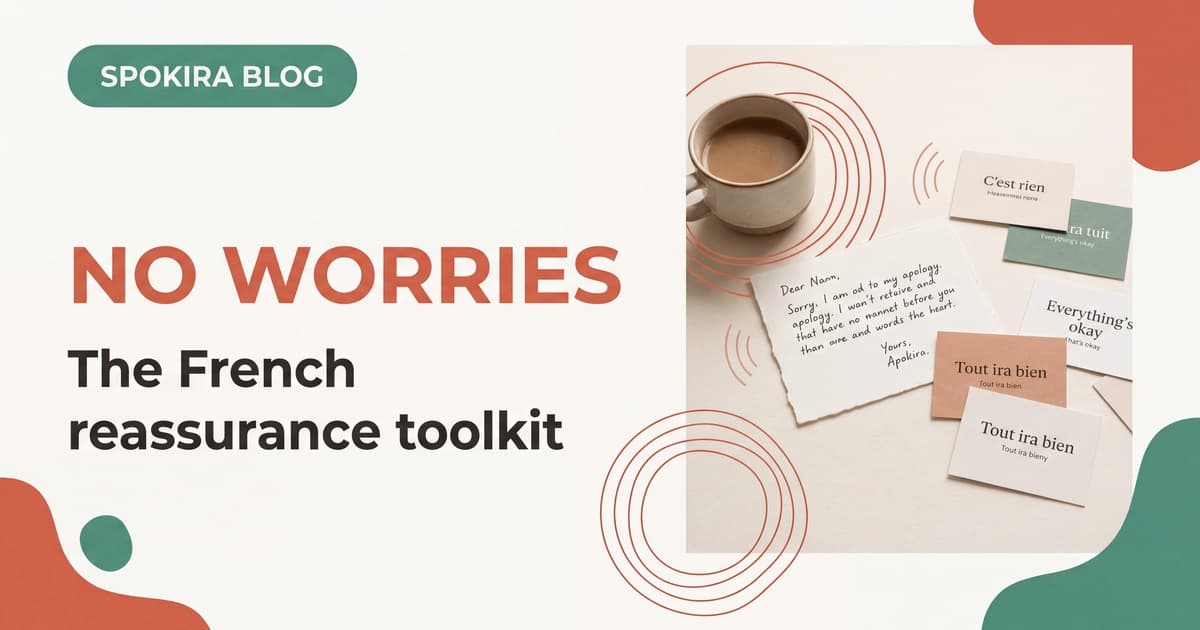
Someone bumps into you. A friend apologizes for being late. A colleague thanks you for helping. In English, the reflex is the same: "no worries."
In French, you have options. Several of them. And picking the right one is the difference between sounding like a textbook and sounding like a person.
The Direct Translation (It's Fine, But...)
Pas de soucis is the closest equivalent to "no worries," and it works. French people say it. You can say it.
But here's the thing: just like "no worries" in English, French speakers don't always reach for the same phrase. The choice depends on context, formality, and what you're actually responding to.
The vocabulary itself explains that split: inquiéter is about worry, souci is a concern, and grave marks seriousness, so t'inquiète, pas de souci, and c'est pas grave each soften a situation in a slightly different way (CNRTL, inquiéter, CNRTL, souci, CNRTL, grave).
The Full Toolkit
| Situation | What to say | Tone |
|---|---|---|
| Someone apologizes | T'inquiète | Casual, warm |
| Someone thanks you | De rien | Standard, polite |
| Someone thanks you (warmer) | Y'a pas de quoi | Friendly, dismissive-in-a-good-way |
| Formal reassurance | Je vous en prie | Polite, professional |
| "It's really no big deal" | C'est rien | Light, easy |
| "Don't even think about it" | T'inquiète pas pour ça | Warm, reassuring |
| "No problem at all" | Pas de problème | Neutral, straightforward |
| "It's nothing" | C'est pas grave | Very common, all-purpose |
C'est pas grave is the one to learn first. French speakers use it constantly, for everything from a spilled drink to a cancelled plan to a minor misunderstanding. It's the emotional reset button.
The One Phrase to Master
T'inquiète (don't worry) is the casual French equivalent of "no worries." Short, warm, and used all day long. It's technically a shortened ne t'inquiète pas, but nobody says the full version in casual speech.
What Each Phrase Really Communicates
These aren't interchangeable. Each one sends a slightly different social signal:
T'inquiète. (Don't worry about it.) This is the real "no worries." Casual, between friends or acquaintances. It actively reassures, it says "I noticed you feel bad, and I'm telling you not to." One word. Powerful.
De rien. (It's nothing / You're welcome.) The standard response to merci. Functional, polite, neutral. Some people consider it slightly cold because it literally means "of nothing", as if the favor wasn't worth mentioning. Still perfectly fine.
Je vous en prie. (Please, don't mention it.) The formal version. Use it with strangers, in professional settings, or with anyone you'd address as vous. It elevates a simple "you're welcome" into something gracious.
Il n'y a pas de quoi. (There's nothing to thank me for.) Warmer than de rien, less formal than je vous en prie. Often shortened to y'a pas de quoi in speech. It gently says "you didn't need to thank me, but I appreciate that you did."
C'est pas grave. (It's not serious / It doesn't matter.) The all-purpose minimizer. Someone's late? C'est pas grave. Someone forgot something? C'est pas grave. It's the French reflex for any situation where someone feels guilty about something small.
When Learners Get It Wrong
The main mistake isn't using the wrong phrase, it's using the same phrase every time. English speakers tend to find one French expression that works and then use it as a blanket response.
If you say de rien when someone apologizes (rather than thanks you), it sounds odd. If you say je vous en prie to a close friend, it sounds weirdly formal. If you say pas de soucis in a formal email, it's too casual.
Matching the phrase to the situation is the skill. Here's a simple decision tree:
- Someone said merci? → De rien / Y'a pas de quoi / Je vous en prie
- Someone said pardon or désolé? → T'inquiète / C'est pas grave / Pas de souci
- Someone seems worried? → T'inquiète pas / C'est rien / Ça va aller
Real Conversation Examples
Friend running 10 minutes late, texts "désolé!!":
"T'inquiète, on vient d'arriver aussi." (Don't worry, we just got here too.)
Colleague thanks you for covering their shift:
"Y'a pas de quoi, c'était tranquille." (No need to thank me, it was chill.)
Someone bumps into you on the métro:
"C'est rien." (It's nothing.), quick, no eye contact needed
Boss thanks you after a presentation:
"Je vous en prie." (My pleasure.), polished, appropriate
Practice These
Run through these scenarios out loud. Imagine the moment, then respond:
- A friend spills water on your notebook: "C'est pas grave, t'inquiète."
- Someone holds the door for you, you say merci, they respond: "De rien."
- Your French tutor apologizes for rescheduling: "Pas de souci, ça arrive."
- A stranger thanks you for directions: "Je vous en prie."
The goal isn't memorizing phrases, it's building the reflex to reach for the right one.
For drilling these reflexive responses until they come out naturally, Spokira's conversation practice puts you in real scenarios where you need to react, not translate.