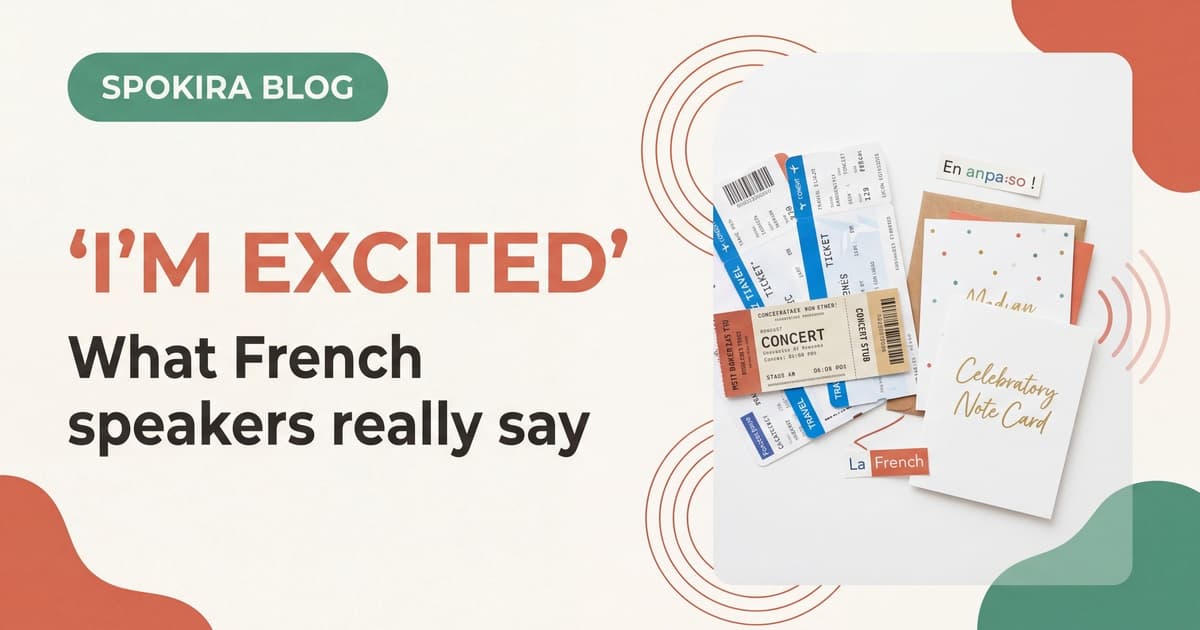
If you want the short answer first: "je suis excité" in English usually means "I'm sexually aroused," not "I'm excited." In everyday French, the natural replacement is usually j'ai hâte.
This is one of the most famous false-friend traps in French. You're heading to a party, someone asks how you feel, and you say "Je suis excité."
The room goes quiet. Or worse, people laugh.
In French, excité primarily means sexually aroused. Saying je suis excité in casual conversation sounds like you're announcing something very personal.
That split is visible in the dictionaries too: CNRTL lists sexual arousal among the core senses of exciter, while hâte names eager anticipation, which is why j'ai hâte is the safer everyday choice (CNRTL, exciter, CNRTL, hâte).
What Does "Je Suis Excité" Mean In English?
For most adult self-descriptions, it lands closer to sexually aroused than enthusiastic. That is why English speakers who want to say "I'm excited" usually need a different French phrase entirely.
What French Speakers Actually Say
When a French person is excited about something, a trip, a concert, a new job, they don't reach for excité. They use completely different expressions:
| English | What to say in French | Literal meaning |
|---|---|---|
| I'm excited (about something) | J'ai hâte | I can't wait |
| I'm so excited! | J'ai trop hâte! | I really can't wait! |
| I'm excited about the trip | Le voyage me fait trop plaisir | The trip gives me so much pleasure |
| I'm thrilled | Je suis ravi(e) | I'm delighted |
| I'm pumped | Je suis à fond | I'm all in |
| I'm looking forward to it | Ça me tarde | It's taking too long (to arrive) |
J'ai hâte is the workhorse. It covers about 80% of situations where an English speaker would say "I'm excited." It's natural, universally understood, and carries real enthusiasm.
Quick Rule
If you want to say "I'm excited about X," say "J'ai hâte de + infinitive" or "J'ai hâte d'y être." It sounds natural every time.
Why This Mistake Happens
English excited is broad. It covers anticipation, enthusiasm, energy, nervousness, all in one word. French doesn't bundle these meanings together. Each emotional shade has its own expression:
- Anticipation → j'ai hâte, ça me tarde
- Enthusiasm → je suis ravi, ça me fait plaisir
- Nervous excitement → je suis impatient(e), j'ai le trac (stage fright)
- High energy → je suis à fond, je suis motivé(e)
This is why direct translation fails. English collapses an entire emotional spectrum into "excited." French keeps it separated.
Contexts Where Excité Is Fine
Excité isn't always sexual. It can mean wound up, hyperactive, or agitated, but these are the main safe uses:
- Describing kids: "Les enfants sont excités" (The kids are hyper), totally normal
- An excited crowd: "La foule était excitée", agitated, riled up
- A stimulating idea: "Ce projet m'excite intellectuellement", but you'd typically add intellectuellement to be clear
For adults describing their own emotional state? Avoid it. Stick with the alternatives.
How Each Alternative Sounds in Real Speech
J'ai hâte d'y être! (I can't wait to be there!) Quick, bright, forward-leaning. The hâte is punchy. This is what you say when tickets go on sale.
Je suis trop content(e)! (I'm so happy!) Warm and genuine. Works for any good news. Pitch rises on content.
Ça va être génial! (It's going to be amazing!) Redirects the excitement outward. Very natural, French speakers often express personal excitement by talking about the thing itself.
J'ai le trac. (I've got butterflies / stage fright.) For nervous excitement. Perfect before a presentation or performance. Not positive or negative, just honest.
Practice These
Try saying these out loud. Focus on the rhythm, not perfect pronunciation:
- "J'ai trop hâte pour ce week-end!" (I'm so excited for this weekend!)
- "Je suis ravi, c'est une super nouvelle." (I'm thrilled, that's great news.)
- "Ça me tarde de te revoir." (I can't wait to see you again.)
- "On y va demain, j'ai hâte!" (We're going tomorrow, I can't wait!)
These sound like real French. "Je suis excité pour le week-end" does not.
For drilling natural alternatives like these until they come out automatically, Spokira's speaking practice trains you on what French speakers actually say, not what a dictionary suggests.