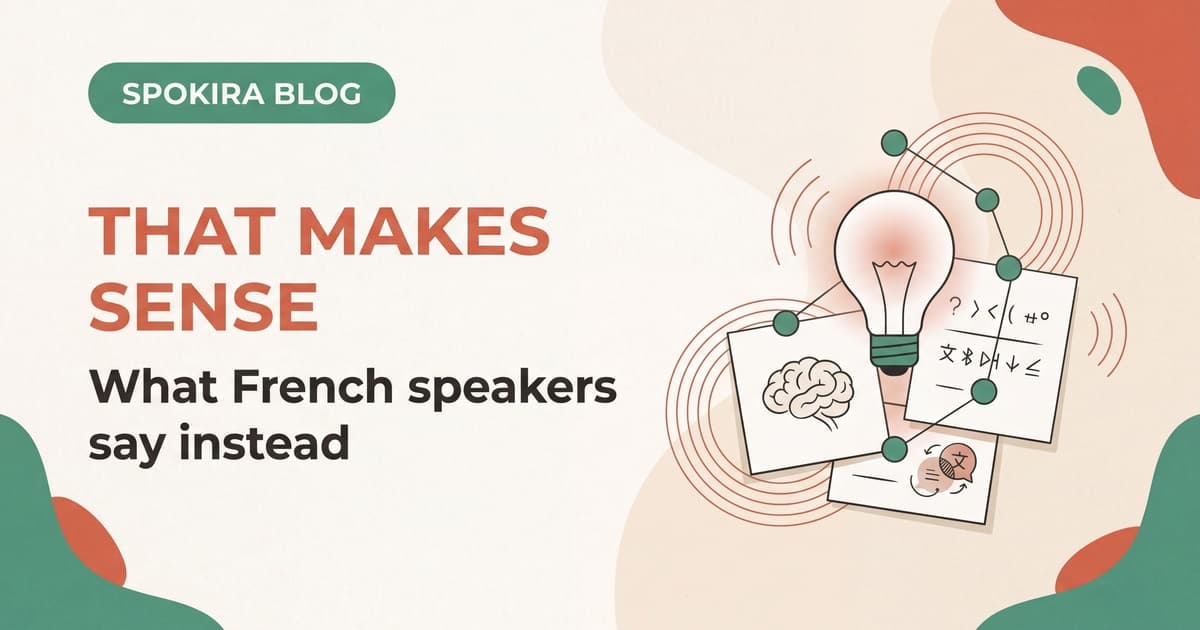
You're in a conversation. Someone explains something and you want to say "that makes sense." So you say "Ça fait sens."
A French person will understand you. But they'll also clock you as someone translating from English.
The phrase ça fait sens is a direct calque of "that makes sense." It's crept into some French usage through English influence, but traditional speakers consider it incorrect, and it sounds off to most French ears.
That is not just classroom snobbery. Quebec's OQLF still flags faire du sens as a discouraged English-influenced turn, and standard verbs like comprendre and tenir better match the meanings French speakers usually want here: understanding something or finding an argument coherent (OQLF, updated 2017, CNRTL, comprendre, CNRTL, tenir).
What French Speakers Actually Say
French has a rich set of phrases for this moment, and they're all more natural than ça fait sens:
| English | What to say in French | When to use it |
|---|---|---|
| That makes sense | C'est logique | Something is rational |
| That makes sense | Je comprends | You now understand |
| Oh I see | Ah d'accord | The penny drops |
| That checks out | Ça se tient | An argument is coherent |
| That's coherent | C'est cohérent | Formal or analytical contexts |
| Fair point | C'est pas faux | Acknowledging someone's logic |
| Right, right | Oui, je vois | Conversational filler |
The most useful everyday phrase is "Ah d'accord" or simply "Je comprends." These are what French speakers reach for ten times a day when something clicks.
The Easy Default
When in doubt, say "Ah d'accord" or "Oui, c'est logique." These work in virtually every situation where you'd say "that makes sense" in English.
Why Direct Translation Fails Here
"Makes sense" is idiomatic in English. Sense doesn't literally make anything, the expression is a metaphor that's become invisible. French has its own invisible metaphors, but this particular one didn't develop the same way.
Sens in French primarily means direction or meaning. Faire sens, to "make meaning", feels clunky because French already has perfectly good verbs for this concept: comprendre (understand), tenir (hold together), coller (stick/fit).
The deeper issue: English speakers use "that makes sense" for three different things, and French separates them:
- Logical agreement, C'est logique / Ça se tient
- Understanding, Je comprends / Ah d'accord
- Conversational acknowledgment (just nodding along), Oui oui / D'accord / Je vois
The third usage is the trickiest. In English, "that makes sense" often means nothing more than "I'm still listening." French speakers use d'accord, oui, je vois, or OK for this.
The Ça Fait Sens Debate
This is a live debate in French. Some younger speakers and business professionals (especially in tech) use ça fait sens regularly. Language purists hate it. The Académie française would frown.
Here's the practical reality:
- In casual conversation, most French speakers don't say it
- In corporate/startup settings, you'll hear it, borrowed from English workplace culture
- In writing, it's widely considered an anglicism to avoid
- Among older speakers, it sounds wrong
You won't be misunderstood if you say it. But you'll sound more natural, and more fluent, using the alternatives.
How Each Alternative Sounds
Ah d'accord. (Ah, okay.) The Swiss army knife. Quick, light, conversational. Pitch drops slightly. This is the phrase you'll hear most in real French conversation when information lands.
C'est logique. (That's logical.) Slightly more analytical. Works when someone explains a plan or reasoning. Not cold, just clear.
Ça se tient. (That holds together.) For when an argument or explanation is convincing. Implies you've evaluated the logic. Slightly more formal but very natural.
Je vois. (I see.) Soft, thoughtful. The French equivalent of nodding slowly while processing. Often followed by more conversation.
Effectivement. (Indeed.) More formal but surprisingly common. French speakers use this to confirm that something aligns with what they already know or suspected.
Practice These
Say these in response to an imaginary explanation. Feel the rhythm:
- "Ah d'accord, je comprends maintenant." (Ah okay, I understand now.)
- "Oui, c'est logique en fait." (Yeah, that's actually logical.)
- "Ça se tient, ton raisonnement." (Your reasoning holds up.)
- "Je vois ce que tu veux dire." (I see what you mean.)
These are small phrases, but they're the connective tissue of real conversation. Getting them right makes you sound fluent even if your grammar isn't perfect.
For practicing these kinds of natural responses in real-time conversation, Spokira's drills train you to react like a French speaker, not like a translator.