You crack a joke in French. It lands weird. Someone looks confused or slightly offended. You panic and say "Je suis juste... kidding?"
Even if you know the textbook phrase, je plaisante, it might not be what a French speaker would actually say in that moment.
The underlying verbs already hint at the register split: CNRTL defines plaisanter in a cleaner, more explicit "joke" register, while rigoler is built around laughing and lightness, and Larousse marks charrier as teasing someone directly (CNRTL, plaisanter, CNRTL, rigoler, Larousse, charrier).
The Textbook vs. The Street
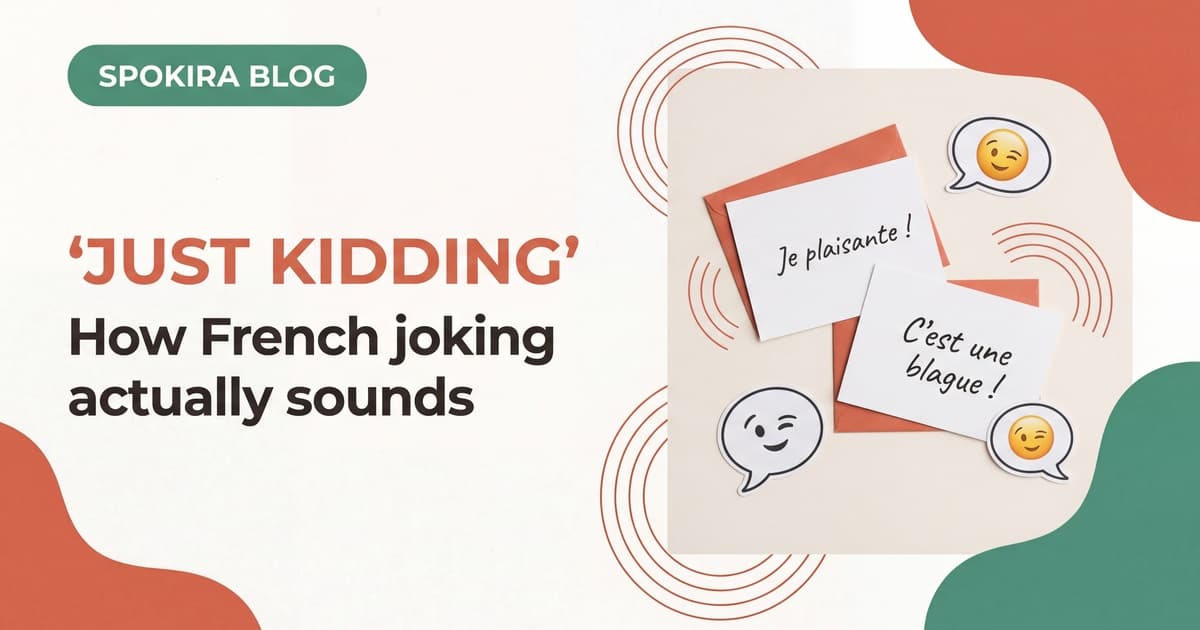
Je plaisante means "I'm joking" and it's correct. But in casual spoken French, it can sound a bit formal, like saying "I am merely jesting" in English. It works in some contexts. It's just not always the natural reflex.
Here's what French speakers actually reach for:
| English | Casual French | When to use it |
|---|---|---|
| I'm kidding | Je rigole | Most common, all-purpose |
| I'm just joking | Je déconne | Casual, slightly crude |
| I'm messing with you | Je te charrie | Teasing someone specifically |
| I wasn't serious | C'était pour rire | After the fact, explaining |
| I'm joking (polite) | Je plaisante | Semi-formal, clear |
| Relax, it's a joke | Détends-toi, c'est une blague | When someone took it wrong |
Je rigole is the default. If you learn one phrase from this entire post, make it this one. It's casual, friendly, and universally understood. You'll hear it ten times a day in France.
The Go-To Phrase
"Je rigole!", said with a smile, covers about 90% of "I'm just kidding" situations. Quick, light, no explanation needed.
What Each Phrase Signals
These aren't synonyms. Each one tells the listener something different about your intent:
Je rigole. (I'm laughing / I'm kidding.) The casual default. Rigoler literally means to laugh, but je rigole has evolved to mean "I'm not serious." It's warm, non-threatening, and works whether the joke landed or not.
Je déconne. (I'm messing around.) A step more casual. Déconner is mildly vulgar, derived from a crude root, but in practice it's used constantly among friends. Think of it as the French "I'm bullshitting." Don't use it with your boss.
Je te charrie. (I'm teasing you.) Specifically for when you're poking fun at someone. It implies affection, you charrie people you like. If someone says "Arrête de me charrier" (stop teasing me), they're usually smiling.
C'était pour rire. (It was for laughs / I was joking.) Retrospective. Use this when you need to clarify after the fact that something was a joke. Slightly more defensive, it acknowledges that the humor wasn't obvious.
Je plaisante. (I'm joking.) The clean version. Good for professional settings, with people you don't know well, or when you want to be absolutely clear. It's correct and natural, just a register above the casual options.
The Tone Matters More Than the Words
In French humor, delivery signals the joke more than explicit disclaimers. French speakers often:
- Lower their voice slightly for deadpan humor
- Pause after the punchline and wait for the reaction
- Raise their eyebrows or give a small smile instead of saying "just kidding"
- Don't explain the joke, if you have to say je rigole, the joke might not have landed
This is a real cultural difference. English speakers (especially Americans) tend to flag humor explicitly: "just kidding!" "I'm joking!" French speakers often let the tone do the work. Adding je rigole is a safety net, not the default.
Common Mistakes
Overusing je plaisante in casual settings. It's not wrong, but it sounds slightly stiff among friends. Like wearing a blazer to a barbecue. Switch to je rigole or je déconne.
Saying c'est une blague too often. C'est une blague (it's a joke) is fine, but French speakers often use it to mean "this situation is ridiculous" rather than "I was joking." Saying it after your own joke can sound like you're labeling it, which kills the humor.
Translating "kidding" literally. There's no good French equivalent of "kid" as a verb meaning "to joke." Don't try to build one. The French verbs are different, rigoler, plaisanter, déconner, blaguer, and each has its own personality.
Practice These
Imagine you've just said something that landed ambiguously. Now clarify:
- "Non mais je rigole, t'inquiète." (Nah I'm kidding, don't worry.)
- "Je déconne! Évidemment que je viens." (I'm messing around! Of course I'm coming.)
- "Arrête, je te charrie." (Stop, I'm just teasing you.)
- "Je plaisante, bien sûr. C'était très bien." (I'm joking, of course. It was great.)
Notice how each one sets a different tone. The first is breezy. The second is energetic. The third is affectionate. The fourth is measured.
For building the instinct to respond naturally in moments like these, Spokira's speaking drills train your real-time reflexes, so humor doesn't get lost in translation.