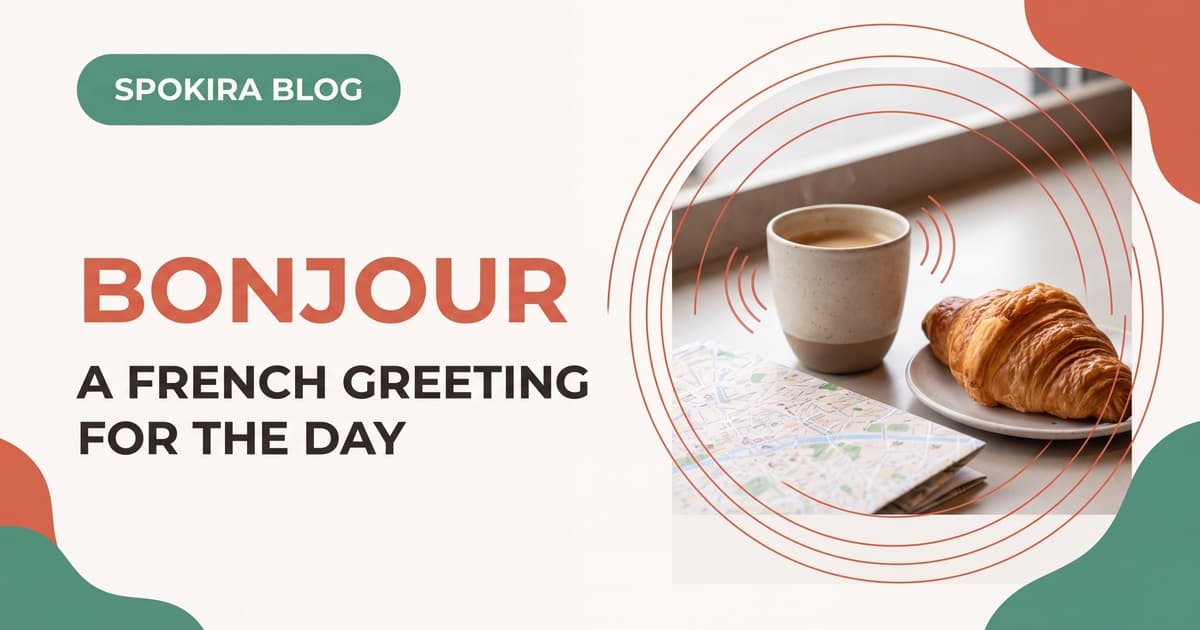
The normal way to say good morning in French is bonjour. Use it when you arrive, meet someone, enter a shop, or begin a conversation during the day. It is one of the safest French words you can learn, but it works best when you treat it as a greeting, not as a word you only use before noon.
That small point matters. A learner who says bon matin in Paris is understandable, but sounds translated. A learner who says bonjour clearly, then adds one useful follow-up, sounds ready to interact. This guide gives you the timing, the polite versions, the pronunciation, and a drill that makes the word available when a real person is waiting for your answer.
Quick answer: how do you say good morning in French?
Say bonjour: /bɔ̃.ʒuʁ/. It is the everyday greeting from the morning through much of the afternoon. Add madame, monsieur, or s'il vous plaît only when the situation calls for it. In most of France, do not replace it with bon matin.
Use these as a starting set:
| French | Natural English meaning | Use it when |
|---|---|---|
| Bonjour | Hello / good morning | Any daytime greeting |
| Bonjour madame / monsieur | Hello, ma'am / sir | Speaking to a stranger, staff member, or older person |
| Salut | Hi | With friends, peers, and people who use tu with you |
| Bonjour, ça va? | Hi, how are you? | Casual conversation after the greeting |
| Bonjour, je voudrais... | Hello, I would like... | Beginning an order or request |
The Académie française defines bonjour as a politeness formula used to greet someone during the day. That is the important part: it is an arrival signal. It tells the other person, “I see you; I am starting this interaction respectfully.”
Why bonjour is not only a morning word
English divides “good morning,” “good afternoon,” and “good evening” more sharply than everyday French does. French uses bonjour for a broad stretch of daytime. It can still sound natural after lunch, particularly when you are walking into a bakery, starting an appointment, or meeting someone for the first time that day.
There is no official clock that flips bonjour into bonsoir. Context does the work. Light, meal time, local habit, and whether the evening has begun all matter. If you are unsure, bonjour is the safer opening earlier in the day; bonsoir takes over as the usual greeting late in the day or in the evening.
The distinction is not merely a classroom convention. The Académie's entry for bonsoir describes it as a greeting used at the end of the day. CNRTL likewise describes bonjour as a greeting directed to someone met during the day (CNRTL, bonjour).
For a visitor, this is good news. You do not need to calculate 12:01 versus 17:59. Look at the scene. At 9:30 in a cafe, bonjour. At 15:00 entering a museum, bonjour. At 20:30 meeting the host of a dinner, bonsoir.
What about bon matin?
In France, bon matin is not the standard daily greeting. It may appear in regional usage or in written contexts, and you will hear it more readily in parts of the French-speaking world, especially Canada. Our guide to French varieties, dialects, and accents explains why familiar vocabulary and usage can shift by region. But if your goal is broadly useful French for France, start with bonjour.
This is a helpful early lesson in real French: a word-for-word translation is often grammatically possible and socially off. Do not let that make you cautious. One reliable phrase, used confidently, beats a long list of fragile translations.
How to use bonjour in real situations
Good morning in French becomes useful when it is attached to a situation. Here are five that cover an impressive amount of travel and daily life.
Entering a shop, bakery, or cafe
Say Bonjour as you enter, even if you are only looking. In France, skipping the greeting can make the next question feel abrupt. You are not required to make small talk; you are simply opening the exchange.
You: Bonjour.
Staff: Bonjour.
You: Je voudrais une baguette, s'il vous plaît.
If cafes are where you freeze, practice this short opening alongside the French cafe conversation script. A greeting, a request, and a thank-you are one repeatable unit.
Meeting a neighbor or colleague
With someone you know a little, Bonjour, ça va? is enough. Do not overbuild it. In a hallway, both people may answer ça va and keep moving. The point is warmth, not an invitation to a long report.
Bonjour, ça va?
Oui, ça va, merci. Et toi?
For a formal relationship, switch the last word to vous: Et vous? The grammar changes, but the rhythm remains compact.
Starting a request with a stranger
French requests land better after a greeting. Compare:
| Less natural opening | Better opening |
|---|---|
| Où est le métro? | Bonjour, où est le métro, s'il vous plaît? |
| Un café. | Bonjour, un café, s'il vous plaît. |
| Vous parlez anglais? | Bonjour, est-ce que vous parlez anglais? |
The second column is not excessively formal. It is normal social cushioning. If you are preparing for a trip, pair it with the phrases in French for travel, then rehearse the opening aloud before you need it.
Answering the phone
On a personal call, allô? is common. On a professional call, bonjour can open the conversation after you answer. Do not force it into every context; listen to what the other person does. A simple bonjour, c'est Alex is clear and polite.
Writing a message or email
Bonjour also works at the start of an email, especially when you know the recipient's name: Bonjour Marie, or Bonjour Monsieur Martin,.
For a formal message, it is an opening, not the whole salutation system. Your email may still end with a longer polite closing. For a quick message to a friend, Salut is usually a more natural fit.
Bonjour, salut, and bonsoir: choose the right level
The word you choose says something about distance, not just time. Use this quick comparison when you have a choice.
| Expression | Register | Best use | Watch out for |
|---|---|---|---|
| Bonjour | Neutral, polite | Shops, work, acquaintances, first meetings | Not a late-evening greeting |
| Bonjour madame / monsieur | Polite | Staff, service encounters, formal first contact | Do not use it with close friends unless joking |
| Salut | Informal | Friends, classmates, children, text messages | Avoid with strangers in formal settings |
| Bonsoir | Neutral, polite | Evening arrival or evening greeting | It means good evening, not good night |
| Coucou | Very informal, affectionate | Close friends, family, playful messages | Never a default travel greeting |
You may hear bonjour in places where English would use a brief nod. That is not stiffness. It is simply the conventional way to mark contact. The word can be quiet. It still counts.
Pronouncing bonjour so people hear it easily
The pronunciation is /bɔ̃.ʒuʁ/. You do not need a perfect French accent. You do need to avoid turning it into three English-shaped pieces.
1. Keep bon nasal
The first syllable is not bone. The letters on make a nasal vowel /ɔ̃/. Let air pass through your nose while your tongue stays low and relaxed. Do not add a hard /n/ at the end.
Think “bɔ̃,” then stop the syllable there. If you say bonn-jour with a clear English n, the word becomes heavier than it needs to be.
2. Make j a soft /ʒ/
The sound in jour is like the middle sound in “measure” or “vision,” not the English j in “job.” Your tongue does not need to strike the roof of your mouth. Let the sound flow.
3. Do not rush the French r
The final r is usually a light French throat sound, /ʁ/. If that sound is new, do not replace it with a loud English r. A soft, brief friction at the back of the mouth is enough. You will be understood long before this sound is perfect.
For the bigger sound system, use French pronunciation for English speakers. It is more useful to train a few high-impact sounds than to judge every syllable you say.
One breath, two beats
Say bonjour in two smooth beats: bon | jour. Do not put equal stress on every letter. French rhythm is flatter and more connected than English word stress.
A five-minute bonjour speaking drill
Reading bonjour once is recognition. This drill turns it into a response you can use at the door, at the counter, and on the street.
Minute 1: build the sound
Say these ten times, slowly:
bon | jour
On each repetition, keep the final n out of bon. Record the tenth attempt. You are listening for a clean nasal vowel and a soft j sound, not a theatrical accent.
Minutes 2 and 3: add a purpose
Say each line five times. Keep the greeting attached to what comes next.
- Bonjour, je voudrais un café, s'il vous plaît.
- Bonjour, où est la gare?
- Bonjour, ça va?
- Bonjour madame, merci.
- Bonjour, est-ce que vous avez une table pour deux?
Do one round looking at the text. Then hide it and speak from the English cue: coffee, station, check-in, thank-you, table. That retrieval step matters. It is the difference between “I recognize it” and “I can say it.”
Minute 4: contrast the greeting
Choose the right word without looking:
- 10:00, you enter a pharmacy: bonjour.
- 14:30, you meet a colleague: bonjour.
- 21:00, you arrive at dinner: bonsoir.
- You text your best friend: salut.
- You are leaving for bed: bonne nuit.
Minute 5: make it yours
Record one 20-second mini-scene. Start with bonjour, state your reason for speaking, and finish with merci, au revoir. Use a different reason tomorrow. The structure stays stable, so your mouth gets faster without memorizing a speech.
Practice greetings until they come out on time
Spokira gives you short native-speaker clips, recording practice, and clear pronunciation feedback for the phrases you need in real situations.
Common mistakes with good morning in French
Translating every English word
Good morning is two words in English. Bonjour is one French greeting. Do not try to make French mirror English. Say the phrase French speakers actually use.
Saying bonjour as a goodbye
In standard French, use au revoir when you leave. You may encounter regional uses of bonjour when taking leave, and the Académie notes that history, but it is not the default a visitor should copy. Keep your core pair simple: bonjour on arrival, au revoir on departure.
Forgetting the greeting before the request
You may know how to ask for directions, but a bare question can feel abrupt. Start with bonjour. Then ask. This tiny habit makes your useful vocabulary easier to receive.
Overthinking the exact hour
Language is social. If you are late in the afternoon and unsure, listen to the first person who greets you. Mirror that choice. You do not need a rulebook at the bakery door.
A short daily plan for keeping it automatic
For one week, attach bonjour to an action you already do. Say it when you make coffee, open your laptop, or walk out the door. Then add one changing line: je voudrais..., comment ça va?, où est...?.
Day by day, you are training transition rather than isolated vocabulary. That is the skill that lets you begin a real interaction without freezing. The broader French speaking practice guide can help you turn this into a 5-10 minute habit.
The takeaway
Good morning in French is bonjour. Use it as your daytime hello, not only before noon. Say it when you arrive, before you request something, and before you worry about more advanced French.
Keep the mouth work small: nasal bon, soft j, light French r. Then practice it in a full sentence. A clear bonjour, je voudrais... will carry you much farther than a perfect translation list. Train your mouth, not your streak.
One last useful reply
When someone says bonjour to you, answer bonjour back before continuing. If you did not catch their next question, say pardon? or vous pouvez répéter, s'il vous plaît? A greeting buys you a calm start; a repair phrase keeps the exchange going. Practice both together, because real conversations rarely stop after the first word.
Continue with how to say cheers and make a toast in French.