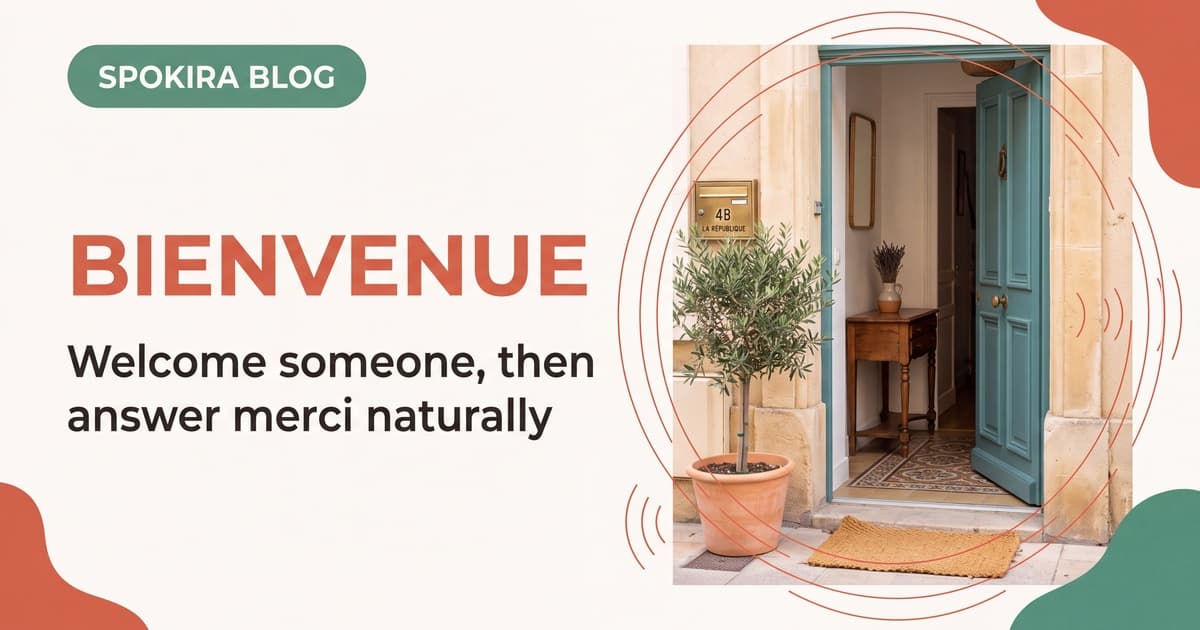
“Welcome in French” looks like a one-word question. It is not. Bienvenue is the word you want when you greet somebody arriving, invite them into a place, or say that they are welcome somewhere. But if somebody says merci, answering bienvenue is usually an English-shaped mistake. In most French conversations, you will say de rien, je vous en prie, or il n'y a pas de quoi instead.
That tiny difference can feel awkward in a café, at a hotel, or during a first meeting. The fix is simple once you see that English “welcome” does two jobs and French separates them. Learn the scenes, not just the word, and your response will arrive on time.
Quick answer: how do you say welcome in French?
Use bienvenue to welcome a person: Bienvenue à Paris, Bienvenue chez nous, or soyez le bienvenu / la bienvenue. To answer “thank you,” use de rien in casual conversation, je vous en prie in a more polite setting, or il n'y a pas de quoi when you want a friendly “don't mention it.”
| English situation | Natural French | Register |
|---|---|---|
| Welcome! Come in. | Bienvenue! Entrez! | warm, common |
| Welcome to our home. | Bienvenue chez nous. | warm |
| You're welcome. | De rien. | casual, everyday |
| You're welcome. | Je vous en prie. | polite / professional |
| Don't mention it. | Il n'y a pas de quoi. | friendly, polite |
The Office québécois de la langue française (OQLF) makes the distinction plainly: bienvenue is used to receive someone, not normally to reply to thanks. It notes that “bienvenue” after merci is an English-influenced usage that is criticized in much of the reference literature.
What bienvenue actually means
Bienvenue is related to bienvenu, literally something like “well come” or “well received.” It can describe a person, an arrival, an idea, or something that comes at just the right moment.
Tu es le bienvenu quand tu veux.
You are welcome whenever you want.
Cette pluie est la bienvenue après la chaleur.
This rain is welcome after the heat.
The word changes in writing to agree with the person or thing: bienvenu for masculine singular, bienvenue for feminine singular, bienvenus and bienvenues in the plural. In everyday greeting formulas, you will often see the fixed-looking feminine Bienvenue! on signs, websites, and invitations. Do not get stuck trying to calculate grammar at the door. Learn the complete formulas first.
The OQLF gives examples such as Soyez la bienvenue dans notre équipe and Michel est toujours le bienvenu à la maison. The Académie française has used “Soyez le bienvenu parmi nous” in formal welcoming language. That wording is elegant and correct, though it is more ceremonial than a friend saying entre, installe-toi.
How to pronounce bienvenue
The standard pronunciation is /bjɛ̃vəny/. A useful approximation is “byehn-vuh-new,” but it needs three French habits: a glide at the start, a nasal vowel in bien, and the front-rounded vowel /y/ at the end.
| Part | IPA | What to do |
|---|---|---|
| bien | /bjɛ̃/ | Begin with a quick /j/ glide, then make the vowel nasal; do not pronounce a final n |
| ve | /və/ | Keep the small schwa light |
| nue | /ny/ | Round your lips as if for /u/ but say /i/ inside |
| full word | /bjɛ̃vəny/ | Join it, do not make “bee-en-ven-yoo” |
The final sound is the same French u as in tu, not the /u/ in tout. If bienvenue comes out as “byehn-veh-noo,” a French speaker will still understand, but you have swapped a sound that appears in many core words. The French u versus ou drill is worth ten minutes of focused practice.
Say these in one breath:
Bienvenue chez nous.
Vous êtes les bienvenus.
Ton aide est la bienvenue.
The last sentence may surprise English speakers. It is not greeting a person. It says that help would be appreciated.
When to say bienvenue in real life
At a home, shop, or event
This is the most literal use. You are receiving somebody.
Bienvenue! Tu veux enlever tes chaussures?
Bienvenue au festival. Voici le programme.
Bienvenue chez moi is “welcome to my place.” Bienvenue chez nous is “welcome to our place,” whether “our” means your household, team, country, or organization. The setting tells listeners which one.
Welcoming someone to a group
Use bienvenue dans l'équipe, bienvenue parmi nous, or bienvenue au club. This is common in work messages and introductions.
Toute l'équipe te souhaite la bienvenue.
That sentence has a modest professional warmth. It is a good line to recognize when you start a course, job, or volunteer group in French.
Saying something is wanted or timely
This use is especially useful in travel and daily life.
Une pause est la bienvenue.
Tes conseils sont les bienvenus.
Here bienvenu is an adjective. It agrees with pause and conseils. You do not need this sense on day one, but it explains why bienvenue is not the French equivalent of an automatic “you're welcome.” The word is about being received gladly.
Why bienvenue does not usually mean “you're welcome” in French
English uses “welcome” after thanks: “Thanks for your help.” “You're welcome.” French normally answers with a phrase about the favour itself: it was nothing, please, there is no reason to thank me.
The OQLF's guidance on de rien and its alternatives describes de rien as a positive, everyday reply to thanks and gives je vous en prie as a more formal alternative. That is a useful everyday rule even though regional habits vary.
The distinction is easiest to remember as a two-part scene. A receptionist can say bienvenue à l'hôtel as you arrive, then answer your merci with je vous en prie. At a friend's home, you may hear entre, bienvenue! and then de rien after you thank them for a drink. The words are simple, but the direction of the exchange changes.
Merci pour le café.
De rien!
If you say bienvenue here, many people will understand the influence of English. In Quebec, you may hear it more often because language contact is real and local usage has its own story. But if your aim is broadly safe French, choose de rien or je vous en prie.
Four ways to say “you're welcome” in French
De rien: the easy default
Literal translation: “of nothing.” Practical translation: “it was nothing.” It is short, friendly, and works after small favours.
Merci de m'avoir attendu.
De rien, j'avais le temps.
Pronounce it /də ʁjɛ̃/. The rien is one nasal-vowel unit; do not add an n sound at the end.
Je vous en prie: polite and flexible
This is a good choice with a stranger, customer, teacher, or colleague. Use je t'en prie with one person you address as tu.
Merci beaucoup pour votre aide.
Je vous en prie.
It can also mean “please, go ahead,” depending on context. That flexibility is normal. Tone and the preceding action tell you which meaning is intended.
Il n'y a pas de quoi: don't mention it
This phrase politely says there was no need for thanks. It can feel warmer than de rien because it has a little more room in it.
Merci de m'avoir expliqué.
Il n'y a pas de quoi.
Avec plaisir: with pleasure
Use this when you genuinely enjoyed helping. It is upbeat without being overdone.
Merci d'avoir gardé mon sac.
Avec plaisir.
Avoid using it after every tiny thanks. De rien will carry most everyday exchanges.
Choose the right reply by the relationship
| Person and situation | Best first option | Why |
|---|---|---|
| Friend thanks you for passing the salt | De rien | relaxed and ordinary |
| Hotel guest thanks you | Je vous en prie | courteous without stiffness |
| Someone thanks you for a real favour | Avec plaisir | acknowledges that you were glad to help |
| Friend apologizes for asking | Il n'y a pas de quoi | reassuring |
| You invite someone inside | Bienvenue, entre! | this is an arrival, not thanks |
These formulas make a small but important difference to politeness. If you want to understand the wider pattern, read polite versus rude French. French politeness is not about finding the fanciest word. It is about matching the person, the setting, and the size of the favour.
“Welcome in French” for travel, work, and friends
For travel, make bonjour do the opening work and use bienvenue when you are receiving someone. You might hear bienvenue à bord on a tour or bienvenue à l'hôtel at reception. As the guest, say bonjour, then merci when somebody helps you.
At work, bienvenue dans l'équipe is common in a first message. You can reply merci beaucoup, je suis ravi(e) d'être là. For scenes like hotels, cafés, and first arrivals, rehearse a few lines from French for travel aloud.
With friends, the warmest welcome may not use bienvenue at all. Entre, installe-toi, and fais comme chez toi (“make yourself at home”) can sound more natural. If you are unsure, entre, je t'en prie is a friendly invitation.
One useful arrival exchange is deliberately plain: Bonjour, entre, installe-toi. Tu veux quelque chose à boire? Your guest may answer oui, volontiers, merci. Then you can say avec plaisir as you bring the drink. No part of that dialogue needs bienvenue, yet it creates the welcome English speakers often want to express. Save bienvenue for the opening itself, then let ordinary invitations carry the warmth.
A three-minute welcome-and-thanks speaking drill
Train the two English meanings separately so they do not collide.
- Arrival line. Say: Bienvenue chez nous, entre! five times. Keep bien nasal and the final /y/ rounded.
- Thank-you response. Say: Merci pour ton aide. De rien. Now replace it with Je t'en prie. Hear that neither answer is bienvenue.
- Formal switch. Say: Merci beaucoup. Je vous en prie. The vous makes the exchange polite without turning it cold.
- Add a real situation. Imagine you are showing a visitor into a flat: Bienvenue, posez vos affaires ici. Then imagine they thank you: Avec plaisir.
- Record one pair. Listen for bienvenue ending in /ny/, not /nu/. If needed, say tu, tu, tu with rounded lips, then return to bienvenue.
Learn the exchange in both directions
Practice greeting someone and answering their thanks as two different moves. That is the fast route from knowing bienvenue on a sign to using it naturally in a conversation.
Common mistakes with bienvenue
Answering merci with bienvenue. In broadly standard French, answer with de rien, je vous en prie, or il n'y a pas de quoi.
Using only bienvenue for “welcome.” Add the place or group: Bienvenue à Lyon, bienvenue dans l'équipe, bienvenue chez nous. It makes the greeting feel directed.
Forgetting the French u. In bienvenue, the final /y/ needs rounded lips. Do not let it become English “oo.”
Using a very formal line with friends. Soyez le bienvenu is correct, but entre, installe-toi often sounds more natural at home.
Memorizing isolated phrases. Rehearse a whole mini-scene: greeting, invitation, thanks, response. The language becomes easier to retrieve when it has a situation attached.
Rehearse the French you need at the door
Use short native-speaker scenarios to practice greetings, travel interactions, and polite replies out loud, then fix the sound that trips you up.
To rehearse the greeting-and-thanks exchange in a short scene, practice French speaking with Spokira.
The takeaway
For “welcome in French,” bienvenue is the right word when someone arrives or is gladly received. For “you're welcome,” French normally gives you de rien, je vous en prie, il n'y a pas de quoi, or avec plaisir.
Try the full exchange today: Bienvenue chez nous., Merci!, Avec plaisir, entre. One scene, two meanings, no translation trap. That is far more useful than a single word on a flashcard.
Before your next French interaction, choose one arrival phrase and one thank-you reply. A short, rehearsed exchange will carry you farther than translating on the spot.
Continue with how aimer and adorer change the meaning of “I love you” in French.