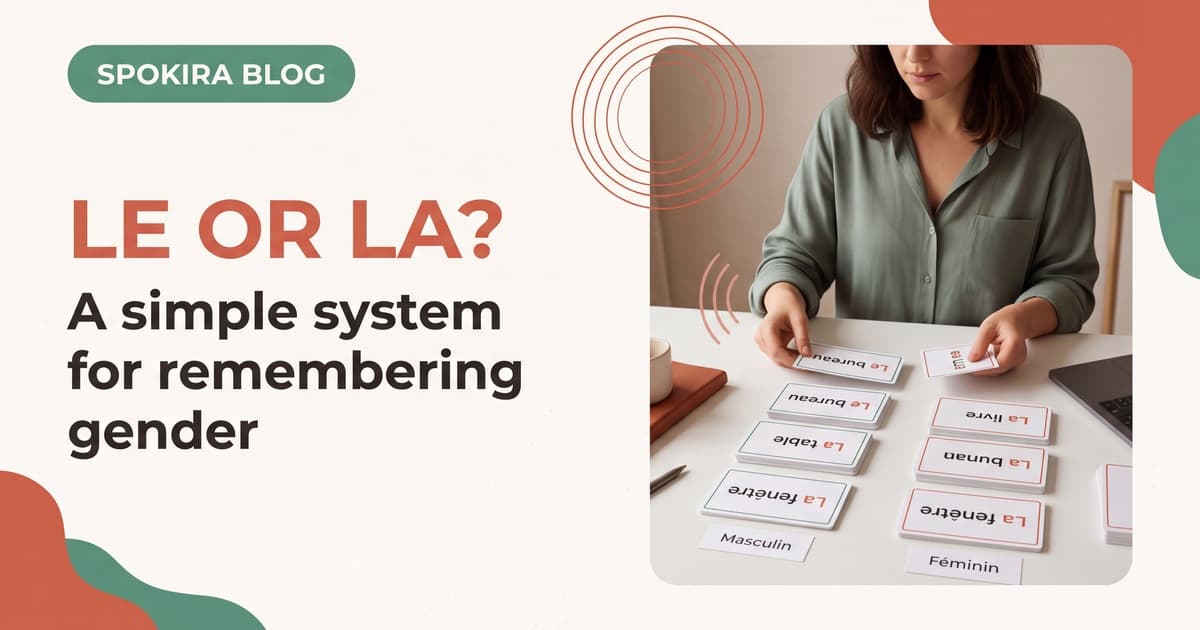
French noun gender feels like a fight when every new word arrives alone. It gets much easier when you stop asking “Is table masculine or feminine?” and learn la table as one piece of language.
That is the practical answer to how to learn French noun gender: attach a determiner to every noun, use word endings only as a clue, and make yourself retrieve the chunk in speech. You do not need to memorize a giant list of rules before you can talk. You need a system that catches uncertainty early and gives the correct form enough repetitions to stick.
French grammatical gender is a noun-class system, not a statement about an object's sex. UT Austin's French grammar notes that inanimate nouns are masculine or feminine and that gender affects articles, pronouns, and adjectives (introduction to nouns). Treat masculine and feminine as labels that help words agree.
Quick answer: what is the fastest way to remember French gender?
Learn the noun with its smallest useful companion: le livre, la maison, l'idée. Then say it inside a short phrase: un petit livre, une grande maison, cette idée. That phrase makes the gender visible and memorable.
Sometimes the article changes the meaning, not just the agreement. The clearest example is un livre for a book versus une livre for a pound, with both nouns pronounced /livʁ/.
Use this order:
- Meet the noun as an article-noun chunk.
- Make a tentative prediction from the ending only when it helps.
- Verify it once in a reliable source.
- Retrieve it from memory in a mixed set.
- Use it in a sentence you might actually say.
The method is modest on purpose. A rule can point you in the right direction, but retrieval is what lets you say la question importante without stopping mid-conversation.
How to learn French noun gender: start with one unit
Do not put table, table on a flashcard. Put la table, table. For a vowel sound, use l' but preserve the full gender cue elsewhere: l'idée, une idée intéressante or l'hôtel, un petit hôtel.
French determiners usually reveal the gender category. UT Austin's gender lesson describes le as masculine and la as feminine for singular nouns, while also stressing that objects and abstractions are arbitrary categories (masculine and feminine). That is why the article belongs in the memory, not in a separate grammar box.
| Learn this | Not this | Why it works |
|---|---|---|
| le problème | problème | you rehearse the gender every time |
| la réponse | réponse | article and noun arrive together in speech |
| un voyage | voyage | indefinite articles give a second cue |
| une chanson | chanson | adjective agreement can be added later |
Use a spoken cue
When you meet a new noun, say the full chunk out loud twice before you write it down. Hearing la gare as a unit is more useful than silently highlighting the final -e.
What about words that start with a vowel?
L' hides the difference between le and la: l'ami is masculine; l'amie is feminine. Do not solve that by memorizing the noun bare. Add an adjective or indefinite article:
- un bon ami / une bonne amie
- un vieil hôtel / une idée utile
Possessive forms have a second trap. Before a feminine noun beginning with a vowel sound, French uses mon, ton, son, not ma, ta, sa: mon amie, ton école, son histoire. This is about smooth pronunciation, not a gender switch; UT Austin's possessive-determiner guide gives the same pattern (forms and liaison).
How to learn French noun gender with ending clues
Endings can reduce guessing, but they cannot replace learning the chunk. Use them like a weather forecast: useful for a first prediction, never a substitute for checking the actual word.
High-value feminine clues
These endings are often feminine in common vocabulary:
| Ending | Examples | Caution |
|---|---|---|
| -tion, -sion | la nation, la décision | le bastion is an exception |
| -té, -tié | la liberté, la moitié | le côté, l'été are exceptions |
| -ette | la baguette, la serviette | learn loans and names individually |
| -ance, -ence | la chance, la différence | le silence is an exception |
High-value masculine clues
These endings are often masculine:
| Ending | Examples | Caution |
|---|---|---|
| -age | le village, le message | la page, la plage, l'image are exceptions |
| -ment | le moment, le gouvernement | do not confuse nouns with verb endings |
| -eau | le bureau, le château | check newly learned words anyway |
| -isme | le tourisme, le réalisme | use the article when you save it |
The famous “words ending in -e are feminine” shortcut is too blunt. It works often enough to feel convincing, then fails on le problème, le musée, le lycée, and le silence. Make the prediction, verify it, and store the verified chunk.
Step 3: make agreement your built-in error alarm
Gender is easier to notice when another word has to agree with the noun. Start with a small set of adjective pairs:
| Masculine chunk | Feminine chunk | What changes |
|---|---|---|
| un petit café | une petite rue | petit adds -e |
| un bon film | une bonne idée | final consonant becomes audible |
| un livre intéressant | une question intéressante | article carries the clearest cue |
Build one “proof phrase” for each noun you keep missing. If question feels uncertain, practice une question importante, not only la question. The phrase creates several memory hooks: meaning, sound, article, adjective, and a situation.
This is also why learning gender matters for speaking. A wrong article rarely blocks comprehension, but repeated hesitation before every noun makes simple French feel much harder than it is. Use a five-minute French speaking routine to turn your proof phrases into quick output.
Step 4: retrieve, mix, and correct, do not just reread
Rereading a color-coded list can make gender look familiar without making it available. Use tiny mixed sets instead.
The 10-card drill
- Choose five masculine and five feminine nouns from your current unit.
- Look at the English meaning or a picture. Say the French article and noun from memory.
- Turn the card over only after you answer.
- Make a short phrase with the nouns you missed.
- Shuffle the same ten cards and do one faster round.
Keep a “repair list” of no more than five stubborn nouns. For each one, make a vivid but ordinary phrase: la voiture rouge, le problème urgent, la personne gentille. Review the repair list tomorrow, then fold correct items back into the wider deck.
Avoid the pink/blue trap
Color can help you scan a page, but it should not be your only cue. In conversation there is no colored label. Article, adjective, and sound need to do the remembering.
Step 5: use a seven-day French gender routine
The goal is automatic article+noun retrieval, not flawless rule recitation. Spend eight to twelve minutes a day for one week.
| Day | Focus | Finish line |
|---|---|---|
| 1 | Save 10 new article-noun chunks | say each twice without reading |
| 2 | Add one proof phrase to each | correct un/une and adjective form |
| 3 | Sort endings, then check exceptions | label every prediction as checked |
| 4 | Do the 10-card drill | repair your five misses |
| 5 | Describe your room or bag | use at least eight chunks aloud |
| 6 | Ask and answer simple questions | “Où est la…?” / “C'est un…” |
| 7 | Record a 45-second recap | mark hesitations and make next week's repair list |
On day 6, borrow simple reaction phrases such as ah bon? or je vois from this guide to showing you are listening in French. It gives your nouns a conversational home instead of leaving them as isolated cards.
How to learn French noun gender in real situations
Use your next everyday situation as the test. You do not need to recite a grammar chart; you need to retrieve the chunks quickly enough to keep talking.
At a café
Build a tiny order from chunks you may really use: un café, une eau, un croissant, la carte. Then add one adjective where it feels natural: un grand café or une eau froide. If the article comes slowly, return to the chunk rather than trying to reason from the last letter while someone waits.
Describing your week
Make four simple lines using nouns from your own life:
- Le travail était chargé.
- La réunion était utile.
- Un problème est arrivé.
- Une solution est venue vite.
The nouns deliberately include endings that are useful clues (-ail, -ion, -ème, -ion), but the practice goal is the full phrase. Say the lines once slowly and once at a conversational pace.
Repairing an error without losing the conversation
If you say un bonne réponse, simply recast it: une bonne réponse, then continue. A short repair gives you correct repetition without turning a normal exchange into a grammar test. Afterward, add une bonne réponse to tomorrow's repair list.
This kind of spoken retrieval is a better measure than how many endings you can list. If an article-noun chunk arrives when you need it, the gender system is doing its job.
FAQ: how to learn French noun gender without memorizing every rule
Should I memorize masculine and feminine ending lists first?
No. Keep a short list of common endings as a prediction tool, but begin with useful chunks you can say. A learner who knows la gare, le train, une question, and un billet can already handle a travel conversation. A learner who can recite twenty endings but cannot retrieve an article still has to pause.
Is it bad to make gender mistakes when speaking?
No. Gender errors are normal and usually understandable. Correct the chunk once, then continue. The goal is fewer pauses and more correct repetitions over time, not silence until every noun feels certain.
When should I check a dictionary?
Check when you first save a noun or when an ending clue conflicts with what you expected. Look for the article, not just an abbreviation. Then write or say a proof phrase immediately. One accurate check followed by retrieval is more efficient than repeatedly guessing.
Does plural make gender disappear?
Plural articles such as les hide the masculine/feminine difference, but the noun keeps its gender. Review the singular chunk too: le livre / les livres, la table / les tables. It preserves the agreement information you need for adjectives and singular sentences.
Common mistakes that keep gender slippery
Learning a noun without an article
This creates a second task every time you speak: retrieve the word, then retrieve its gender. Store the answer together from the start.
Treating endings as rules
An ending pattern is a helpful first guess. Exceptions are normal vocabulary, not proof that you are bad at grammar. Le problème becomes easy after enough correct chunks.
Practicing only recognition
You can often spot la when it is printed but still freeze when you need to say it. Add no-look recall and short spoken phrases.
Correcting yourself too late
When you notice an error, repeat the entire chunk correctly three times: la question, une question importante, cette question est importante. The correction becomes a mini drill instead of a vague apology to yourself.
A short self-check
Fill the blanks aloud, then make one complete sentence with each noun:
- ___ problème important
- ___ bonne réponse
- ___ grande décision
- ___ vieux village
- ___ amie française
Answers: un, une, une, un, une. For number five, remember that amie is feminine even though the possessive phrase is mon amie before a vowel sound.
Make French noun gender useful, not perfect
You will not absorb every gender rule in a weekend. You can, however, make each new noun easier to retrieve by learning it with its article, checking it once, and using it in a short phrase.
Start with ten useful nouns from your own life this week. Say them, mix them, and reuse them in a tiny spoken recap. Once articles stop being a separate decision, you have more attention for the sounds themselves, use the French pronunciation guide for English speakers to keep that next layer practical too.
Turn grammar into speech
Practice short French chunks aloud and get focused feedback before hesitation becomes a habit.