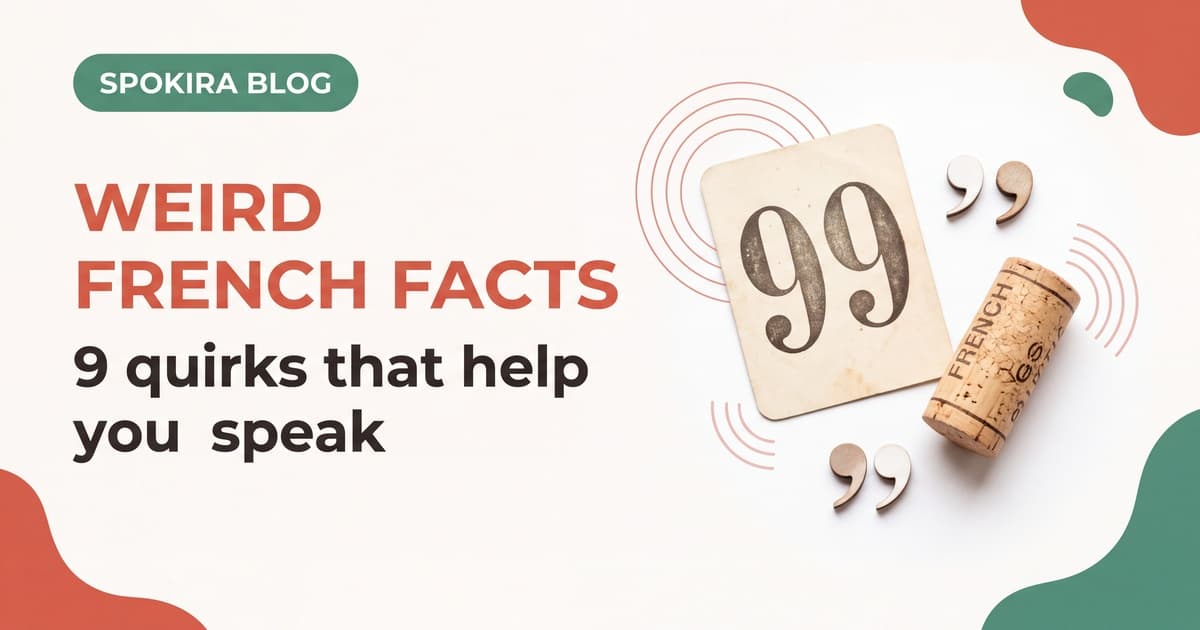
French gets called strange for good reasons. A number can sound like arithmetic. A word for a cork can describe a motorway. A phrase that means "anything" can also mean "what nonsense."
But the useful weird French language facts are not party tricks. They tell you what to expect when someone speaks quickly, how to choose a more natural phrase, and when a literal translation will land badly. That matters when you know plenty of French on paper but your mind goes blank at the counter, on the métro, or halfway through an answer.
Here are nine facts worth keeping. Each one ends with something you can say or listen for today.
Quick answer: which weird French language facts matter most for speaking?
Start with the quirks that change sound or meaning in real time:
- hear quatre-vingt-dix-neuf as a chunk, not a math problem;
- notice that a bouchon may be traffic, not a wine cork;
- use pas cher and bon marché with a little more intention;
- expect written French to contract in ordinary conversation;
- let context decide whether n'importe quoi is neutral or annoyed.
The aim is not to collect clever facts. You want recognition to become a quick reaction, before the conversation moves on. For the bigger practice system, start with French speaking practice for A2-B1 learners.
1. Why does 99 sound like "four twenties plus nineteen"?
Short answer: Standard French says quatre-vingt-dix-neuf, literally "four twenties, ten, nine." It looks odd in writing, but your ear soon learns it as one familiar number shape.
French keeps a historical base-20 pattern in 80, 90, and 99. The Académie française explains that earlier counting in France used groups of twenty, and that septante, octante, and nonante did not become the standard French forms in France. Those alternatives are still used in parts of the Francophone world, so do not assume that every French speaker says numbers the same way.
For speaking, the trap is trying to calculate as you listen. At a train platform, a price, a time, or a street number, that delay feels long. Make the common endings automatic instead:
| Number | French | Say it as a chunk |
|---|---|---|
| 71 | soixante et onze | "sixty-and-eleven" |
| 80 | quatre-vingts | "four twenties" |
| 91 | quatre-vingt-onze | "four-twenty-eleven" |
| 99 | quatre-vingt-dix-neuf | "four-twenty-nineteen" |
Try this out loud: Le bus quatre-vingt-dix-neuf arrive dans dix minutes. Do not translate while you say it. Keep the number in one breath group. The first few repetitions feel clumsy; then it becomes a sound pattern.
2. Aujourd'hui contains an old extra "day"
Short answer: Aujourd'hui means "today," but its final element comes from hui, an older word that also meant "today." That little redundancy is a history lesson you still say every morning.
The Académie dictionary entry for hui traces it to Latin hodie, "on this day," and says that hui now survives mainly in aujourd'hui and the archaic legal phrase ce jour d'hui. You do not need this etymology to order a coffee. It helps because it makes the word easier to hear and remember: au-jour-d'hui has layers, but it is one everyday unit.
There is a practical pronunciation bonus. Learners often give every spelling piece equal weight. In relaxed speech, aujourd'hui flows as /o.ʒuʁ.dɥi/, with the glide in d'hui doing real work. Listen for the ending as one quick movement, not "dee-oo-ee."
Say three small sentences with different time words:
- Aujourd'hui, je travaille à la maison.
- Hier, j'ai travaillé au bureau.
- Demain, je travaille plus tard.
That contrast trains a useful habit: common time words deserve to be stored as whole sounds.
If the history behind a phrase helps it stick, explore ten everyday French expressions with strange histories. That companion article stays focused on documented idiom origins rather than broader language quirks.
3. Pas cher and bon marché are both right, but they do not feel identical
Short answer: Use pas cher when you mean "not expensive" in ordinary conversation. Use bon marché when you want the established expression for low-priced or good-value goods. Neither is a magic upgrade over the other.
The Académie's language answer calls bon marché the common locution and lists peu onéreux, à bas prix, and abordable among alternatives. In ordinary conversation, pas cher is a direct way to say "not expensive." Bon marché is another established expression and can sound a touch more descriptive, as though you are assessing a product or a deal. Context and tone matter more than a rigid rule.
The mistake to avoid is telling a host that their gift was pas cher. Even if you only mean "a bargain," it can sound like "cheap." Praise the value instead:
- C'est pas cher ici. = "It's not expensive here."
- C'est bon marché pour Paris. = "It's good value / inexpensive for Paris."
- C'est abordable. = "It's affordable."
At a market, try: Vous avez quelque chose de bon marché? In a casual chat with a friend, try: Tu connais un resto pas cher dans le coin? One is not "better French." They fit slightly different moments.
Turn useful French into speech
Practice short, real-life French lines with native audio, then record yourself until the rhythm feels familiar.
4. A bouchon can block a road, not only a bottle
Short answer: A bouchon is a stopper or cork, but it also means a traffic jam because vehicles are packed into a blockage. If you are travelling, this is worth recognizing immediately.
The Académie/CNRTL entry for bouchon includes the traffic sense, and CNRTL lists it as a synonym of embouteillage. You might hear Il y a des bouchons sur le périphérique on the radio, in a taxi, or when somebody is late.
The image is useful: a cork stops a bottle; a bouchon stops a flow. French uses that same blockage idea in other places too, so do not lock a new word to its first translation.
Use these travel-ready lines:
- Il y a un bouchon? = "Is there traffic?"
- On est dans les bouchons. = "We're stuck in traffic."
- Le train a du retard à cause d'un incident. = "The train is late because of an incident."
That last line is not a synonym. It is a reminder to listen for the actual cause before you jump to a familiar word. If you want more travel rehearsal, French for travel gives you short scripts you can repeat before you need them.
5. N'importe quoi can mean "anything" or "rubbish"
Short answer: In a neutral sentence, n'importe quoi can mean "anything." Said with irritation, it can mean "nonsense" or "what are you talking about?" The grammar is the same; the social signal is not.
CNRTL records n'importe quoi as an indefinite construction in its entry for quoi. That neutral meaning appears in lines such as Tu peux choisir n'importe quoi ("You can choose anything"). In everyday conversation, though, Tu racontes n'importe quoi! is a sharp objection: "You're talking rubbish."
So pause before copying it from a show. Tone, relationship, and the rest of the sentence decide whether it is easygoing or confrontational.
| What you hear | Likely meaning | Safe response |
|---|---|---|
| Choisis n'importe quoi. | Choose anything. | D'accord, merci. |
| J'ai mangé n'importe quoi. | I ate whatever / ate badly. | Ask what they mean. |
| Tu racontes n'importe quoi! | That is nonsense. | Do not use lightly with strangers. |
One useful repair line is Attends, je me suis mal exprimé. ("Wait, I expressed myself badly.") It lowers the temperature without making you defend every word.
6. Bof and ben are tiny words with a job
Short answer: Bof gives a lukewarm reaction. Ben buys a beat before you answer. They are normal conversational signals, not compulsory markers of coolness.
French oral material from RFI includes ben as a spontaneous-speech marker. You will also see it written as bah in informal dialogue. The exact feel varies by region, generation, and person, so your job is to recognize it first and add it only when it feels natural in your own speech.
Bof is the noise of "meh." It can be friendly, but it is not enthusiastic:
- Tu aimes ce film? Bof, c'est pas mal, mais c'est un peu long.
- Ben, je sais pas encore.
The second answer matters because ben leads somewhere. It is not dead air. This is the same principle behind French filler phrases that help you keep talking: choose a small bridge, then finish the thought.
Written chat has a separate set of shortcuts. MDR and other French texting abbreviations help you decode messages, but they are not automatically phrases to copy into speech.
7. Written French shrinks when people speak
Short answer: Casual French often removes sounds that remain on the page. Je ne sais pas commonly becomes j'sais pas; il y a becomes y a. Learn the full form for writing, then train your ear for the shorter form.
RFI's 2025 teaching material explicitly flags disappearing ne and je sais pas as markers of oral French (RFI, 2025). This is not a licence to drop sounds in a formal presentation. It is a listening lesson: the words you know may arrive in a compressed package.
Here are common pairs to recognize:
| Written / careful | Casual speech you may hear |
|---|---|
| Je ne sais pas | J'sais pas |
| Je ne veux pas | J'veux pas |
| Il n'y a pas | Y a pas |
| Tu es où? | T'es où? |
| Je suis | J'suis |
Do not rush to imitate every reduction. First, listen to one native clip, read the full line, then say it in a relaxed but intelligible way. The French your teacher taught you versus the French you hear outside explains more of that register gap.
8. Silent letters are conditional, not random decoration
Short answer: Many final French letters are silent when a word stands alone, but pronunciation can change with grammar, a following vowel, or a related word. The spelling is not trying to trick you; it is carrying more information than one isolated sound.
Take petit. Alone, it ends /pə.ti/. Before a vowel in a fixed phrase, you may hear a linking consonant: petit ami has /pə.ti.ta.mi/. Then compare petit with petite, where the final /t/ is pronounced. One spelling pattern helps show gender and related forms even though the sound changes.
This is why "just pronounce every letter" fails so badly in French. The better habit is: learn the word in a phrase. French silent final consonants gives you the core pattern and exceptions, while French connected speech rules shows how liaison and enchaînement change the boundaries you hear.
Try this three-part drill slowly, then at a natural pace:
- un petit café
- une petite table
- un petit ami
Hear the consonants as part of the next sound group. That is closer to how French actually flows than word-by-word reading.
9. The Académie française recommends and records; it does not ban your conversation
Short answer: The Académie française is influential, especially through its dictionary and language guidance. But everyday French changes through speakers, places, and situations. Treat its views as guidance, not as a patrol officer in your café conversation.
The Académie describes the tenth edition of its dictionary as reflecting current usage and says its entries can recommend one term over another or explain a rule (Académie française). That is why headlines about the body "banning" words usually oversimplify what it does.
For learners, this distinction is freeing. You need standard forms for writing, work, and polite situations. You also need to understand what actual people say. Those goals can sit together.
When somebody tells you that one expression is "not real French," ask two better questions:
- Is it understood in this setting?
- Is it right for the level of formality I need?
That approach keeps you curious without chasing every trend. You do not need to sound like a social-media clip. You need French that is clear, appropriate, and available when it is your turn to speak.
Put the facts in your mouth: a five-minute recall drill
Pick three facts from this list. Make one short sentence for each, record it, and say it again with less reading support.
- Say a number: Le train part à quatre-vingt-dix-neuf minutes... Then correct yourself with a realistic time.
- Give an opinion: Bof, c'est pas mal, mais c'est un peu cher.
- Explain a delay: Désolé, il y avait des bouchons.
- Repair a misunderstanding: Attends, je me suis mal exprimé.
- Read one written sentence, then say it in a relaxed rhythm: Je ne sais pas -> j'sais pas.
The recording is the useful part. You will hear where you still translate, where you stop after a number, and where a French sound group breaks apart. Shadowing French helps you close that gap by copying native rhythm before you have to create a sentence from scratch.
Practice until the odd bits feel normal
Use short native French clips, repeat them out loud, and get feedback on the sound that needs attention next.
Weird French language facts work when you use them
The best weird French language facts change your next conversation. A strange counting system becomes a number you can catch. A cork becomes a traffic report. A missing ne becomes a sentence you finally recognize at full speed.
Choose one fact this week and make it physical: say the line ten times, hear it in a clip, and use it in a tiny imagined scene. Train your mouth, not your streak. The language will still have surprises. You will simply be less likely to freeze when one arrives.
Start a free speaking practice trial when you want a native voice to copy and a reason to say the line again. Or try Spokira speaking practice for short clips and feedback.