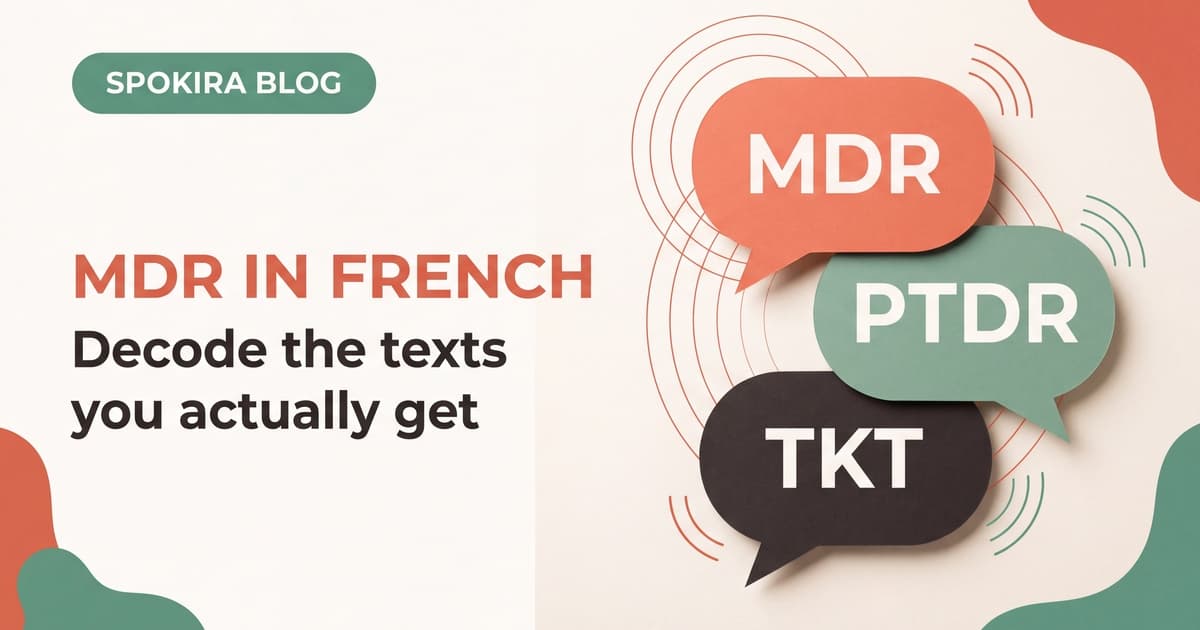
What does MDR mean in French? It means mort de rire, literally "dying of laughter." In a French text, it is the close cousin of "lol," but it does more than report a laugh. It can show that something is genuinely funny, make a blunt line feel lighter, or signal dry irony. The surrounding message decides which one you are reading.
That is why a neat English replacement is not always enough. A friend writes mdr t'abuses after you miss the train. Are they laughing with you, teasing you, or quietly annoyed? Usually, the answer is in the relationship, the punctuation, and what happened just before.
This guide is for the French you meet in messages with friends, classmates, flatmates, and people you know in France. It is a recognition guide, not a command to turn every sentence into initials.
Quick answer: how should you read MDR?
Read MDR as a familiar written reaction. It expands to mort de rire, and the French dictionary Le Robert defines it as a familiar interjection used for something comic or ironic.
Use the small clues around it:
- Mdr, ce chat est incroyable is probably an ordinary laugh.
- Ah mdr, super, le métro est encore bloqué is likely sarcastic.
- Mdr t'inquiète may simply soften a friendly reply.
Do not translate it word for word and then overanalyse it. Think: "What emotional job is this tiny reaction doing here?" That gets you much closer to the message.
What does MDR mean in French, literally?
Mort de rire is an exaggerated French expression: "dead from laughing" or "dying of laughter." In ordinary French, you can say or write the full phrase. In a chat, people often reduce it to mdr or MDR. Lowercase and uppercase are both normal; lowercase feels visually quieter.
The useful comparison is approximate, not exact:
| French | Literal meaning | Closest English feeling | Register |
|---|---|---|---|
| mdr | dying of laughter | lol / haha | familiar text chat |
| mort de rire | dying of laughter | "I'm dying" | familiar, spoken or written |
| ptdr | pété de rire | lmao / "I'm crying" | more emphatic, very casual |
| lol | English initialism | lol | common online, but not specifically French |
The RFI and Le français dans le monde teaching transcript records French teenagers naming mdr, ptdr, and longer playful variants such as xptdr. That is good evidence that these forms are recognizable. It is not evidence that every French speaker, or every age group, uses them at the same rate.
MDR versus LOL
If you already use "lol," you have the right general instinct. Both can mark amusement, friendliness, or a little awkwardness. The difference is cultural familiarity: mdr is a French-built abbreviation, while lol came from English and travels easily online.
In a French conversation, either may appear. If someone has written mdr to you, replying with mdr is safer than forcing a dramatic alternative. You do not have to match their spelling exactly. A plain haha, a laughing emoji, or a real sentence can be the more natural response.
MDR can mean "that is not funny"
This is the part learners often miss. The RFI transcript explicitly describes mdr, xptdr, and similar reactions as capable of irony: the writer can mean something like "yes, hilarious" when the situation is clearly bad.
Compare these two exchanges:
A: J'ai renversé mon café sur mon devoir. B: mdr 😭
Here B is laughing at a small disaster with A. The crying emoji makes the shared misery clear.
A: Le propriétaire augmente encore le loyer. B: mdr super nouvelle.
Here super nouvelle means the opposite of its literal words. Mdr helps you hear the deadpan tone. It does not make the rent rise funny.
When you are unsure, do not assume mockery. Many messages are just quick, messy, friendly reactions. Look for a pattern: repeated mdr, a flat "great," a negative event, or emojis that point toward sarcasm.
The French texting abbreviations worth recognizing
You will see a much larger universe of shortcuts online. Start with these because they help you understand an actual invitation, apology, question, or reaction. They are informal, and several are older SMS-style spellings that remain readable rather than compulsory.
| Abbreviation | Full French | What it means in a chat | A natural example |
|---|---|---|---|
| PTDR | pété de rire | laughing very hard | PTDR, j'avais pas vu la marche. |
| JPP | je n'en peux plus | I can't take it anymore; can be laughter, exhaustion, or disbelief | JPP, ce dossier est interminable. |
| TKT / TQT | t'inquiète or t'inquiète pas | don't worry | Tkt, je t'attends. |
| JSP | je sais pas | I don't know | Jsp, demande à Léa. |
| CV | ça va | how are you? / okay | Cv? Tu arrives bientôt? |
| PK / PQ | pourquoi | why | Pk tu pars si tôt? |
| BCP | beaucoup | a lot / very much | Merci bcp! |
| DSL | désolé(e) | sorry | Dsl, je vais avoir du retard. |
| STP / SVP | s'il te plaît / s'il vous plaît | please | Envoie-moi l'adresse stp. |
| AJD | aujourd'hui | today | Tu fais quoi ajd? |
| ASKIP | à ce qu'il paraît | apparently / I heard that | Askip, le concert est annulé. |
The full forms matter. They let you move from recognition to a reply you could say aloud. For example, JSP is not a mysterious new word. It is simply the casual spoken shape je sais pas squeezed into three letters. That makes it a useful bridge to classroom French and the French you hear outside, rather than a separate language to memorize.
Le Robert also lists askip as a familiar abbreviation of à ce qu'il paraît in its entry for paraître. Treat it as reported information: someone has heard something, not necessarily checked it.
A few tone notes that save embarrassment
PTDR is a bigger laugh than mdr in many exchanges, but it is not a scientific meter. People also stretch letters, write xptdr, stack emojis, or use nothing at all. Read the person, not just the acronym.
JPP is emotional shorthand for je n'en peux plus. It can mean "I am exhausted," "I cannot believe this," or "this is so funny I cannot cope." The next sentence tells you which sense is intended.
TKT is warm and casual. It works between peers. It is not the phrase to use when you need to reassure a client, your manager, or somebody you do not know well.
STP and SVP do not make a demand polite by magic. Envoie le document stp can be fine between friends, yet abrupt in a work chat. Add a greeting, a reason, and a full sentence when the stakes are higher.
One easy distinction helps when you start replying yourself. Abbreviations compress a message; they do not replace its social cues. A friend may write Tu peux m'envoyer ça stp? with a heart emoji after years of shared messages. The same words, dropped into a new group chat at 8:45 on a Monday, can read like an order. When you cannot judge the relationship yet, write the full phrase and let warmth come from the rest of the sentence.
The same goes for mdr after a mistake. In a close friendship, it may mean "I know that feeling." In a tense thread, it may look dismissive. If you are replying to bad news, acknowledge the problem first: Ah non, désolé. Tu veux que je t'aide? That is clearer than trying to signal sympathy with a laugh marker.
What these abbreviations do not tell you
Texting French is not a personality test. Seeing mdr does not prove that the writer is young, from Paris, relaxed about you, or laughing out loud in the room. It only tells you that this writer chose a compact reaction in this conversation.
The same caution applies to missing accents and vowels. Pk, bcp, and ajd are compact spellings that many readers recognize quickly. But a person may write every accent in one chat and use mdr in the next.
This is also different from French reaction phrases you can speak. Mdr belongs mainly on the page, though someone may occasionally spell the letters aloud for comic effect. If you want words for a face-to-face response, try French reaction phrases that sound natural. If you want to understand a strong word in messages or speech, this guide to merde gives you a clearer register map. For the separate skill of holding your turn in conversation, see French filler phrases that help you keep talking.
Can you use MDR at work in France?
Usually, no, at least not by default. MDR is friend-chat language. In a close team chat where everyone writes casually, you might see it after a harmless joke. That does not make it a good first move with a new colleague, a client, a recruiter, or anyone handling a problem.
For a work message, say what you mean:
- Instead of mdr jpp, write: J'ai bien ri, merci.
- Instead of dsl, retard, write: Désolé(e), je vais arriver avec dix minutes de retard.
- Instead of envoie le fichier stp, write: Peux-tu m'envoyer le fichier, s'il te plaît?
The point is not to sound stiff. It is to remove avoidable uncertainty. A written joke can land badly when the reader does not know you, and terse shortcuts can hide whether you are asking, apologizing, or dismissing an issue.
A short French texting decode exercise
Try these before looking at the answers. Focus on the message's job, not only the dictionary expansion.
- Dsl, je peux pas ajd. On reporte?
- Mdr, pk tu m'as pas dit?
- Tkt, jsp encore à quelle heure je finis.
- Askip, le prof donne bcp de devoirs.
- PTDR, cette vidéo. JPP.
Answers
- "Sorry, I can't today. Shall we reschedule?" This is casual, but clear enough between friends.
- "Haha, why didn't you tell me?" Depending on the situation, the mdr could be light teasing rather than anger.
- "Don't worry, I don't know yet what time I finish." Tkt reassures; jsp explains the uncertainty.
- "Apparently, the teacher gives a lot of homework." Askip tells you this is hearsay.
- "I'm laughing so hard at this video. I can't cope." Here JPP is almost certainly comic overload, not physical exhaustion.
If you got the full sense, you are doing the useful part already: reading tone in chunks. Do not try to reproduce all eleven abbreviations tomorrow. Choose one you have actually received and notice how the other person uses it.
Turn recognition into a reply you can send
For A2-B1 learners, passive recognition is the first win. The next win is replying without freezing. Use this small routine:
- Read the full French behind the abbreviation once: t'inquiète pas, je sais pas, désolé(e).
- Say the full phrase aloud twice. Your mouth needs the real words, not the initials.
- Write one ordinary reply: T'inquiète, on verra demain.
- Keep the abbreviation only if the chat already feels casual: Tkt, on verra demain.
That keeps the priority where it belongs: you are learning to communicate, not collecting internet code. For a broader routine that turns familiar French into speech, use French speaking practice for A2-B1 learners. Spokira can also give you short native-speaker clips and feedback, so the phrases you recognize in a chat become phrases you can say smoothly.
Move from reading French to replying in it
Practice short, real-life French aloud with native-speaker shadowing and focused feedback.
The takeaway
MDR means mort de rire: a familiar French-texting signal for laughter, lightness, or sometimes irony. Read it with the event and the relationship, not as a fixed translation. Then keep a short practical set nearby: tkt, jsp, dsl, stp, ajd, and askip will help you decode a surprising amount of everyday chat.
Use them sparingly until they feel natural. Clear French beats abbreviated French when a message matters. In a friendly thread, though, recognizing mdr means you will spend less time translating and more time following the joke. When you are ready to practise the full phrases out loud, try a French speaking practice session.