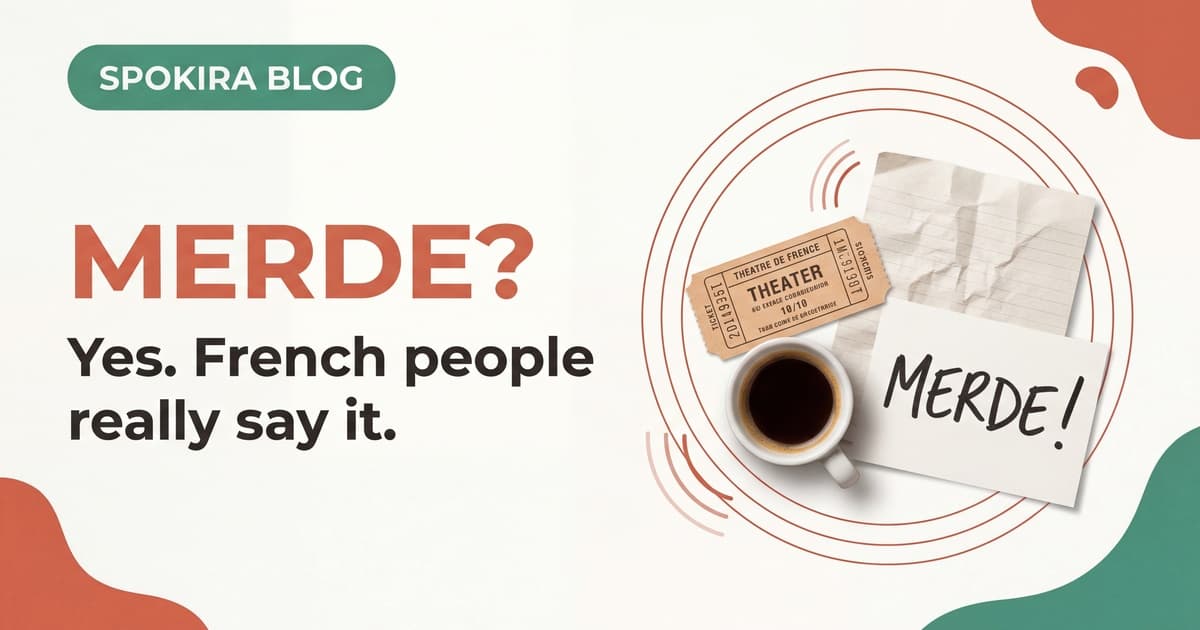
Every language learner knows this word. It's usually the first French swear word anyone picks up. But is merde actually part of daily French speech, or is it just a word tourists giggle about?
French people say merde all the time. It might be the single most versatile word in the French language.
How Common Is It?
Very. Merde sits roughly where "shit" sits in English. Most adults use it in casual settings without much drama. You hear it in conversation, in films, in books, and quietly at work when something goes wrong.
Unlike some swear words that have become too crude for most contexts, merde occupies a middle ground. It's not polite, but it's not shocking either. A French grandparent might say merde when they stub their toe. A news anchor wouldn't say it on air. A dinner party host might say it when they burn the roast.
The Many Meanings of Merde
What makes merde special isn't that it's vulgar. It's that it does so many different jobs:
| Usage | Example | Meaning |
|---|---|---|
| Frustration | Merde, j'ai oublié mes clés | Damn, I forgot my keys |
| Surprise | Merde! T'es déjà là? | Whoa! You're already here? |
| Good luck | Merde pour demain! | Break a leg tomorrow! |
| Dismissal | J'en ai rien à foutre, merde | I don't care, damn it |
| Admiration | Merde, c'est impressionnant | Damn, that's impressive |
| Refusal | Merde, non! | Hell no! |
The "good luck" usage surprises most learners. Saying merde to someone before a performance, exam, or important event is the French equivalent of "break a leg." The superstition is the same: saying "good luck" directly might jinx it, so you say something crude instead.
Cultural Note
If a French friend has a job interview, you say "Merde !" and they'll thank you. Saying "Bonne chance" is fine too, but merde is warmer and more personal.
Pronunciation
English speakers tend to pronounce it murd (rhyming with "bird"), which isn't quite right.
The French pronunciation:
- "Mehrd": the vowel is open, like the "e" in "bet"
- The final "e" is barely there, just a whisper that keeps the "d" from being fully swallowed
- The "r" is the French uvular R, not an English R
- Total duration: short and punchy
When used as an exclamation, it often stretches: "Meeeeerde..." It's a long, descending sigh of resignation.
The Intensity Scale
Merde is a 4 out of 10 on the French vulgarity scale. For context:
| Word | Rough intensity | English equivalent |
|---|---|---|
| Zut | 1/10 | Darn |
| Mince | 2/10 | Shoot |
| Merde | 4/10 | Shit / Damn |
| Putain | 6/10 | F*** (but used very casually) |
| Bordel | 5/10 | What the hell |
Putain is actually more common than merde in some demographics, especially among younger French speakers. It's a whole topic on its own. But merde remains the safe-ish default that almost everyone uses.
When Not to Say It
Merde is casual. Avoid it in:
- Job interviews (obviously)
- Formal business meetings
- Speaking to someone's parents for the first time (unless they say it first)
- Official settings (administration, police)
In casual settings, dinner with friends, chats with colleagues you know well, text messages, it's fine. French people do not usually treat it as a shocking word. It's just expressive, and sometimes very useful.
Related Expressions
Merde generates a whole family of expressions:
- Merdique: crappy, lousy ("Ce film est merdique")
- Emmerder: to annoy/bother someone ("Tu m'emmerdes" = you're bugging me)
- S'emmerder: to be bored ("Je m'emmerde" = I'm so bored)
- Un emmerdeur: an annoying person
- C'est la merde: it's a mess / everything's going wrong
- Être dans la merde: to be in trouble
These derivatives are used constantly. "C'est la merde" is practically a national motto during transit strikes.
Practice in Context
You probably don't need to practice swearing. But understanding how merde sounds in real speech helps your comprehension:
- "Merde, j'suis en retard." (Damn, I'm late.) Quick, muttered.
- "Oh merde, pardon !" (Oh crap, sorry!) Bumping into someone.
- "Merde pour ton exam !" (Good luck on your exam!) Warm, supportive.
- "C'est la merde au boulot." (Work is a disaster.) Flat, resigned.
Listen for these in French podcasts and movies. Once you start noticing merde, you'll hear it everywhere, because it really is everywhere.
For building natural-sounding French responses (profanity optional), Spokira's conversation drills train your reflexes for real-world exchanges.