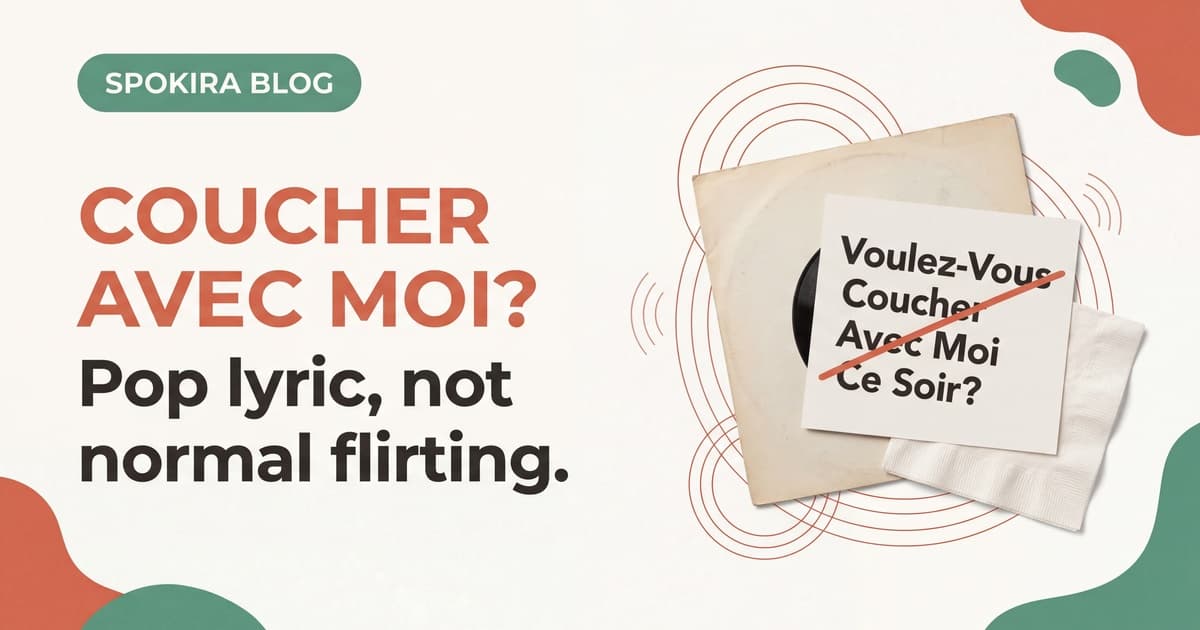
Thanks to Labelle's 1974 hit "Lady Marmalade," this is probably one of the most famous French phrases in the English-speaking world. People quote it, parody it, print it on T-shirts, and treat it like shorthand for French seduction.
But would an actual French person ever say this in real life?
Basically never. If they heard you say it, the response would land somewhere between laughter and secondhand embarrassment.
What It Literally Means
"Voulez-vous coucher avec moi (ce soir) ?" translates to "Do you want to sleep with me (tonight)?"
Grammatically, it's correct. The words are all real. The construction makes sense.
The issue is everything around the grammar.
Why It's Strange in French
Three things make this phrase weird in a real French context:
1. The "Vous" Is Wrong
Voulez-vous uses the formal "you." In French, vous is what you use with strangers, your boss, or elderly people you respect. Using vous in a sexual proposition creates a bizarre tonal mismatch, like propositioning someone while addressing them as "Sir" or "Madam."
If this sentence existed in real life, it would use tu: "Tu veux coucher avec moi ?" But even that version would be extremely direct for French culture.
2. It's Too Blunt
French flirting leans indirect. The norm is suggestion, not blunt proposition. Saying "do you want to sleep with me" to someone you've just met, or even to someone you're dating, bulldozes right past the usual social rhythm.
A French person trying to signal romantic interest would more likely say:
| What they'd say | What it means | What it really means |
|---|---|---|
| On va prendre un verre ? | Want to grab a drink? | I'm interested |
| Tu veux monter boire un café ? | Want to come up for coffee? | We both know what this means |
| On va chez moi ? | Go to my place? | Direct, but natural |
| T'es libre ce soir ? | Are you free tonight? | Open-ended invitation |
The classic euphemism is the coffee line: "Tu veux monter boire un café ?" Everyone knows "coffee" is not actually about coffee. But the indirectness is the point. It gives both people room to navigate gracefully.
Cultural Context
In French culture, flirting is a conversation, not a transaction. The pleasure is in the back-and-forth, the ambiguity, the escalation. Jumping straight to the destination skips the entire game.
3. It Sounds Like a Pop Song
At this point, the phrase is so tied to the song that saying it in France makes you sound like a tourist quoting pop culture. It has the same energy as visiting New York and saying "I'm walkin' here!" Yes, it's language people recognize. No, nobody takes it seriously.
Where the Phrase Comes From
The song "Lady Marmalade" uses the phrase to evoke a New Orleans streetwalker speaking French. The context was always transactional, not romantic. The phrase was chosen because it sounds blunt and provocative. That was the artistic intent.
French audiences understand this. They know the song. They might even enjoy it. But they recognize the phrase as an English-language caricature of French seduction, not as something anyone would actually say.
What French Flirting Actually Sounds Like
If you're curious about real French romantic language (for comprehension, not deployment), here are phrases that actually exist in French dating:
- "T'as de beaux yeux, tu sais." You have beautiful eyes, you know. (Classic film line, sometimes used playfully.)
- "Ça te dit qu'on se revoie ?" Feel like seeing each other again?
- "Tu me plais." I like you. (More direct than it seems. This is a meaningful statement in French.)
- "J'ai passé une super soirée." I had a great evening. (Signal of interest.)
These are warm, real, and normal. They do what French flirting often does best: say something small that leaves room for something bigger.
The Verdict
| The phrase | Reality | |
|---|---|---|
| Grammatically correct? | Yes | Yes, but awkward in context |
| Used by French people? | Almost never | Known as a pop culture quote |
| Would it work? | No | Comes across as bizarre or funny |
| Register | Formal "vous" + blunt proposition | Mismatched |
| Alternative | "Tu veux monter boire un café ?" | The actual French move |
Do French people say it? Only as a joke, quoting the song. In real French social interaction, it would land somewhere between absurd and uncomfortable.
Practice Real Conversational French Instead
If you want phrases that actually work in French social situations:
- "T'es libre ce soir ?" (Are you free tonight?) Casual, open.
- "On va prendre un verre ?" (Want to grab a drink?) Low-pressure invitation.
- "J'ai passé une super soirée avec toi." (I had a great evening with you.) Warm closing.
These are the kinds of lines that actually show up in French social life. Practice them with natural intonation using Spokira's conversation exercises.