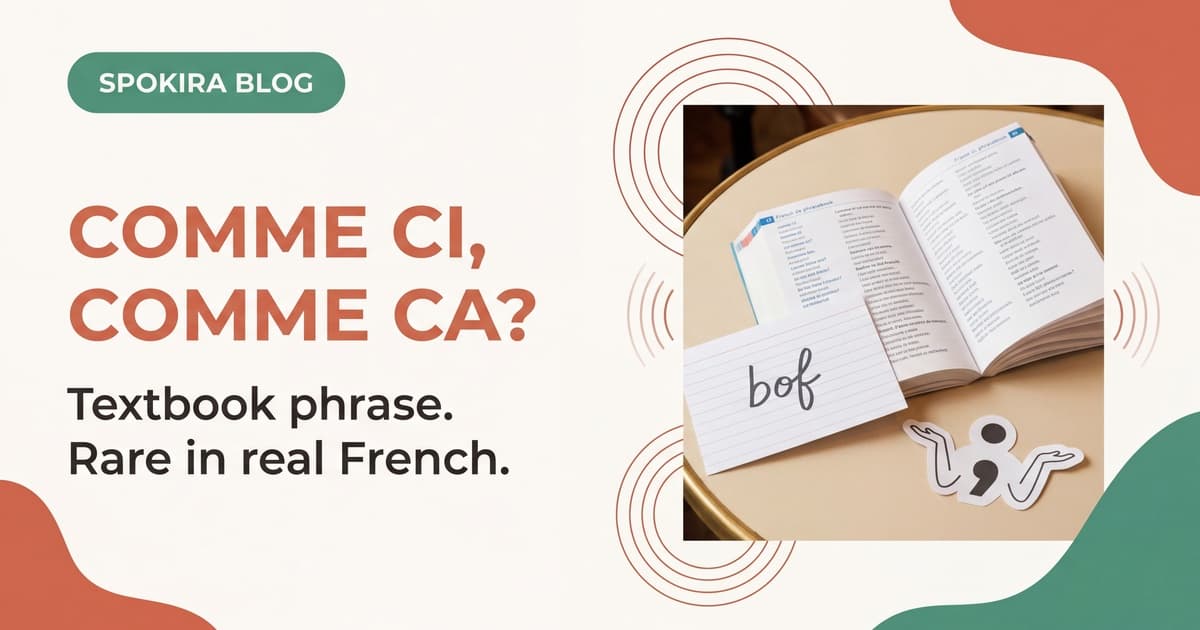
Ask any French textbook how to say "so-so" and you'll get comme ci, comme ça. It's probably the first French phrase you learned after bonjour.
Here's the problem: French people almost never say it.
Why You Learned It
"Comme ci, comme ça" is a clean, easy-to-teach expression. It translates neatly to "like this, like that" and maps onto the English concept of "so-so." Textbooks love it because it's symmetrical, memorable, and grammatically safe.
It's also stuck in a time warp. The phrase exists in French the way "golly gee" exists in English: technically correct, immediately dated.
What French People Actually Say
When a French person wants to express "meh" or "so-so," here's what comes out:
| What they say | Literal meaning | Feel |
|---|---|---|
| Bof | (no translation, pure sound) | The universal French shrug |
| Couci-couça | Like this, like that | Slightly more natural cousin |
| Moyen | Average | Matter-of-fact |
| Pas terrible | Not terrible | Actually means "not great" |
| Ça va (flat tone) | It's going | The tone does the work |
| Bah, ça va | Well, it's okay | Resigned acceptance |
The king of this list is bof. One syllable. Add a shoulder raise and a slightly unhappy mouth, and you've said plenty. Bof is what comes out when the movie was forgettable and you don't feel like pretending otherwise.
The One Word to Learn
Replace every "comme ci, comme ça" in your vocabulary with bof. It's shorter, more natural, and French people actually use it daily. Practice the shoulder shrug too. It's part of the word.
"Pas Terrible": The Trap
One phrase on that list trips up English speakers: pas terrible.
Your brain translates it as "not terrible," which sounds neutral or even positive. In French, it means the opposite: not great. Terrible in French can mean "amazing" in casual speech, so pas terrible = "not amazing" = "pretty bad."
"Comment c'était, le restaurant ?" "Pas terrible." "How was the restaurant?" "Not great."
This is one of those false friends that will confuse you until you hear it used a few times in context.
When "Comme Ci, Comme Ça" Does Appear
Is the phrase dead? Not entirely. You might hear it from:
- Older speakers in more formal contexts
- People talking to foreigners who simplify their French
- Written French where it serves as a clear, unambiguous expression
But among friends, at a café, in any casual exchange? Almost never. Using it marks you as a textbook speaker.
The Real Conversation
Here's how "How are you? / So-so" actually sounds in France:
Textbook version:
"Comment allez-vous ?" "Comme ci, comme ça."
Real version:
"Ça va ?" "Bof, ça va."
Or even shorter:
"Ça va ?" "Moyen."
Notice how much less formal the real version is. The question shrinks, the answer shrinks, and the meaning stays the same.
Practice These Instead
Say each one out loud three times. Focus on the flat, unbothered tone. That's what carries the "meh" meaning.
- "Bof." (one syllable, mouth rounds, shoulders go up)
- "Bof, ça va." (bof sah vah, resigned but alive)
- "C'était moyen." (say-teh mwah-YEN, it was average)
- "Pas terrible." (pah teh-REEBL, not great)
Shadow these with native audio and you'll sound much closer to someone who has actually been in a French conversation, not someone reciting the dialogue exercise from page 12.
Want to practice these responses with real pronunciation feedback? Spokira's shadowing drills help you train the casual rhythm French speakers actually use.