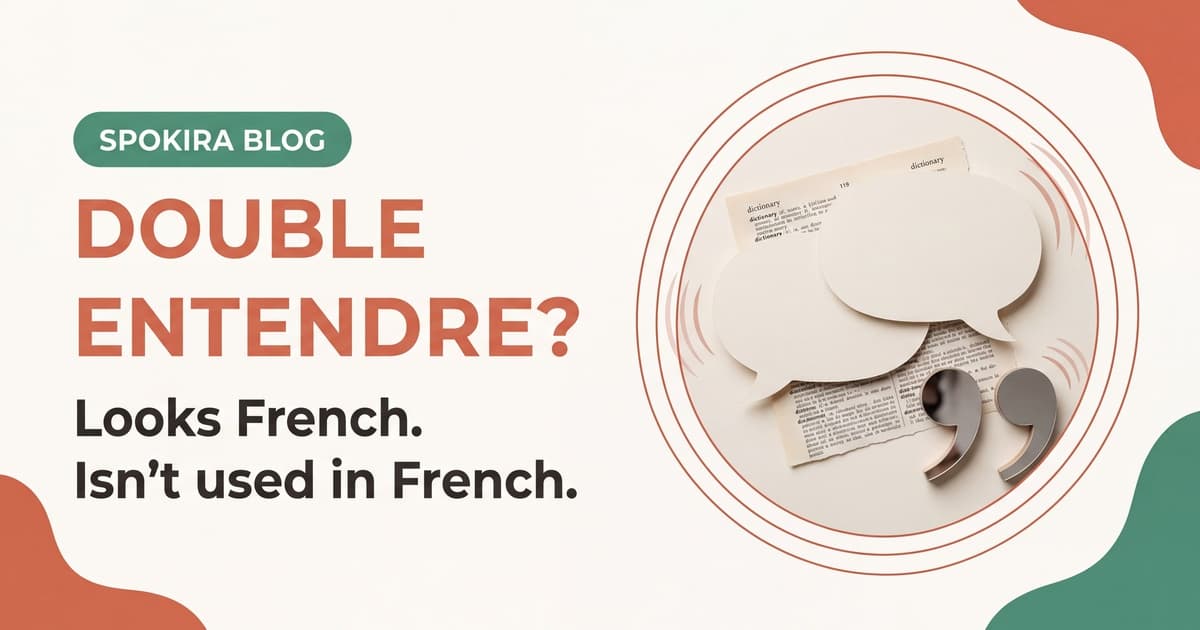
In English, a "double entendre" is a phrase with two meanings, usually one innocent and one suggestive. Comedians use them. Headlines play with them. Everyone understands the term.
It sounds French. It looks French. It is even built out of French words.
But French people don't say it. The phrase doesn't exist in French.
Wait, it's not French?
Technically, the individual words are French. Double means double. Entendre means to hear (or, in older usage, to understand). But the combination double entendre as a fixed expression? That's English.
It was borrowed during the long stretch when English pulled in huge amounts of French vocabulary. But this particular phrase was assembled in English, not in French. It looks French from a distance. Up close, it is an English invention wearing French clothes.
Think of it like "entrée." In English, it means the main course. In French, entrée means the starter. The word crossed the channel and changed meaning. Double entendre crossed the channel and became a phrase that never existed on the other side.
What French People Actually Say
The French concept exists. French speakers definitely talk about words and phrases that carry a second, hidden meaning. They just use a different term:
Double sens literally means "double meaning."
"C'est un double sens." It means "It's a double meaning."
"Il y a un double sens dans cette phrase." It means "There's a double meaning in that sentence."
That's it. Plain, logical, and actually used in France.
| What English says | What French says | Literal translation |
|---|---|---|
| Double entendre | Double sens | Double meaning |
| That's a double entendre | C'est un double sens | It's a double meaning |
| Full of double entendres | Plein de sous-entendus | Full of implications |
Bonus Word: Sous-entendu
For the suggestive, wink-wink type of double meaning, French uses sous-entendu, literally "under-heard" or "implied." It's the word for when someone says something innocent that everyone knows means something else.
"Sous-entendu": The word you actually want
Sous-entendu is the French word that does the most work in this space. It covers:
- Sexual innuendo: "C'était clairement un sous-entendu." (That was clearly an innuendo.)
- Political subtext: "Son discours était plein de sous-entendus." (His speech was full of implied meanings.)
- Social hints: "Elle a fait un sous-entendu sur leur relation." (She hinted at something about their relationship.)
Where English uses "double entendre" primarily for suggestive wordplay, sous-entendu covers the full range, from dirty jokes to diplomatic subtext. It's a more useful word.
Why This Matters for Learners
This is a pattern worth recognizing. English has many phrases that look French but aren't used in France:
| English "French" | Actual French | Status |
|---|---|---|
| Double entendre | Double sens / Sous-entendu | Fake French |
| RSVP (used as a verb) | Répondre (just the verb) | Abbreviation, not a verb in French |
| Résumé (for CV) | CV | Résumé means "summary" |
| Fiancé (for any gender) | Fiancé (m) / Fiancée (f) | English dropped the gender distinction |
| Encore! (requesting a repeat) | Bis! | Encore means "again/still" |
Knowing these differences saves you from a very specific kind of embarrassment: confidently using a phrase you think is French, in France, to a French person who has never heard it.
How to Pronounce the Real Words
Double sens: doob-luh SAHNS
- The "s" at the end of sens is pronounced (unlike most French final consonants)
Sous-entendu: soo-zahn-tahn-DÜ
- The "s" in sous links to the vowel in entendu (liaison)
- The final "u" is the French [y] sound, not "oo"
Practice These
- "C'est un double sens." (It's a double meaning.) Matter-of-fact.
- "Y'a un sous-entendu là, non ?" (There's an implication there, right?) Playful, knowing.
- "Arrête avec tes sous-entendus !" (Stop with your innuendos!) Teasing.
- "C'est plein de sous-entendus, ce film." (This movie is full of double meanings.)
These are phrases you'd actually hear in a French conversation about a movie, a joke, or a friend's suspicious comment. Practice them with Spokira's pronunciation coaching to get the rhythm right.
The Verdict
Do French people say "double entendre"? No. The phrase was assembled in English from French parts, like furniture from a store where the instructions are in another language. The result looks right but isn't quite how the original manufacturer intended.
Use double sens for the neutral concept. Use sous-entendu for the suggestive one. And enjoy knowing something most English speakers don't: their favorite "French" phrase isn't French at all.