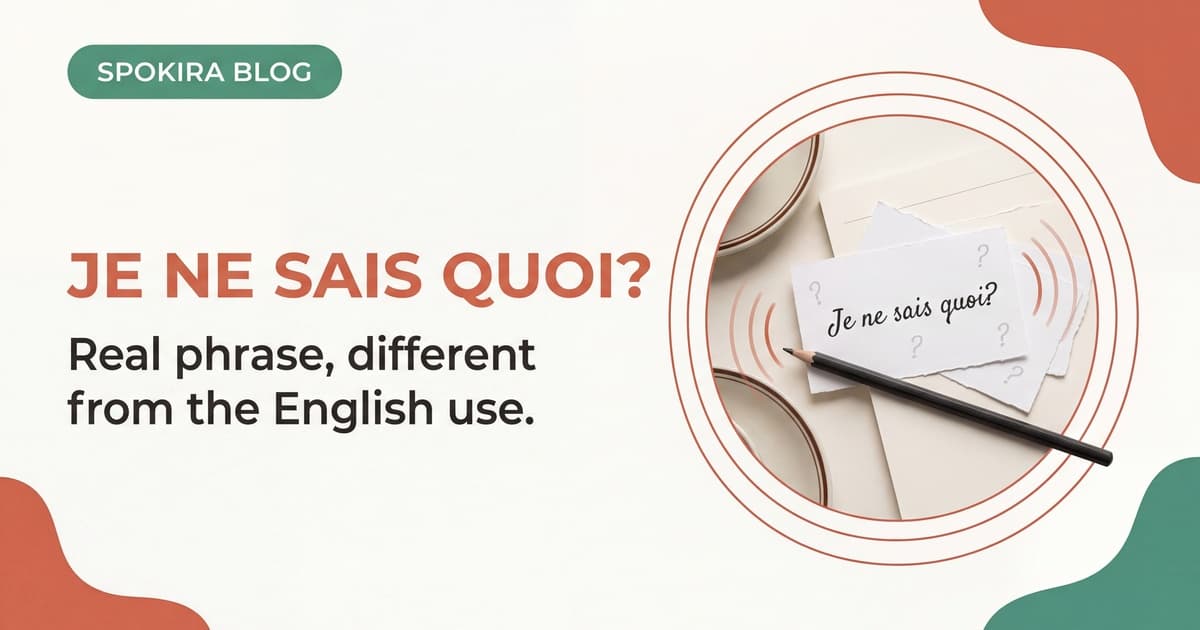
You've heard it in English a hundred times. "She has a certain je ne sais quoi." It sounds impossibly chic. But if you dropped this phrase into a real conversation in Paris, would anyone blink?
Short answer: yes, French people say it. But not the way English speakers think.
What "Je Ne Sais Quoi" Actually Means
The phrase translates literally to "I don't know what." That's it. No mystery. No glamour. Just "I don't know what."
In French, it's a building block of normal sentences:
| French | English | Context |
|---|---|---|
| Je ne sais quoi faire | I don't know what to do | Everyday frustration |
| Je ne sais quoi dire | I don't know what to say | Speechless moment |
| Je ne sais quoi penser | I don't know what to think | Uncertainty |
French speakers use "je ne sais quoi" as a grammatical fragment all day long. It's about as exotic as saying "I don't know what" in English.
The English Version vs. The French Version
Here's the gap. In English, "je ne sais quoi" has become a standalone noun meaning "an indefinable, attractive quality." You'd say:
"This restaurant has a certain je ne sais quoi."
In French, they can use it this way too, but it sounds more literary than casual. A French person describing a restaurant would more likely say:
"Ce resto a un truc en plus." (This place has something extra.)
"Il y a quelque chose, je sais pas quoi." (There's something, I don't know what.)
Notice that second one? That's closer to how French people actually express the concept: they just say the regular sentence.
How It Really Sounds
If you say "je ne sais quoi" with careful, separated syllables, zhuh nuh say kwah, you'll sound like an English speaker quoting a phrase they know from a magazine.
In real spoken French, the "ne" almost always drops. So it becomes:
"J'sais pas quoi" → sounds like shay pah kwah
This is the version you'll hear on the street, in cafés, among friends. The full "je ne sais quoi" with every syllable pronounced? That's formal writing or very deliberate speech.
Pronunciation Shortcut
Practice saying "shay pah kwah" fast. That's the real spoken rhythm. The polished four-syllable version is for written French and English borrowings, not for real conversation.
When French People Actually Use the "Fancy" Version
There is one context where French speakers use "un je-ne-sais-quoi" as a noun, similar to English: literary or slightly poetic descriptions.
"Elle a un je-ne-sais-quoi qui attire." (She has a certain something that draws you in.)
You'll find this in novels, magazine profiles, and occasionally in thoughtful conversation. But it's marked. People know they're reaching for an effect.
In everyday speech, they'd just say:
"Elle a un truc." (She's got something.)
"Je sais pas ce qu'elle a, mais ça marche." (I don't know what she's got, but it works.)
The Verdict
| English usage | French usage | |
|---|---|---|
| Meaning | Mysterious, indefinable quality | "I don't know what" (literal) |
| Register | Casual, borrowed elegance | Everyday grammar fragment |
| As a standalone noun | Very common | Rare, literary |
| Pronunciation | zhuh-nuh-say-kwah | shay pah kwah (spoken) |
Do French people say it? Yes, constantly. But they're usually just saying "I don't know what" in the middle of a normal sentence. The glamorous English meaning exists in French too, but it's a niche, slightly fancy choice, not an everyday phrase.
Try It Yourself
Want to actually use this phrase in context instead of just quoting it? Practice these three sentences out loud:
- "J'sais pas quoi faire ce soir." (I don't know what to do tonight.)
- "Il a un truc en plus, j'sais pas quoi." (He's got something extra, I don't know what.)
- "C'est quoi, ce je-ne-sais-quoi ?" (What is this je-ne-sais-quoi?) Playful, self-aware.
Shadow each one five times. Focus on the collapsed rhythm of j'sais pas, not the classroom version. That's what makes it sound lived-in.
If you want guided pronunciation feedback on French phrases like these, try shadowing with Spokira. It coaches your mouth to match native rhythm, not just vocabulary.