Learning to speak French rarely breaks down because you have never seen enough grammar rules.
It breaks down because the sentence you need is not there when you need it. You can recognize a phrase but cannot quite say it. You know something sounded off, but not which word or what to do differently on the next attempt.
Since March 16, we have been rebuilding Spokira around those practical moments.
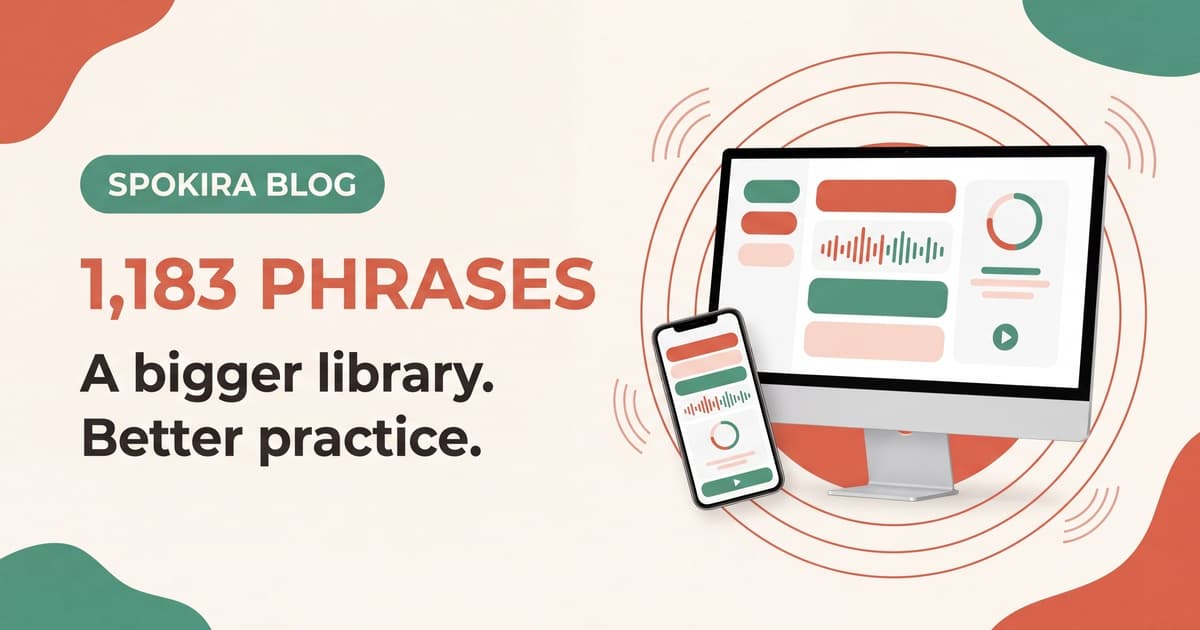
This Spokira August 2026 update takes the practice library from 126 to 1,183 French phrases, organized into 234 packs across 11 paths. The underlying taxonomy now spans 78 situations and 11 learner goals, giving us a clearer map for current and future practice. The number is only part of the story. We also changed how you find the right material, move through a session, hear the reference audio, and decide what to fix next.
The result is a more focused Spokira: broader real-life coverage, clearer practice paths, more specific pronunciation feedback, and audio controls built for repetition.
We also want to be precise about what this does not mean. A larger phrase library is not automatically a finished curriculum. There is more sequencing, review support, and quality work ahead. Still, this is a substantial step toward a product that helps you prepare for real conversations instead of collecting disconnected French content.
Quick answer: what changed in the Spokira August 2026 update?
| Area | In March | Now |
|---|---|---|
| Practice library | 126 phrases | 1,183 phrases |
| Organization | A much smaller set of packs | 234 packs across 11 paths, mapped to 78 situations and 11 learner goals |
| Practice flow | More fragmented navigation | Focused sessions, clearer library browsing, history, and progress |
| Pronunciation feedback | Broad scores and limited detail | More useful word- and sound-level guidance |
| Reference audio | Whole-phrase playback | Active-word highlighting, exact-word replay, and slower pitch-preserved playback |
| Mobile | Not yet available | Coming soon, starting with iOS |
If you have not visited recently, the easiest way to understand the difference is to review how Spokira works, then open one practical pack and complete a short session.
The library grew from 126 to 1,183 French phrases
The clearest number in this update is the library expansion: 126 phrases became 1,183. That is more than nine times the original practice inventory.
The current library is organized into 234 packs across 11 paths. Those paths cover different kinds of speaking needs, including everyday basics, social situations, home and administrative tasks, health, travel, work, and longer personal exchanges.
Behind those paths, the taxonomy now defines 78 situations and 11 learner goals. It helps us connect packs to why someone is learning and where they expect to speak, while leaving room to improve coverage as the library grows.
That breadth matters because learners do not encounter French as a tidy sequence of grammar chapters. They encounter it while ordering lunch, calling a landlord, explaining a symptom, joining a conversation, or trying to recover after an unexpected reply.
So the unit we care about is not a vocabulary item sitting by itself. It is a phrase you can hear, say, and reuse in a recognizable situation.
That direction is consistent with the Council of Europe's CEFR key concepts, which describe the learner as a social agent and emphasize action-oriented language use. A learner needs French to do something: ask, respond, clarify, disagree, repair a misunderstanding, or keep an exchange moving.
This is why our library is organized around situations and practice packs rather than one enormous phrase list. A person preparing for a move to France should not need to sift through hundreds of unrelated expressions to find the language for a doctor, apartment viewing, or repair call.
You can see the same approach in our complete French speaking practice guide: choose a small set, practice aloud, correct one problem, and return to the phrase until the response becomes easier to retrieve.
More content creates a navigation problem too
Going from 126 to 1,183 phrases could easily make the product harder to use. A larger shelf is not useful if you cannot find the right book.
That is why we rebuilt the surrounding practice experience at the same time. The library needs to answer two different learner needs:
- "Tell me what to practice next."
- "Let me choose the situation that matters to me today."
The new structure supports both. You can continue through a path when you want direction, or browse the library when you have a specific conversation in mind.
Practice now starts with a clearer next step
The web app has been redesigned around a simple daily question: what is the next useful thing for me to practice?
The home, library, practice, and progress areas now work as parts of the same learner flow. The current path and next relevant pack are easier to find. Focused sessions keep the immediate task in front of you. Practice history and progress are available when you want context, without turning every repetition into a chase for points.
You can now:
- open a focused session from a relevant pack;
- browse a much larger library by path and situation;
- check your microphone before a session;
- review practice history and recent activity;
- complete a pack and continue without losing your place; and
- use a personal daily goal as a guide rather than a punishment.
We have also strengthened how completed sessions and practice records are saved. Most people will never notice that work directly. They should not have to. When persistence works properly, you finish a session, come back later, and find your progress where you left it.
The aim is not to force every learner through one rigid sequence. Someone moving to France, someone preparing for a weekend trip, and someone trying to speak with their partner's family need different material.
The redesign has a smaller and more useful goal: reduce the distance between "I should practice French" and one clear, finishable session.
If you want to compare this approach with broader conversation tools, our French speaking practice app guide explains why Spokira centers the listen, record, feedback, and retry loop.
Pronunciation feedback now points to a better next attempt
An overall pronunciation score can be a useful signal. It becomes frustrating when your next question is: "Fine, but what exactly should I change?"
This update makes feedback more specific at the word and sound level. Instead of ending with one verdict on an entire recording, Spokira can help you locate the part of the phrase that deserves another attempt, connect it to a relevant sound issue, and show more focused coaching.
The practice loop is straightforward:
- Listen to the reference phrase.
- Record yourself saying it.
- See which part was strong and which part needs attention.
- Select the word worth revisiting.
- Listen, repeat, and compare again.
That difference matters. A score of 73 does not tell you whether to focus on rendez-vous, a nasal vowel, a liaison, a rushed ending, or the rhythm of the whole phrase. Useful feedback should narrow the next attempt.
Pronunciation research also argues against treating every intervention as interchangeable. Thomson and Derwing's 2015 review of 75 pronunciation studies found that outcomes vary with instructional focus, duration, assessment, and learner differences. Lee and colleagues' 2015 meta-analysis of 86 reports found larger effects in treatments that provided feedback, while also documenting important limits in the evidence.
We are not turning those findings into a promise that one score or one repeated phrase will transform your accent. Our goal is more practical: help you notice a specific issue, make a more informed next attempt, and spend your practice time on something you can actually change.
For a deeper explanation of that philosophy, read what useful French pronunciation correction should tell you.
Reference audio is easier to follow and control
Listening and repeating are basic activities. They become more useful when you can stay oriented inside the phrase and isolate the part you need.
This update adds three audio improvements that work together.
Follow the active word while the phrase plays
Karaoke-style highlighting tracks the active word as the native reference audio plays.
This is not decoration. It answers a common learner question: "Where are we in the sentence right now?"
French connected speech can make familiar words sound very different once they are joined inside a sentence. Visual tracking gives you an anchor between the written phrase and the sound moving through it. It also makes later feedback easier to use because you can locate the target word in context.
Replay the exact word instead of restarting the sentence
Repeating a complete sentence is useful. Repeating it ten times because one word in the middle is difficult becomes wasteful.
You can now jump to the relevant word in the reference audio and replay that region. This makes it easier to isolate a trouble spot, listen carefully, and try again without manually scrubbing through the whole clip.
Then you can return to the complete phrase. That last step matters. The goal is not to pronounce detached fragments perfectly while losing the rhythm around them. Exact-word replay is a repair tool inside full-sentence practice.
Slow the reference without dropping the pitch
Learners often need a slower first listen. Traditional slowdown can make a voice sound unnaturally deep, which introduces a different distraction.
Spokira now supports slower playback while preserving the voice's pitch more naturally. You can reduce the speed to hear transitions and word boundaries, repeat deliberately, then return to normal speed as the phrase becomes more comfortable.
Together, highlighting, exact-word replay, and pitch-preserved slowdown make the reference audio feel less like a recording you can only start and stop. It becomes something you can work with.
Try the new practice loop
Choose one useful French situation, listen to the reference, record yourself, and use the word-level feedback to guide your next repetition.
The Spokira mobile app is coming soon, starting with iOS
Spokira is coming to mobile, and the first release will be on iOS.
The iOS app is being built around the same learner loop as the web experience: onboarding, library access, focused practice, progress, audio controls, and word-level pronunciation feedback. We want moving between desktop and phone to feel familiar rather than like switching to a smaller, disconnected product.
We do not have an exact public release date to share yet. We will start with iOS and announce availability as soon as the first release is ready.
That direction matters because French practice often happens in ten free minutes, on a commute, or just before the conversation you are nervous about. The mobile app should make those moments easier to use without weakening the listen, record, feedback, and retry loop.
What remains unfinished after this Spokira August 2026 update?
This release makes Spokira broader and more useful. It does not make the product complete.
Library breadth is not curriculum completeness
The count of 1,183 phrases is a much stronger base than 126. It does not prove that every learner has the ideal sequence, review schedule, cultural context, or progression for every situation.
We still need to improve how paths develop across levels, how packs connect to clear speaking goals, and how practice moves from supported repetition toward more flexible conversation.
Feedback is guidance, not a final judgment on your French
Word-level feedback is more actionable than one overall score, but it is still a practice tool. It cannot fully measure your ability to handle spontaneous conversation, regional variation, social tone, or the confidence to keep talking after a mistake.
We want feedback to help you choose the next repetition, not make a sweeping claim about your French.
iOS comes first
The first mobile release will focus on iOS. Starting with one platform gives us room to make the core practice experience dependable before expanding further. We will share the release date and availability details when they are ready.
More depth still matters
The next stage is not simply adding another large number of phrases. It is improving coverage where real-life situations are still thin, tightening progression, expanding review support, and making the feedback loop more dependable.
What should you try first?
If you already use Spokira, open your practice area and choose a phrase that has felt difficult before.
Try this five-minute loop:
- Listen once at normal speed.
- Follow the active-word highlighting.
- Slow the reference if one section disappears too quickly.
- Record one complete attempt.
- Use the feedback to replay and repeat one word.
- Finish with the complete phrase at normal speed.
If you are new to Spokira, start with one situation that matters to your life. Not "French in general." Pick one conversation you want to handle with less hesitation, then practice until the response feels easier to retrieve.
More phrases matter. Better feedback matters. Better audio controls matter. But the measure we care about is simpler: when the moment comes, can you say a little more of what you mean?
Start a free Spokira practice session and try the updated loop for yourself.