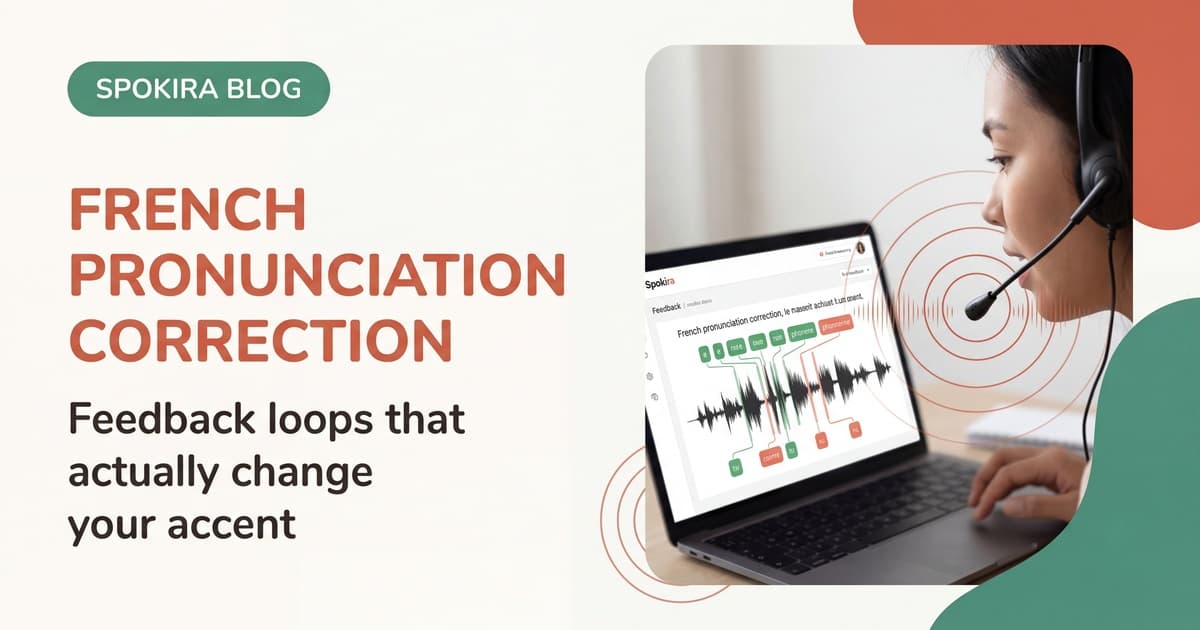
French pronunciation correction works when feedback changes what you do in the next rep, not when it only labels your performance. If you want faster accent improvement, you need a loop: diagnose one issue, correct immediately, test in context, and recheck after spacing.
In this guide, you will get a practical correction system you can run in 15 minutes per day. The goal is not sounding "perfect." The goal is becoming clearly understood, with less effort and more confidence.
For factual grounding, this article references primary sources reviewed on March 12, 2026: the Council of Europe CEFR Companion Volume (2020), retrieval-practice findings in PNAS (Karpicke and Roediger, 2008), distributed-practice evidence in Psychological Bulletin (Cepeda et al., 2006), and meta-analytic evidence on oral corrective feedback effects in classroom SLA (Lyster and Saito, 2010).
If you want a tool-focused buyer rubric first, use French pronunciation app and AI French pronunciation feedback, then return here for the daily correction protocol.
Quick answer: what kind of feedback actually improves French pronunciation?
The best French pronunciation correction feedback is specific, immediate, and actionable. It tells you:
- Exactly what failed (sound, syllable, timing, or intonation)
- Exactly what target to produce instead
- Exactly what to try in your next attempt
Generic feedback like "good" or "incorrect" usually does not create durable change. You need targeted cues with short rep cycles. This aligns with communicative performance framing in the CEFR Companion Volume (Council of Europe, 2020), and with learning-science results showing stronger retention from retrieval practice (PNAS, 2008) and spaced review (Psychological Bulletin, 2006).
One correction rule
If feedback does not change your very next repetition, it is not useful feedback.
Why learners plateau even when they "practice pronunciation"
Most learners do more exposure than correction. They listen, repeat a little, then move on. The problem is not effort. The problem is loop design.
A typical weak loop looks like this:
- hear the model once,
- repeat once,
- get a vague score,
- switch topic.
That loop is too shallow for durable motor and timing changes in speech. Pronunciation is a coordination skill. You need enough consecutive attempts on the same target to stabilize a better pattern.
A stronger loop looks different:
- one target sound or prosody pattern,
- multiple reps with immediate correction,
- short transfer into phrase-level speech,
- delayed recheck after spacing.
This is where many learners finally notice visible progress: not because they found secret techniques, but because they stopped changing targets every minute.
If this sounds familiar, pair this article with French pronunciation for English speakers, then use fast-fix accent drills for your first correction set.
The 6-step French pronunciation correction system
Step 1: Record a baseline you can compare
Record 30-60 seconds on one stable prompt. Keep the same prompt for at least 7 days.
Good prompts:
- self-introduction,
- describing your morning routine,
- ordering at a cafe,
- giving directions.
Why this matters: without a stable baseline, you cannot measure real improvement. You only get mood-based impressions.
Use your first sample as "Day 0." Then compare Day 3 and Day 7 on the same text or same speaking task.
Step 2: Pick one correction target only
Choose one issue per micro-session. Common high-impact targets for English speakers:
- French R consistency,
- nasal vowel contrast (
an/en/on/in), uvsou,- phrase rhythm and chunking,
- final consonant over-pronunciation.
Trying to fix five things in one session creates noise. Your brain gets mixed error signals and keeps old habits.
If your main blocker is R production, use French R sound practice daily drill. For vowel contrasts, use nasal vowels practice and French U vs OU practice.
Step 3: Demand actionable feedback
Not all feedback is equal. Use this filter immediately:
- Reject: "wrong," "try again," or a score without diagnosis.
- Accept: "your /u/ is drifting toward /ou/ because lip rounding is too weak; hold lip rounding and shorten vowel duration."
Useful feedback has three components:
- error label (what happened),
- target cue (what should happen),
- next-rep instruction (what to do now).
In classroom research synthesis, oral corrective feedback shows measurable learning effects, but quality and delivery matter (Lyster and Saito, 2010). For self-study, this means you should prefer correction systems that drive immediate retries instead of passive explanation.
Step 4: Run 10-20 tight correction reps
Now run concentrated reps on one phrase set. Keep the cycle short:
- listen to model,
- produce,
- read correction cue,
- retry immediately.
Do not wait until the end of the session to apply feedback. Immediate retry matters because it maps correction to fresh motor output.
A practical set:
- 5 reps at word level,
- 5 reps in short phrase,
- 5 reps in mini-sentence,
- optional 5 reps under slight speed pressure.
Retrieval-focused repetition supports durable learning better than repeated passive review (Karpicke and Roediger, 2008).
Step 5: Transfer correction into a mini-dialogue
Once the sound improves in isolation, place it in speech. Use a 2-4 line dialogue where you must answer, not only repeat.
Example for u vs ou:
- "Tu veux du sucre ?"
- "Oui, un peu de sucre, s'il vous plait."
The objective is transfer. If you only fix sounds in isolated drills, conversation pressure will often pull you back to old habits.
For daily transfer practice with broader output pressure, use app to practice speaking french and French accent training app as your scenario layer.
Step 6: Recheck after spacing (24h and 72h)
Correction that disappears the next day is not yet learned. Re-test the same target at two spacing checkpoints:
- after 24 hours,
- after 72 hours.
If accuracy drops, restart a shorter correction block.
Spacing has robust evidence for longer-term retention effects (Cepeda et al., 2006). In pronunciation training, that means short repeated sessions beat long one-off marathons.
What to correct first in French pronunciation correction: a priority model that avoids overwhelm
Use this order to choose correction targets:
- Intelligibility blockers first
- High-frequency sound errors second
- Prosody and naturalness third
1) Intelligibility blockers
These are errors that cause misunderstanding or frequent repetition requests. Fix these before accent polish.
Examples:
- collapsing
uandou, - unstable nasal vowels,
- deleting key syllables under speed.
2) High-frequency sound errors
Focus where communication load is highest: sounds and patterns that appear every day in your speaking contexts.
If you say these patterns constantly, even small gains create large perceived improvement.
3) Prosody and naturalness
After baseline intelligibility improves, prioritize rhythm grouping, stress timing, and phrase melody. These features strongly affect perceived fluency and listening comfort.
Correction sequencing
Do not spend week after week on low-impact rare sounds while high-impact daily errors remain unstable.
How to score progress without fooling yourself
Use a simple 4-column scorecard for each session:
- target (for example: French R in initial position),
- attempt count,
- successful attempts,
- transfer score in short dialogue (0-2).
Weekly metrics to watch:
- success rate on focused reps,
- carryover into dialogue,
- consistency after 24h and 72h.
Ignore vanity metrics like total minutes alone. Minutes matter only when tied to correction quality.
A sample threshold model:
- Green: 80%+ successful reps plus stable 24h check
- Yellow: 60-79% successful reps or unstable carryover
- Red: <60% successful reps and no transfer
Stay on the same target until it reaches green twice in one week.
15-minute daily routine for French pronunciation correction
Use this exact structure:
- Minute 0-2: baseline replay + target reminder
- Minute 2-8: tight correction reps (10-15 attempts)
- Minute 8-12: short dialogue transfer
- Minute 12-15: record one no-script take + score
This routine is deliberately short. Consistency beats intensity. A repeatable 15-minute loop outperforms occasional 60-minute sessions that you cannot sustain.
French pronunciation correction feedback types: what to use and what to skip
You will get better results from French pronunciation correction when your feedback format matches your current stage. Early on, you need tight diagnostic cues. Later, you need transfer pressure in connected speech.
Use this quick comparison:
| Feedback type | What you get | Best use case | Limit to watch |
|---|---|---|---|
| Generic score only | One number after recording | Fast rough screening | Does not tell you what to fix next |
| Sound-level cue | Error label + mouth or timing cue | Building a stable sound contrast | Can feel repetitive if never moved into phrases |
| Phrase-level correction | Sound plus rhythm grouping | Transition from drill to communication | Harder if your base sound is still unstable |
| Dialogue correction | Real response with corrective hints | Conversation transfer | Slower if you skip focused reps first |
For most learners, the sequence that works is:
- sound-level French pronunciation correction,
- phrase-level French pronunciation correction,
- dialogue-level French pronunciation correction.
Do not invert this order. Jumping directly into long dialogues often hides errors instead of fixing them.
Weekly planning template for French pronunciation correction
If you are unsure how to structure a full week, use this template:
- Monday: baseline + choose one target
- Tuesday: 15-minute focused correction reps
- Wednesday: phrase transfer and light speed pressure
- Thursday: 24-hour recheck + cue refinement
- Friday: dialogue transfer with no full script
- Saturday: 72-hour recheck + scoring
- Sunday: keep target if yellow/red, or rotate if green
This schedule keeps French pronunciation correction measurable. You know what changed, what stayed unstable, and what to train next week.
Before-and-after checklist for each French pronunciation correction session
Use this quick checklist at the start and end of every session:
Before session:
- I can name one target for French pronunciation correction.
- I have one sentence set prepared for reps.
- I know my success threshold for today.
After session:
- I logged successful attempts out of total attempts.
- I tested transfer in a short dialogue.
- I set the next 24-hour or 72-hour recheck time.
This prevents random practice. French pronunciation correction works best when each session has a clear diagnostic objective and a concrete carryover test.
Want Daily Pronunciation Feedback You Can Act On?
Run focused French pronunciation correction with fast retry loops, sound-level cues, and speaking transfer drills.
Common mistakes that make feedback useless
Mistake 1: chasing perfect native accent too early
If your speech is understandable and stable, you are already winning. Keep pushing clarity and control before stylistic polish.
Mistake 2: switching targets every session
Target-hopping feels productive but slows motor adaptation. Keep one priority target until it stabilizes.
Mistake 3: accepting generic app scores
A single number does not tell you what to fix next. Use tools and coaches that produce concrete correction cues.
Mistake 4: no delayed review
If you never recheck after one day, you overestimate progress. Spacing checks prevent false confidence.
Mistake 5: no conversation transfer
Many learners improve in drills but collapse in dialogue. Always include short transfer tasks under light pressure.
Tool stack: what to use for correction, transfer, and tracking
You do not need a complicated setup. You need role separation:
- Correction layer: precise diagnosis and immediate retry cues
- Transfer layer: scenario responses and short interaction drills
- Tracking layer: visible before/after recordings and scorecard
For most self-learners, a practical stack is:
- correction and diagnosis via AI French pronunciation feedback,
- broader comparison framework from French pronunciation app,
- speaking transfer from practice speaking French app.
The rule is simple: if your current stack cannot tell you what to change in the next rep, upgrade the correction layer first.
Frequently asked questions about French pronunciation correction
How long does French pronunciation correction take to show results?
Most learners notice audible improvement within 2-3 weeks when they run focused daily loops and keep one target at a time. Durable change usually appears after repeated spacing checks, not one intensive week.
Should I fix sounds first or rhythm first?
Start with the errors that most hurt intelligibility. Then stabilize frequent sound contrasts. Then improve rhythm and naturalness.
Can I improve my accent without a tutor?
Yes, if your feedback is specific and actionable, and if you keep a strict retry-transfer-spacing loop. Human coaching can accelerate progress, but tool-based correction can still produce visible gains when the loop quality is high.
Final takeaway: correction quality beats correction quantity
French pronunciation correction is not about collecting more feedback. It is about converting feedback into better next attempts, then proving those improvements survive time and context.
If you apply the six-step system in this article for the next 14 days, you will know exactly whether your accent is changing, and why. Keep your target narrow, your reps tight, and your reviews spaced.
If you want a concrete place to start today, pick one target sound, record a 45-second baseline, run 15 focused reps, then validate in a 3-line dialogue. That single loop will teach you more than another week of passive tapping.
Start now with one guided loop inside AI French pronunciation feedback, then continue your decision framework with French pronunciation app. If you are ready to practice daily, start your free 7-day trial.