If you want to understand why French feels so different in your mouth, you need more than a list of "difficult sounds." You need a side-by-side view of French sounds vs English.
That comparison explains two common learner frustrations:
- "I know the word, but I still say it wrong."
- "I can copy one word, but my whole sentence still sounds English."
French and English do not just use different sounds. They organize speech differently. French uses different vowel contrasts, different lip shaping, a different r, smoother word-linking, and more even phrase rhythm. That is why you can know the vocabulary and still sound off.
This article gives the seven differences that matter most for speaking clarity. For the raw count question, read How many sounds are in French?. If you want the difficulty question directly, read Is French pronunciation hard?.
French sounds vs English: the short practical comparison
If you only need the fastest version, this is the comparison that matters:
| Area | English habit | French habit | Why learners notice it fast |
|---|---|---|---|
| Rounded front vowels | Rare | Core categories like u and eu | Words blur together if you flatten them |
| Nasal vowels | Usually vowel + consonant | Nasality lives inside the vowel | Learners add extra n sounds |
r sound | Front-of-mouth r | Back-of-mouth uvular friction | Accent stays strongly English if unchanged |
| Rhythm | Bigger stress jumps | More even phrase flow | Sentences sound choppy |
| Word linking | More word-edge release | More linking across words | Speech sounds textbook rather than spoken |
That is the core reason French and English feel different even when the alphabet looks familiar.
1. French has front-rounded vowels that English does not train well
This is one of the biggest French-vs-English differences.
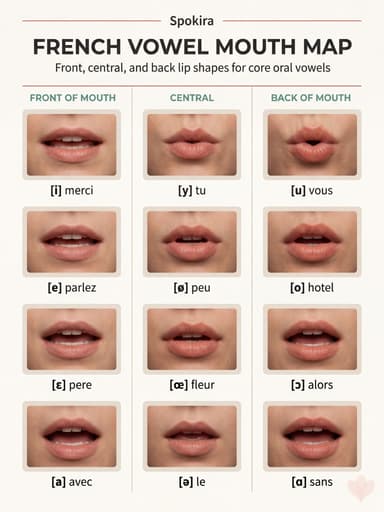
French uses vowels such as:
uas intueuas indeuxorpeur
These combine a front tongue position with rounded lips. English speakers usually want to separate those jobs:
- front tongue with unrounded lips
- rounded lips with a back tongue position
French asks for both at once.
That is why u often gets replaced with ou, and eu often turns into a vague English uh.
In the modern standard French inventory, these front-rounded vowels are core categories, not optional details (Cambridge JIPA, "French").
If this is your biggest issue, use French U vs OU pronunciation practice before trying to fix everything else.
2. French nasal vowels are built into the vowel itself
English speakers often treat French nasal spellings as "vowel plus n." French often treats them as nasal vowels.
That means:
bonis not justboplus a strongnpainis not an English-style "pan" with a French accent
The vowel itself carries the nasal quality.
This difference matters because learners often add an extra final consonant even when they know the spelling rule. The mouth habit is still English.
If you want a focused correction loop, use Nasal vowels French practice.
3. The French R and the English R come from different places
English r is usually made toward the front of the mouth. Standard French r is usually uvular, produced farther back with friction.
That means the two sounds are not small accent variants of one another. They are different articulatory gestures.
Why this matters:
- the French
rappears in basic words constantly - the wrong
rmakes speech sound strongly English - the contrast remains noticeable even when grammar is correct
If your r is still unstable, use French R sound practice: mouth position cues + daily drill.
If you want one page that maps the physical cues behind r, front-rounded vowels, nasal vowels, and liaison timing, use French pronunciation mouth position cues for the sounds English speakers miss.
French sounds vs English in connected speech
At the sentence level, the gap between French sounds vs English gets larger, not smaller.
Why:
- English tolerates stronger word boundaries
- French expects more carry-through across phrases
- English stress can hide imprecise vowels
- French exposes unstable vowels more quickly
That is why many learners sound acceptable in isolated words and much weaker in full sentences.
4. French rhythm is more even across syllables
English often relies on larger stress contrasts and stronger reductions. French tends to distribute energy more evenly and organize speech in smoother phrase groups.
This means English speakers often:
- hit one word too hard
- reduce surrounding syllables too much
- create an English beat pattern inside a French sentence
The sentence may be "correct," but the rhythm still sounds foreign.
This is one reason pronunciation improves slowly if you practice only word lists. French is a phrase-level language as much as a sound-level one.
5. French links words more aggressively in connected speech
This may be the most important sentence-level difference in French sounds vs English.
In French, everyday speech relies on:
- liaison
- enchainement
- elision
The University of Texas phonetics lessons explain how French syllables and liaison encourage smoother consonant-vowel chaining in connected speech (UT Austin, syllables; UT Austin, liaison).
If you need a neutral symbol reference while reading these comparisons, use the International Phonetic Alphabet chart.
English learners often pause or release consonants too strongly at word edges. French expects more flow across those boundaries.
That is why a learner can pronounce les and amis fine separately and still sound unnatural in les amis.
If your speech sounds word-by-word, use French pronunciation rules that matter for speaking clarity.
6. French spelling pushes you toward the wrong output in different ways than English
English spelling is famous for inconsistency. French spelling is not simple either, but the problem is different.
French often keeps written letters that do not surface in the same way in speech:
- silent final consonants
- digraphs and trigraphs that compress into one sound
- vowel spellings that are broader than the sound system suggests
So the challenge is not only "French spelling is hard." The challenge is that spelling often encourages overpronunciation if you read too literally.
That is why many learners sound textbook-correct in slow reading and less natural in live conversation.
7. French vowels stay tighter and more stable than many English vowels
English has many diphthong-like movements inside vowels. French vowels are often perceived as steadier targets.
That creates a subtle but important difference:
- English lets you glide through some vowel space
- French asks you to land and hold a cleaner target
This is why French can feel "tense" or "precise" in the mouth. Learners often need more lip control and more exact tongue placement than they expect.
The upside is that once you lock the target, the sound becomes more repeatable.
Practical Takeaway
The biggest French-vs-English differences are not just new sounds. They are new habits: lip rounding, nasal airflow, uvular friction, smoother linking, and more even phrase rhythm.
Which French sounds vs English differences matter most for clarity?
Not every French-vs-English difference deserves equal practice time.
If you want the fastest clarity gains, prioritize:
uvsou- nasal vowels
- French
r - liaison and phrase linking
- rhythm and intonation
Those five usually create a larger improvement than chasing tiny accent details.
French sounds vs English in daily conversation
This comparison becomes most useful when you move from single words to live speaking.
Example: what changes inside one simple phrase
Take a phrase like tu as un rendez-vous.
An English-speaking learner may:
- flatten
tutowardtoo - over-separate
as - add too much force to
rendez-vous - miss the smoother phrase-level flow
A stronger French version keeps:
- rounded lips on
tu - lighter word boundaries
- steadier vowel targets
- more continuous phrase rhythm
None of that requires native-level polish. It requires noticing which English habits are still in control.
A better way to compare
When you study French sounds vs English, compare at three levels:
- isolated sound
- word
- short phrase
If you only compare isolated sounds, you will miss the timing problem. If you only compare full sentences, you may miss the exact sound causing the breakdown. You need both.
If you want the broader coaching overview after this comparison, French pronunciation for English speakers connects these differences to a full training path.
A simple training plan based on the comparison
Here is a better use of the French-vs-English comparison than just memorizing facts.
Day 1 to 7: one contrast only
Pick one of these:
uvsou- one nasal family
- French
r
Do 5 minutes daily.
Day 8 to 14: add one phrase-level feature
Pick one:
- mandatory liaison
- smoother syllable chaining
- statement/question intonation contrast
Keep your original contrast.
Day 15 onward: practice in real chunks
Use one dialogue and repeat:
- listen
- shadow
- record
- compare
- repeat
That is how the sound comparison starts changing your actual speech.
If you want feedback instead of self-diagnosing everything, Spokira's speaking practice app is built around this exact progression.
A weekly practice split based on French sounds vs English
Here is a simple schedule built from the comparison:
Monday and Tuesday
- one vowel contrast
- 5 to 8 minutes of minimal pairs
- one recorded sentence
Wednesday and Thursday
- one consonant or nasal target
- 5 minutes of slow-to-normal reps
- one no-text recall round
Friday
- one connected-speech feature
- liaison, enchainement, or phrase rhythm
- one short dialogue loop
Weekend
- replay your recordings
- note the two English habits that keep returning
- choose next week's focus
That keeps the French-vs-English comparison practical. You are not just learning what is different. You are turning those differences into a repeatable practice system.
How to hear French sounds vs English differences faster
Some learners understand the comparison on paper but still struggle to hear it in audio. That is normal. Perception usually sharpens after repeated contrast exposure, not before it.
Use this sequence:
- listen to a minimal pair
- decide which word you heard
- check the answer
- repeat the same pair immediately
- say both words yourself
That matters because hearing and producing reinforce each other. Once your ear starts separating the categories more clearly, your mouth has a better chance of holding the French target instead of falling back into English defaults.
Three listening questions to ask yourself
- Did I hear one vowel or a glide inside the sound?
- Did the word end cleanly or with an extra English-style consonant release?
- Did the phrase move smoothly across word boundaries or stop too hard between words?
Those questions make the French-vs-English comparison concrete. You stop listening for "accent" in a vague way and start listening for a small set of repeatable differences.
Do you need to master every French-vs-English difference at once?
No. That approach usually slows learners down.
What works better is sequencing:
- one sound contrast first
- one sentence-level habit second
- one short dialogue for transfer
If you do that, the comparison stops being overwhelming. You are no longer trying to fix "French pronunciation" as one giant problem. You are fixing one English carryover habit at a time.
Which French-vs-English differences matter least at the start?
Not everything deserves equal attention in week one.
You can usually delay:
- minor regional accent distinctions
- low-frequency vowel subtleties you do not use yet
- fine stylistic prosody details after the sentence is already clear
That does not mean those details are unimportant forever. It means they are lower ROI than u vs ou, nasal vowels, the French r, and connected speech.
This prioritization is what keeps the French sounds vs English comparison useful instead of overwhelming.
If you keep that order, you will usually sound clearer faster than learners who spread attention across ten tiny pronunciation details at once.
Turn Sound Differences Into Better Speech
Spokira helps you practice the French sound contrasts and connected-speech habits that English speakers usually miss.
Final answer: French sounds vs English
The biggest differences are not just "French has different vowels." The real changes are:
- front-rounded vowels
- nasal vowels
- a different
r - steadier vowels
- smoother linking across words
- more even phrase rhythm
- spelling habits that mislead learners in different ways
Once you understand those seven shifts, French pronunciation stops feeling random. It becomes a map: different targets, different timing, different linking. That is much easier to train than the vague idea that your accent is "just bad."