If your French sounds clear in drills but shaky in conversation, the issue is often physical, not intellectual. You may know the rule, but your mouth still moves like English.
That is why french pronunciation mouth position cues matter. They give you body-level anchors you can repeat under pressure. Instead of "try to sound more French," you get cues you can feel: where the tongue sits, what lips do, where airflow goes, and how much tension is allowed.
In this guide, you will get:
- The four sound families English speakers miss most
- Exact mouth-position cues for each family
- A transfer sequence from isolated sounds to live sentences
- A 14-day plan to make cues automatic
Core references in this article were web-verified on March 10, 2026, including UT Austin phonetics lessons on syllables/final consonants and liaison, the Académie française liaison framework, CEFR Companion volume resources, and L2 phonetic-training evidence from PubMed.
If you want the full sound map first, start with French Pronunciation for English Speakers. Then use this article as your execution layer.
Quick answer: which french pronunciation mouth position cues should you learn first?
Start with cues for these four categories:
- Uvular
Rplacement (back-of-mouth friction with low neck tension) - Front rounded vowels (
u/oucontrast stability) - Nasal vowel oral-nasal balance (
an/en/on/infamilies) - Linking and flow cues (liaison + CV syllable rhythm)
Why this order works:
- UT Austin's French phonetics lesson on syllables explains how spoken French favors consonant-vowel flow and how liaison/elision support connected rhythm, which directly affects intelligibility in continuous speech (UT Austin, les syllabes).
- UT Austin's liaison chapter and the Académie française both separate required, optional, and forbidden liaison contexts, giving concrete environments you can rehearse physically instead of guessing in real time (UT Austin, la liaison; Académie française).
- A 2025 meta-analysis of 65 studies (2,793 learners) reported a large overall effect for L2 phonetic training (
d = 0.762), which supports structured practice over random repetition (Yao et al., 2025). - Evidence on distributed practice supports short daily spacing over occasional long blocks (Cepeda et al., 2006).
One Rule for Faster Progress
Do not chase ten sounds at once. Pick one cue family for 7-14 days, then re-measure.
Why English-speaker pronunciation errors are mostly motor-pattern errors
Many learners think they have a hearing problem. Sometimes they do, but often the bottleneck is motor habit.
English has its own default settings:
- heavier word-final closures,
- stronger stress contrast,
- different tongue posture for
rand front vowels, - more diphthong drift in vowels.
French needs different settings. If you keep English defaults, you may still be understood, but your speech will sound clipped, unstable, or inconsistent across speed levels.
The practical implication is simple: treat pronunciation as physical training. Your ears guide the target, but your mouth training creates reliability.
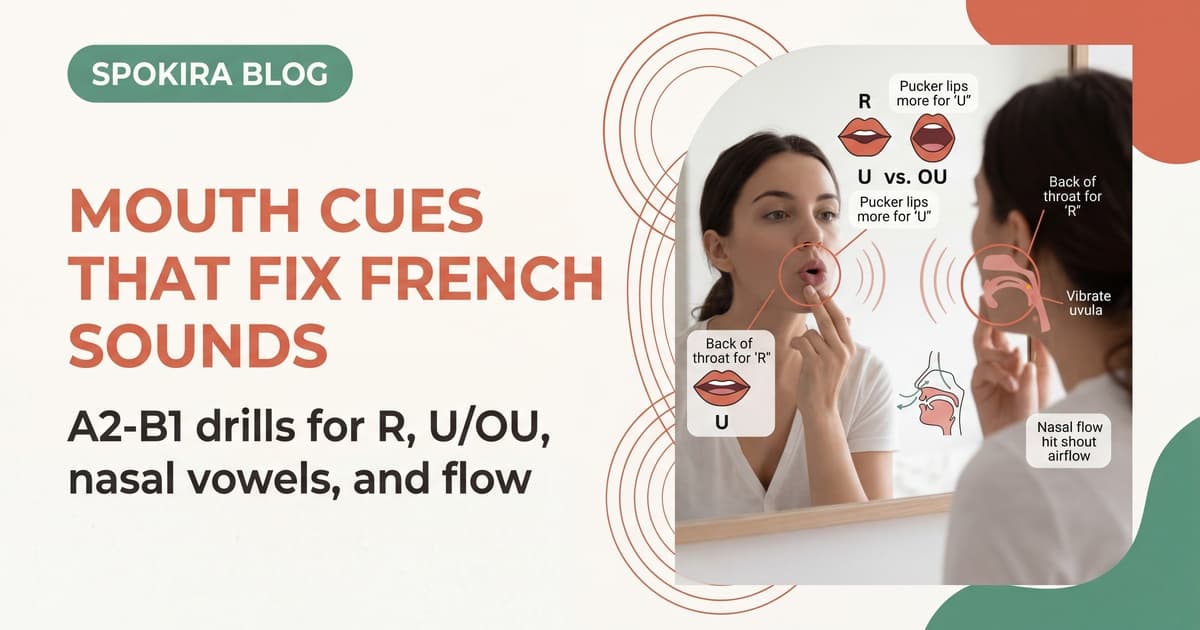
Cue family 1: french R that stays stable in real speech
For many English speakers, French R breaks first under pressure. The fix is not "harder throat." The fix is controlled constriction plus relaxed airflow.
Mouth-position cue
Use this sequence:
- Let the back of the tongue lift slightly toward the uvular area.
- Keep jaw and neck relaxed.
- Send steady air through a narrow back channel.
- Add voice lightly only after placement is stable.
What you should feel:
- soft friction behind the oral cavity,
- no squeezing at the larynx,
- no explosive cough-like release.
What usually goes wrong:
- over-tension in neck muscles,
- forcing volume instead of placement,
- practicing only isolated
Rand never transferring to words.
For a full routine, use French R sound practice: mouth position cues + daily drill.
3-minute stabilization loop
- 30 sec: voiceless friction (
hhh-like back friction, low volume) - 60 sec:
ra re ri ro ruat slow pace - 60 sec: high-frequency words (
merci,train,prendre,rue) - 30 sec: one short sentence at natural speed
Repeat once. Stop when quality drops.
Cue family 2: u vs ou without English vowel drift
English speakers often collapse French u and ou because lip and tongue cues split across two gestures that feel unnatural together.
Mouth-position cue for u
- Lips: rounded and forward, but not protruded aggressively
- Tongue: high and front-ish inside the oral cavity
- Jaw: small opening, stable
Mouth-position cue for ou
- Lips: rounded, but generally less tight than forced
u - Tongue: high and back compared with
u - Jaw: similarly compact
The key is keeping each vowel monophthongal. Do not let an English glide sneak in at the end.
You can train this contrast with French U vs OU pronunciation practice.
Fast mirror drill
- Say
ufive times slowly, watching lip shape stay constant. - Say
oufive times slowly with the same stability. - Alternate
u-ou-u-oufor 20 seconds. - Move into words and one sentence immediately.
If contrast disappears in sentences, go back one step and reduce speed.
Cue family 3: nasal vowels without over-nasalizing everything
Nasal vowels feel hard because English has less systematic oral-nasal contrast at the phonemic level. Learners either denasalize too much or send too much resonance into the nose across the whole phrase.
Mouth-position cue
- Keep oral space active (do not collapse the mouth cavity).
- Allow controlled nasal resonance for the target vowel only.
- Release cleanly into following consonants/vowels.
For many learners, a useful check is "buzz in the right place, not everywhere." If every neighboring sound starts sounding nasal, your timing is too broad.
Train with Nasal vowels French practice: AN/EN/ON/IN.
Minimal-pair transfer ladder
- 60 sec: isolated contrasts
- 60 sec: words in pairs
- 60 sec: short chunks
- 60 sec: one prompt sentence repeated with two lexical variations
Do not leave the contrast in word-list mode. Sentence transfer is mandatory.
Cue family 4: liaison and syllable flow as physical timing cues
Even good segmental sounds can fail if you keep English stop-start timing. French often sounds clearer when consonant-vowel linking and rhythm grouping are controlled.
UT Austin's liaison lesson lists required/optional/forbidden environments, and the Académie's summary confirms the same categories. These are not just grammar notes. They are movement instructions for timing (UT Austin liaison; Académie française).
UT Austin's syllable chapter also shows why CV flow matters for French connected speech (UT Austin syllables).
Mouth-timing cue
Think in linked groups, not isolated words:
les_amisils_onttrès_utile
Physical targets:
- lighter final closures,
- earlier transition into next vowel onset,
- fewer micro-pauses after function words.
For intonation and pacing integration, pair with Sound more natural fast: rhythm and intonation practice.
How to train french pronunciation mouth position cues so they transfer
Most learners fail at transfer because practice stays too "clean." Real speech adds retrieval load, timing pressure, and decision noise.
Use this sequence in every session:
- Isolated sound (20-40 sec)
- Syllable sets (40-60 sec)
- Word reps (60-90 sec)
- 3-5 word chunks (90 sec)
- Timed no-text sentence (2 min)
- Prompt variation (1-2 min)
That sequence bridges control to communication.
If freezing interrupts transfer, use Stop freezing mid-sentence drill patterns before returning to sound work.
14-day plan for french pronunciation mouth position cues
Run one 12-minute session daily with one primary cue family.
| Days | Primary cue focus | Transfer target |
|---|---|---|
| 1-3 | R placement or u/ou contrast | 6 high-frequency words + 2 short sentences |
| 4-6 | Same cue under faster tempo | 20-second roleplay with no full restarts |
| 7-10 | Add liaison timing in phrase chains | 8 scripted chunks with clean links |
| 11-14 | Free-response integration | 60-second response to one prompt |
Daily template:
- Minute 1-2: cue setup + mirror check
- Minute 3-5: sound and syllable reps
- Minute 6-8: words and chunk chains
- Minute 9-10: timed no-text response
- Minute 11-12: before/after recording + score
This plan aligns with evidence that structured phonetic training and spacing improve outcomes over ad-hoc repetition (Yao et al., 2025; Cepeda et al., 2006).
How to score progress without guessing
Use a simple 0-2 score per category:
- cue accuracy (did the mouth posture match target?)
- sound stability (did it hold under speed?)
- flow continuity (did rhythm break?)
- recovery quality (did you recover after one miss?)
Total out of 8.
Interpretation:
- 0-3: stay with current cue family
- 4-6: keep cue, increase retrieval pressure
- 7-8: maintain for two sessions, then add second cue family
If your score rises but conversation still feels brittle, your weak point is usually flow. Revisit French pronunciation rules for speaking clarity and French sounds vs English for recalibration.
Common mistakes with french pronunciation mouth position cues
Mistake 1: changing cues every day
Switching cues too often prevents motor consolidation. Keep one cue family for at least one week.
Mistake 2: over-focusing on sound aesthetics
At A2-B1, target intelligibility and consistency first. The CEFR Companion volume materials emphasize communicative control and phonological intelligibility rather than accent perfection as the core trajectory for learners (Council of Europe CEFR resources).
Mistake 3: drilling without recording
Without recordings, perceived progress is unreliable. Use Record yourself in French without cringing to keep feedback objective.
Mistake 4: staying in word lists
Word lists are setup, not destination. Transfer to chunks and prompts in the same session.
Mistake 5: trying to fix all pronunciation issues at once
Layering too many corrections increases cognitive load and reduces carryover to conversation.
3 speaking scenarios to apply mouth-position cues immediately
You do not need advanced dialogues to transfer this work. Use short, repeatable scenarios where the same sound targets appear often.
Scenario 1: cafe order with R plus liaison
Practice lines:
Bonjour, je voudrais un cafe et un croissant.Vous avez une table pres de la fenetre?Je prends le cafe ici, merci.
Targets:
- keep
Rstable invoudrais,croissant,prendre - link required liaison points like
vous_avez - let statements land and questions rise
Scenario 2: directions with u/ou contrast under speed
Practice lines:
Ou est la rue du Louvre?Vous pouvez me montrer le chemin?Merci beaucoup, je continue tout droit.
Targets:
- maintain
uandoucontrast when speaking faster - avoid English-style diphthong glide
- keep phrase flow in short breath groups
Scenario 3: small talk with nasal vowels
Practice lines:
On prend un train demain matin?Non, on attend un ami.On confirme le plan ce soir.
Targets:
- controlled nasal resonance on target vowels only
- clean oral transitions between words
- no full sentence restart after one miss
Run each scenario for three days before switching. Repetition with stable cues builds automaticity faster than daily novelty.
FAQ: how should beginners use french pronunciation mouth position cues?
Beginners should treat french pronunciation mouth position cues as a narrow, repeatable system, not a giant syllabus. Start with one cue family and one daily speaking context. If you are unsure where to begin, use this order:
Rplacement if your speech sounds blocked or harshu/oucontrast if listeners mix up high-frequency words- nasal vowels if words blur in connected speech
- liaison timing if your delivery sounds choppy
The mistake beginners make is trying to learn all french pronunciation mouth position cues in one week. That usually creates confusion and inconsistent output. Instead, pick one cue, then run a short cycle:
- 2 minutes setup
- 4 minutes controlled reps
- 4 minutes chunk and sentence transfer
- 2 minutes recording and scoring
When this cycle feels easy for three sessions in a row, add one new cue. Keep the previous cue active so you do not lose it under load.
If you are studying without a tutor, use one fixed prompt per week and compare day 1 vs day 7 recordings. This gives you objective evidence that french pronunciation mouth position cues are transferring to real speech.
FAQ: how long before french pronunciation mouth position cues feel automatic?
Most learners notice the first stability gains in 7-14 days if practice is daily and specific. Full automaticity takes longer because conversation adds retrieval pressure, emotion, and speed variation.
A practical benchmark:
- Week 1: fewer obvious articulatory misses in drills
- Week 2: cleaner carryover to short scripted sentences
- Week 3+: better stability in free responses and roleplay
If progress stalls, do not switch to a brand-new method immediately. Audit the basics first:
- Are you practicing french pronunciation mouth position cues daily?
- Are you recording before and after each session?
- Are you moving from isolated reps into timed no-text production?
- Are you keeping one cue family long enough to consolidate?
When those checks are in place, gains usually resume. If not, get targeted feedback with French Pronunciation App and apply corrections during the same session. Immediate correction plus repetition is what makes french pronunciation mouth position cues stick.
Want Guided Pronunciation Feedback?
Practice mouth-position cues for French sounds with short drills, recording loops, and AI feedback designed for speaking clarity.
What to do next
If you want fast gains, keep this sequence:
- Pick one cue family (
R,u/ou, nasal vowels, or liaison timing) - Train 12 minutes daily for 14 days
- Score the same four categories each session
- Increase pressure only after stability appears
Then connect your cue work to real speaking with French Pronunciation App and Practice Speaking French App.
Small physical cues, repeated consistently, outperform big theory notes that never reach your mouth in live conversation.