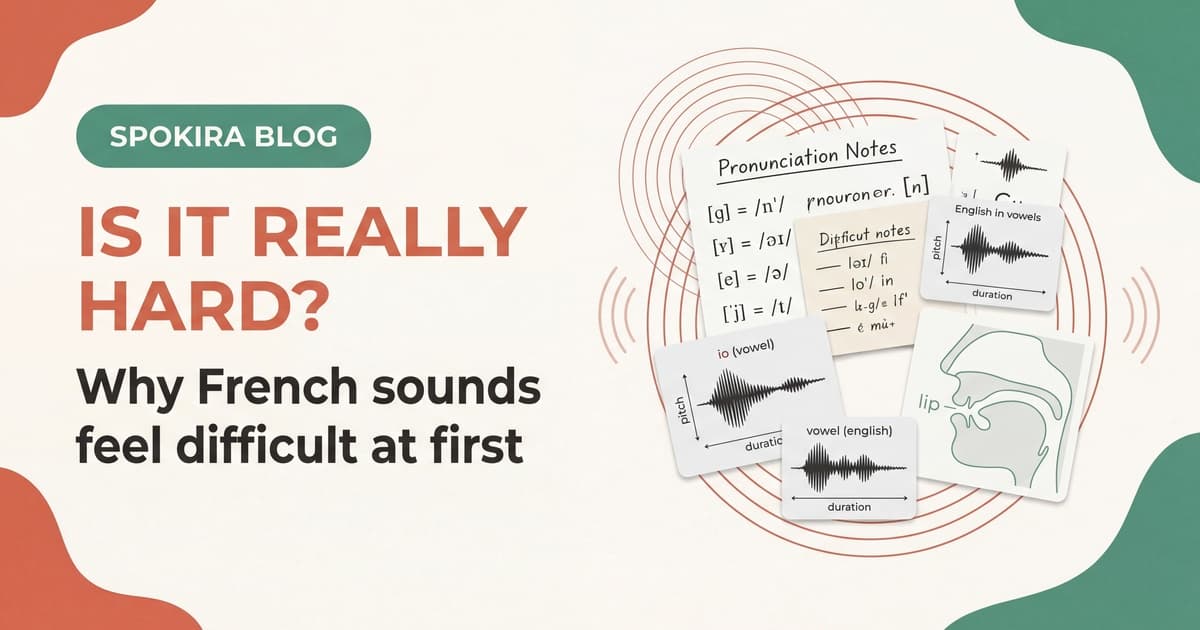
If you are asking is French pronunciation hard, the honest answer is: it often feels hard for English speakers at the beginning, but not for the reason people usually assume.
French is not impossible, mysterious, or inherently harder than every other language. The real issue is that French asks your mouth and ears to do a few things English does not train well: front-rounded vowels, nasal vowels, a uvular r, smoother word-linking, and more even rhythm. Those features show up in high-frequency words, so you notice the difficulty early.
That also means the problem is trainable. A 2025 meta-analysis of 65 pronunciation-training studies found a large overall benefit for targeted pronunciation instruction compared with control conditions (Yao et al., 2025).
So the short answer is:
Short Answer
French pronunciation is hard at first for many English speakers because the sound system and speaking rhythm differ in a few high-impact ways. It becomes much easier once you train those specific contrasts instead of trying to fix everything at once.
If you want the complete sound map after this article, start with French pronunciation for English speakers. Here, the goal is to explain what feels hard and how to reduce that difficulty fast.
This article is about difficulty and training order, not a full rules catalog. If you want the rule-by-rule clarity guide, use French pronunciation rules that matter for speaking clarity as the companion page rather than the substitute.
Is French pronunciation hard in practice? The short answer
For most English-speaking learners, French pronunciation is hard in three places first:
| Problem | Why it feels hard | What usually fixes it fastest |
|---|---|---|
| Unfamiliar sounds | English does not prepare your mouth for u, nasal vowels, or the French r | Focused contrast drills |
| Connected speech | Real French links words more than textbook reading suggests | Chunk shadowing and liaison reps |
| Rhythm | English stress habits make French sound choppy | Sentence-level repetition with recordings |
That is why the right answer is not "French pronunciation is hard, period." The better answer is "French pronunciation is hard in a few predictable places, and those places are trainable."
Why French pronunciation feels hard
French pronunciation usually feels hard for five concrete reasons.
- French has sounds English speakers do not already own.
- French connects words differently in real speech.
- French rhythm is flatter and more syllable-driven than English.
- French spelling hides some of the sounds that disappear.
- Learners often practice reading rules before they practice speaking.
Each one matters, but not equally. The biggest jump in clarity usually comes from the first three.
Is French pronunciation hard or just unfamiliar?
Usually it is both, but "unfamiliar" is the more useful diagnosis.
When learners say French pronunciation is hard, they often mean one of three things:
- the sounds do not match English categories
- the sentence flow feels slippery
- they cannot keep good pronunciation once they start thinking about meaning
That matters because each problem needs a different fix. A sound contrast needs repetition. A rhythm problem needs phrase work. A pressure problem needs short recall drills.
That is also why this article should stay separate from the rules-focused page. This page answers why French feels hard. The other page answers which speaking rules matter most once you are ready to train them deliberately.
1. French has a few high-impact sounds English speakers do not have
This is the most obvious problem. The modern standard French system includes front-rounded vowels, nasal vowels, and a uvular r that do not line up neatly with English categories (Cambridge JIPA, "French").
That creates predictable trouble spots:
uvsoueuvowels- nasal vowels like
bon,pain, andun - the French
r
If your first language does not already use those categories, your ear tends to group them into the nearest English sound. Then your mouth reproduces the wrong category under pressure.
That is why French pronunciation can feel hard even when you understand the rule intellectually. Knowing that tu and tout are different is not the same as hearing and producing the contrast automatically.
2. French connected speech is less word-by-word than many learners expect
Many English speakers start French by reading individual words carefully. But spoken French is not just a chain of isolated dictionary forms.
French uses linking and flow patterns such as:
- liaison
- enchainement
- elision
- smoother consonant-vowel transitions
The University of Texas French phonetics materials explain how syllable structure and liaison shape connected speech, not just individual words (UT Austin, syllables; UT Austin, liaison).
This matters because many learners think:
- "I know the words."
- "I know the grammar."
- "Why do I still sound broken?"
Often the answer is not one bad consonant. It is that each word is being pronounced separately with English-style stop-start timing.
If this is your pattern, use French pronunciation rules that matter for speaking clarity and French rhythm and intonation practice.
3. French rhythm is different from English rhythm
English uses stronger stress patterns and larger reductions across syllables. French is not stressless, but it is often taught and heard as more syllable-driven and more even in timing than English.
That creates two common learner problems:
- too much force on one lexical word in each phrase
- too many small pauses between short function words and content words
The result sounds choppy even if individual sounds are mostly correct.
This is also why French pronunciation can feel "harder in sentences than in drills." In drills, you can manage one sound. In phrases, you must keep the right sound, the right linking, and the right rhythm at the same time.
4. Spelling can mislead you
French spelling is not random, but it is not transparent if you learned to trust English spelling habits.
Learners often overpronounce:
- silent final consonants
- written vowels that reduce into one sound
- letter combinations that map to one phoneme
That means French can feel hard partly because the page keeps pushing you toward a sound sequence you should not say.
This is why reading more does not automatically fix pronunciation. You need speaking reps that override spelling-based habits.
If silent endings and textbook-sounding speech are still a problem, use 5 French accent errors that block clarity.
If the bottleneck is one sound rather than overall timing, work through French R sound practice: mouth position cues + daily drill or Nasal vowels French practice before coming back to full-sentence work.
5. Many learners are practicing the wrong thing
This is the part most people miss.
French pronunciation does not improve fastest through:
- memorizing IPA charts without speaking
- reading grammar examples silently
- repeating isolated words once or twice
- waiting for listening exposure to "fix it naturally"
It improves fastest when you do four things together:
- focus on one contrast at a time
- repeat it daily in short sessions
- use phrase-level audio, not only word lists
- record yourself and compare
The CEFR Companion Volume frames phonological development around intelligibility and control in connected speech, not around sounding perfectly native (Council of Europe, 2020).
That is a useful lens. The goal is not "erase your accent by next week." The goal is "be easier to understand and more stable under pressure."
What makes French pronunciation hard for beginners specifically?
Beginners often assume the hard part is memorizing more rules. In practice, the hard part is usually automation.
You may already know that:
- final consonants are often silent
uis notou- some written
nletters should not be pronounced fully - liaison changes how phrases sound
But when you speak in real time, English habits take over. That is normal.
The beginner version of the problem usually looks like this:
- you read the word correctly in theory
- you start the sentence
- cognitive load rises
- your mouth returns to English defaults
That is why pronunciation training has to move from rule knowledge to timed repetition.
Is French pronunciation hard forever? No
This matters because many learners confuse "hard now" with "hard permanently."
French pronunciation usually stops feeling globally hard once you can do three things consistently:
- hear your main contrast errors
- reproduce them in short phrases
- keep them stable under light speaking pressure
At that point, the problem shrinks. You no longer feel that every French word is dangerous. You know where the risk zones are.
A useful mindset shift
Instead of asking:
- "Why is all French pronunciation so hard?"
Ask:
- "Which 2 or 3 features are making French pronunciation hard for me right now?"
That turns the problem into training instead of frustration.
A 10-minute routine when French pronunciation feels hard
If you want one simple drill block, use this:
- pick one target sound or one linking pattern
- listen to one short native phrase
- shadow it five times
- say it without text
- record one take
- compare and fix only one thing
This works because it combines perception, production, and retrieval in one loop.
Example 10-minute split
- 2 minutes: hear the contrast
- 3 minutes: repeat isolated words
- 3 minutes: repeat one sentence
- 2 minutes: record and compare
That is enough to make French pronunciation feel less abstract and more controllable.
What to expect after two weeks
If you stay consistent for two weeks, do not expect a native accent. Expect something more useful:
- fewer collapses under pressure
- clearer awareness of your error pattern
- more confidence starting sentences aloud
That is usually the point where French pronunciation stops feeling generically hard and starts feeling measurable.
Is French pronunciation harder than Spanish or Italian?
Usually, learners asking this are really asking whether French is harder to pronounce from spelling and whether it has more unfamiliar sounds.
For English speakers, French often feels harder than Spanish or Italian because:
- spelling-to-sound mapping feels less transparent at first
- nasal vowels and front-rounded vowels are less familiar
- connected speech creates larger gaps between citation form and real speech
That said, difficulty depends on your background. A learner who already speaks a language with nasal vowels or front-rounded vowels may find a different part easy and a different part hard.
So the clean answer is not "French pronunciation is objectively hard." It is:
- French pronunciation is selectively hard for English speakers
- the hard parts are concentrated in a manageable set of features
What is actually hard in daily conversation?
From a coaching perspective, these are the pain points that show up most:
You can say the sound in isolation, but not inside a sentence
That is a transfer problem. You need phrase reps, not more theory.
You can hear your teacher, but not your own error
That is a perception problem. You need tighter contrast drills and recordings.
You sound accurate when slow, but everything collapses when you speed up
That is an automation problem. You need timed practice and repeated chunking.
You know the rule, but spelling keeps winning
That is a decoding habit problem. You need more listen-repeat-record cycles and less text dependency.
None of these means you are bad at French. They are normal stages in pronunciation training.
How to make French pronunciation feel easier fast
If French currently feels hard, simplify your plan.
Week 1: fix one sound contrast
Pick one:
uvsou- nasal vowels
- French
r
Train it for 5 to 8 minutes per day only.
Week 2: add one connected-speech rule
Pick one:
- mandatory liaison in common phrases
- smoother syllable chaining
- statement vs question intonation
Keep the same contrast from week 1.
Week 3: run sentence-level reps
Use one short dialogue and repeat it daily:
- slow read
- normal shadow
- no-text recall
- record and compare
This is where pronunciation starts to feel less fragile.
Week 4: use feedback instead of guessing
At this stage, outside feedback matters. Self-correction helps, but it misses the sounds you still cannot hear clearly.
That is exactly where a speaking-first tool like our French speaking practice app becomes useful.
Make French Pronunciation Feel Easier
Use short speaking reps with feedback instead of random repetition. Spokira helps you train the sounds and rhythm that matter most.
Final answer: is French pronunciation hard?
Yes, French pronunciation is hard at first for many English speakers, but it is hard in a very specific and trainable way.
The main difficulty is not the total number of sounds. It is the combination of:
- unfamiliar vowel categories
- the French
r - nasal vowels
- liaison and connected speech
- more even phrase rhythm
Once you isolate those features and train them in short speaking loops, French usually stops feeling "globally hard" and starts feeling like a set of solvable problems.
That is the mindset shift that actually improves pronunciation.