If you search how many sounds in French, you will quickly notice that different sources give different totals. That is not because anyone is being sloppy. It is because "sound" can mean different things: letters, phonemes, vowels only, or the set used by one specific accent.
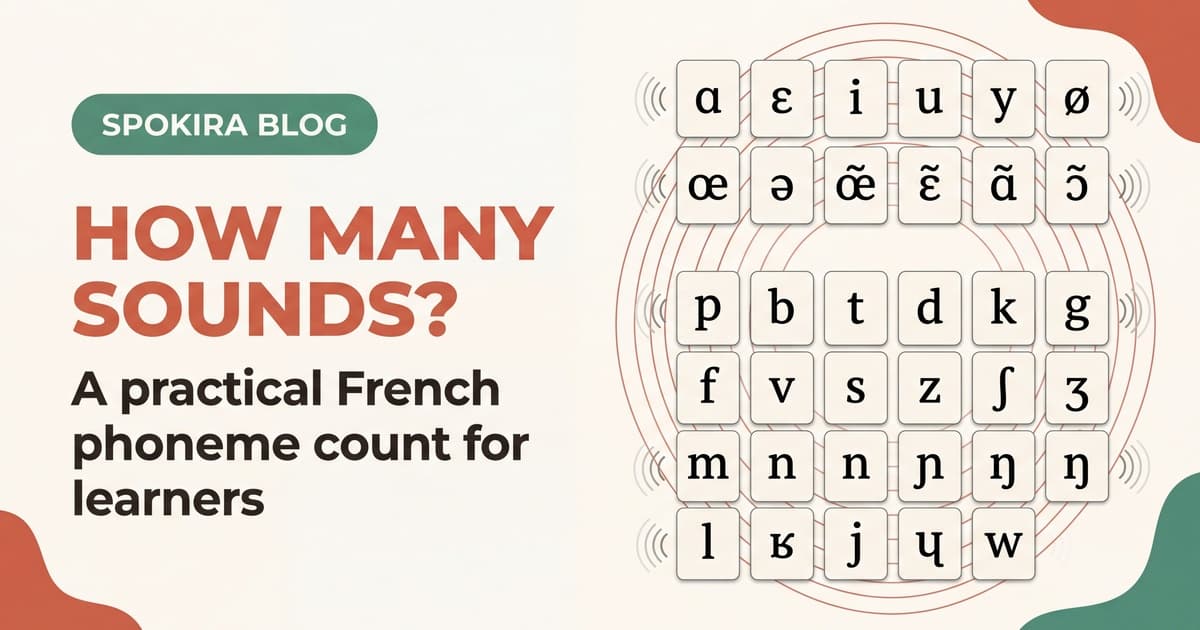
The practical learner answer is this: standard French is usually described with about 35 distinct sounds, give or take a few depending on accent and what you count separately. A modern Parisian inventory in the Journal of the International Phonetic Association lists 11 oral vowels, 3 nasal vowels for that speaker, 17 core consonants, and 3 glides, while also noting marginal or changing contrasts in the system (Cambridge JIPA, "French"). Traditional learner descriptions often add a fourth nasal vowel, which is why you may also see slightly higher totals.
So if you want the short version:
Quick Answer
For learners, French has about 35 sounds to control in standard pronunciation. Depending on accent and analysis, you will also see counts around 34 to 37.
This article breaks down where that number comes from, why different totals appear online, and which sounds matter most if your goal is clearer speech rather than phonetics trivia.
If you want the full sound-by-sound training guide after this overview, use French Pronunciation for English Speakers. If your main problem is connected speech rather than isolated sounds, pair this article with French pronunciation rules that matter for speaking clarity.
First: letters are not sounds
The biggest source of confusion is that the French alphabet has 26 letters, but the spoken language uses more sound categories than that. One letter can represent different sounds, and several letters together can represent one sound.
Examples:
ouusually represents one vowel sound, not two.eauinbeaualso represents one vowel sound.- final consonants are often written but not pronounced.
chrepresents one consonant sound.
That is why phonetics uses the International Phonetic Alphabet: it tracks speech sounds directly instead of spelling.
When linguists answer "how many sounds are in French," they are usually talking about phonemes, meaning the contrastive sound categories that can change meaning.
How many sounds in French are there in standard speech?
For learners, the cleanest way to think about the system is in four groups:
- Oral vowels
- Nasal vowels
- Consonants
- Glides or semivowels
1. Oral vowels
Modern standard French is commonly described with 11 oral vowels in broad learner-oriented inventories. These include high vowels like i, u, ou, front rounded vowels like u and eu, and mid/open contrasts that matter for words such as été, mère, peu, and peur.
Why learners care:
- French vowels are more stable than English vowels.
- lip rounding matters more than many English speakers expect.
- a small difference in tongue position can create a different word.
That is why contrasts such as u vs ou matter so much. If that pair still collapses in your speech, go straight to French U vs OU pronunciation practice.
2. Nasal vowels
This is where counts start to vary.
Many learner resources teach 4 nasal vowels:
an/enonin/ainun
But the modern Parisian illustration in Cambridge's IPA journal describes 3 nasal vowels for that speaker, reflecting a real merger in contemporary speech for many speakers (Cambridge JIPA, "French").
That means both of these statements can be true:
- traditional French teaching often counts 4 nasal vowels
- some modern standard inventories effectively work with 3 for many speakers
For learners, the safest takeaway is not to obsess over the abstract number. Focus on whether you can hear and produce the contrasts that still matter in the speech you are targeting. If nasal vowels are your main blocker, use Nasal vowels French practice: AN/EN/ON/IN.
3. Consonants
Standard French is often described with about 17 core consonants, with some extra marginal cases in loanwords or specific accents.
For example:
- the French
ris usually uvular, not the Englishr gnrepresents the palatal nasal in words likemontagne/ŋ/appears mainly in loanwords and is often treated as marginal
That is why you may see a count of 17 core consonants in one source and a slightly higher number elsewhere.
The most important consonant difference for many English speakers is the French r. If that sound is still unstable, use French R sound practice: mouth position cues + daily drill.
4. Glides or semivowels
French also uses 3 glides:
jas infilleorhierwas inouiɥas inhuit
Some learner explanations fold these into the vowel system. Others count them separately. That alone can change the final total you see online.
So when someone says French has 32, 35, or 37 sounds, they may simply be using different counting rules.
| Category | Common learner count | Why the number can change |
|---|---|---|
| Oral vowels | 11 | Some analyses split or merge mid-vowel contrasts differently |
| Nasal vowels | 3 to 4 | Modern mergers reduce one traditional contrast for many speakers |
| Core consonants | About 17 | Marginal loanword consonants may or may not be counted |
| Glides | 3 | Some sources count them separately, others fold them into the vowel system |
| Practical learner total | About 35 | Different accents and counting rules shift the final total slightly |
Why do "how many sounds in French" answers differ online?
If you have seen conflicting answers, these are the usual reasons.
They are counting different accents
French is not pronounced exactly the same everywhere. Metropolitan standard French, Quebec French, Swiss French, Belgian French, and regional accents can preserve or merge different contrasts.
If a source uses a Parisian speaker as its reference point, it may show fewer vowel distinctions than a more traditional textbook count.
They are mixing phonemes and spelling patterns
Some articles say "French has more than 30 sounds" but then list letter combinations like eau, ou, oi, or gn as if they were all separate phonemes. That is not the same thing.
Letter patterns matter for reading, but phoneme counts answer a different question.
They treat glides differently
As noted above, glides can be counted separately or treated as closely tied to high vowels.
They disagree on marginal contrasts
The status of sounds such as /ŋ/ in loanwords or the old brun-type nasal contrast changes the total.
This is normal in phonology. You are looking at a system with real variation, not a one-line trivia answer.
So how many sounds should a learner care about?
For practical speaking progress, think in layers:
- Core learner target: about 35 sounds in standard French
- High-priority mastery set: the sounds that English speakers usually miss
- Accent-specific refinements: details you add later
That second layer matters most. You do not need perfect mastery of every possible contrast before you become understandable.
The sounds that usually deserve the earliest attention are:
uvsou- the French
r - nasal vowels
- rounded
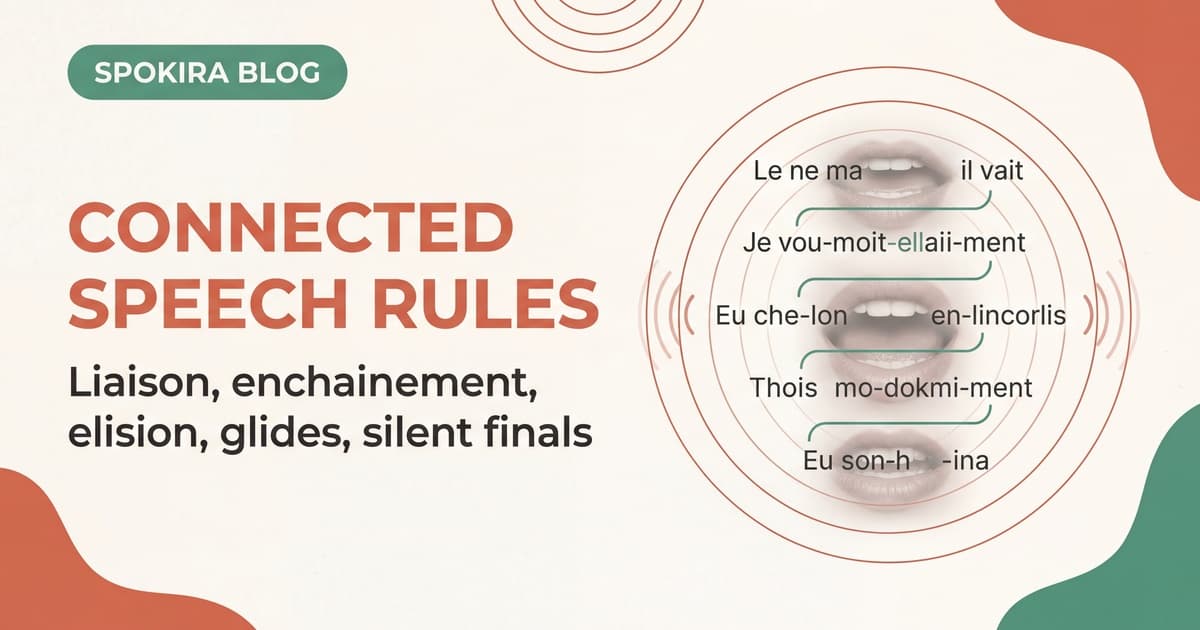
euvowels - connected-speech patterns like liaison and syllable flow
That is why French often feels harder than its raw sound count suggests. The challenge is not just the number. It is the mismatch between English habits and French articulation.
Which French sounds matter most first for English speakers?
If you are asking how many sounds in French you need to learn first, the practical answer is "not all of them equally."
Use this priority order:
uvsou- nasal vowels
- French
r - rounded
euvowels - liaison and phrase-level flow
That order works because those differences create the largest clarity gap between French and English in ordinary high-frequency speech.
High-priority learner map
| Sound group | Why it matters early | Example contrast | Best next step |
|---|---|---|---|
u vs ou | Meaning changes fast in common words | tu vs tout | Train one minimal-pair loop daily |
| Nasal vowels | English speakers add an extra n or m | beau vs bon | Practice airflow and clean cutoffs |
French r | Strong accent marker in basic vocabulary | rue, Paris, tres | Build a soft-friction throat placement |
eu vowels | Often replaced with English uh | deux vs peur | Practice rounded-lip mid vowels |
| Linking and rhythm | Sentences sound broken without it | les amis | Add chunk shadowing and liaison reps |
If you want a complete guided order for those high-value sounds, French pronunciation for English speakers is the best next page after this overview.
Does French have more sounds than English?
Usually, not in a simple dramatic way.
English is also a large and variable sound system, and English counts shift by accent as well. So the right comparison is not "French has way more sounds than English." The better comparison is:
- French uses some contrasts English speakers do not already have
- French handles rhythm and word-linking differently
- French spelling does not always tell you which final sounds disappear
That means French can feel hard even if the total sound count is not massively bigger.
If you want a practical side-by-side breakdown, use French sounds vs English: 7 differences that change how you sound after this post.
How should you study the French sound system without getting lost?
Many learners make the same mistake after reading a phoneme count: they try to memorize the full chart before they can reliably pronounce even the highest-impact categories.
A better progression is:
- learn the rough sound inventory
- identify the 3 to 5 sounds you personally miss
- train those in words and short phrases
- add connected-speech practice
- revisit the full chart only when it helps you solve a concrete problem
That sequence keeps the number useful. Instead of treating "how many sounds in French" as trivia, you turn it into a map of what you still need to train.
A simple 2-week sound-system plan
Days 1 to 4
- listen for
uvsou - record five minimal pairs
- compare your vowels to a native model
Days 5 to 8
- focus on one nasal family
- stop adding hard final
nsounds - repeat one short sentence until airflow feels stable
Days 9 to 11
- isolate the French
r - move from single words to one short phrase
- keep the sound soft rather than harsh
Days 12 to 14
- combine your target sounds in short connected phrases
- add one liaison pattern
- do one recorded comparison round
That is enough to make the French sound system feel smaller and more workable.
What to learn first instead of memorizing the full chart
If your goal is real speaking clarity, do not spend a week memorizing every symbol before you train your mouth.
Use this order:
- Learn the high-impact French-only contrasts.
- Train one contrast at a time in short daily reps.
- Add phrase-level connected speech.
- Record yourself and compare weekly.
That sequence works better than trying to hold the whole phoneme inventory in your head on day one.
If you want sound-by-sound feedback instead of guessing, Spokira's French pronunciation app is built for exactly that stage.
Train the Sounds That Actually Matter
Skip random pronunciation drills. Spokira helps you hear, practice, and correct the French sounds English speakers miss most.
Final answer: how many sounds are in French?
The clean learner answer is:
- about 35 sounds in standard French
- often shown as 34 to 37 depending on accent and counting method
If you want the reason in one sentence: French sound counts vary because speakers, nasal-vowel mergers, glides, and marginal consonants vary across descriptions of standard French.
That is the technical answer. The practical answer is even simpler: you do not need all 35 at once. You need the handful that English speakers usually miss, then enough connected-speech practice to keep them stable in real conversation.
Start with the contrasts that change clarity fastest, then build from there.