You know the words on the page. Then a French speaker says them at normal speed, and the sentence seems to collapse into one long sound.
If you want to know how to understand spoken French, do not begin by forcing yourself through longer podcasts. Start with one short recording. Find the hidden word boundaries, notice what changed from the written form, loop the difficult part, then answer the meaning without the transcript.
Fast French becomes easier when you stop treating it as a speed contest. The real problem is usually segmentation: your ear has not yet learned where one spoken unit ends and the next begins.
Quick answer: how to understand spoken French when natives talk fast
Use the same four passes on a two-to-five-second clip:
- Listen for the situation. Identify the speaker's likely meaning without chasing every word.
- Reveal the French transcript. Mark rhythmic groups, linked consonants, and weak sounds that disappeared.
- Loop one boundary. Replay the smallest part that hid the words from you.
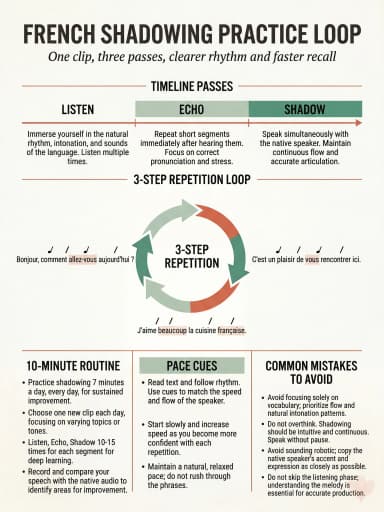
- Shadow, hide, and answer. Copy the phrase once, remove the text, then respond to what it means.
Do not slow every clip to 0.5× and leave it there. A small slowdown can help you inspect a boundary, but the final passes should return to natural speed.
The Council of Europe's CEFR descriptors set a sensible expectation: A2 listeners still rely heavily on slow, clear speech, while B1 listeners are expected to follow the main points of clearly articulated standard speech. Struggling with fast casual conversation at A2-B1 is not evidence that your French has failed. It tells you which listening layer needs training next.
Why does spoken French sound so fast?
Spoken French can feel faster than written French because words are not delivered as separate dictionary entries. Syllables link across spaces, some weak vowels disappear, frequent expressions compress, and casual grammar may omit elements you expect to hear.
Four changes cause most of the initial confusion.
1. Your ear is looking for English-style word boundaries
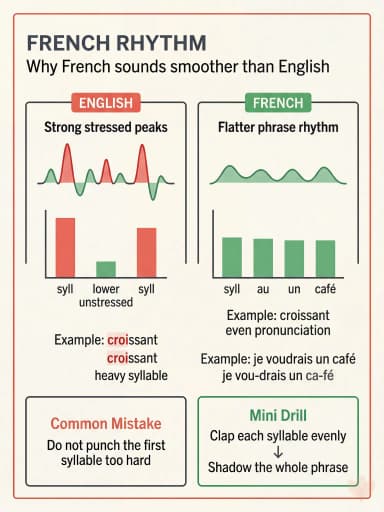
English speakers often wait for strong stress cues to signal the start of an important word. French listeners use the syllable structure of French differently.
In a classic listening experiment, Cutler, Mehler, Norris, and Segui found that French listeners used syllabic information when segmenting speech, while English listeners did not show the same pattern. The authors' 1986 paper on French and English speech segmentation is useful here because it explains why a string that feels naturally divided to a French listener may not divide itself for an English-trained ear.
This is not something you fix by learning more vocabulary. You fix it by hearing the same boundary several times while looking at the French transcript, then checking whether you can still hear it after the text disappears.
2. French links sounds across written spaces
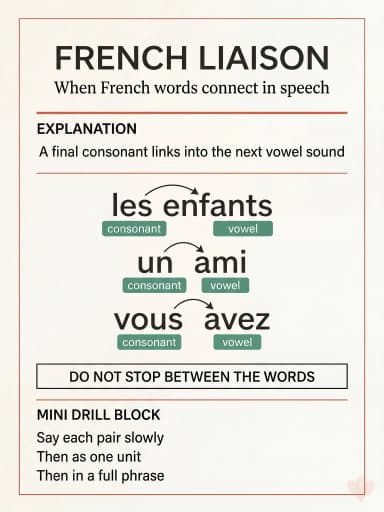
In vous avez, the final consonant of vous links into the next syllable. The phrase sounds closer to vou-za-vez than two isolated words, vous | avez.
The University of Texas French phonetics materials describe liaison and elision as changes triggered by the surrounding sound context. This is why the blank space on the page is a poor guide to the boundary you hear.
Three processes matter most:
- Liaison: a normally silent consonant appears before a following vowel, as in vous avez.
- Enchaînement: a consonant that is already pronounced moves into the following syllable.
- Elision: a vowel disappears before another vowel, as in le ami becoming l'ami.
You do not need to learn every exception before listening. Start with the complete connected-speech map, then use the focused guides to French liaison, enchaînement, and elision when one pattern keeps fooling your ear.
3. Weak vowels and familiar function words may shrink
The French e muet is not equally audible in every context. The University of Texas guide to the silent French e notes that its retention or deletion depends partly on speech rate, emphasis, and surrounding consonants. Experimental work has also examined how schwa deletion affects spoken-word recognition.
That matters because small words carry grammar while receiving little acoustic weight. A learner may expect a careful sequence such as je te le demande and hear something closer to j'te l'demande in casual speech.
Do not copy every reduction immediately. First learn to recognize the careful form and the reduced form as the same message.
4. Casual spoken French is not always the sentence in your textbook
Some differences are grammatical or register-based, not merely phonetic. In everyday conversation, speakers often omit ne and use common contractions.
| Careful or written form | A casual form you may hear | What changed |
|---|---|---|
| Je ne sais pas. | Je sais pas. | informal omission of ne |
| Tu as une minute ? | T'as une minute ? | vowel elision |
| Il y a un problème. | Y a un problème. | frequent expression compressed |
| Je te le demande. | J'te l'demande. | weak vowels reduced in casual speech |
| Vous avez réservé ? | vou-za-vez réservé ? | liaison hides the written boundary |
These forms vary by speaker, region, and formality. Treat the table as recognition training, not a script you must imitate in every conversation.
A four-pass method for decoding one fast French clip
The best clip is short enough to replay without losing attention. Two to five seconds is ideal at first. Use a line from a café exchange, workplace introduction, appointment call, or another situation you may actually need.
Pass 1: listen for the situation, not the transcript
Play the clip once at normal speed with no text.
Answer three questions:
- Who is probably speaking?
- What do they want or need?
- What kind of response would make sense?
If the line is Vous avez une table pour deux ?, you may catch only table and deux. That is enough to infer a restaurant interaction. Meaning gives your next listen somewhere to land.
Do not replay ten times yet. One or two blind listens reveal what your ear can currently do.
Pass 2: reveal the French transcript and mark sound groups
Now read the French, not an English translation.
Mark the phrase as you hear it:
Vous avez / une table / pour deux ?
Then note one change:
vous avezlinks with /z/,- the phrase moves in groups rather than isolated words,
- the question rises or stays open at the end, depending on the speaker.
The goal is not a full phonetic transcription. One useful mark is enough.
Pass 3: loop only the boundary that disappeared
If vous avez was the problem, loop that fragment. Do not restart the whole dialogue every time.
Use this sequence:
- listen while reading,
- point to each syllable group,
- listen with the text covered,
- say what you heard,
- reveal the text and check.
Move on when you can hear the words without needing the page. Perfect imitation is not required.
Pass 4: shadow the line, then answer it
Shadow the complete phrase two or three times. Stay close enough to the model that you copy the boundary you just learned. The French shadowing guide explains how close to follow the audio and when to stop copying.
Then stop copying.
Hide the transcript and answer:
Oui, pour deux personnes, s'il vous plaît.
This last step prevents a common trap: becoming good at echoing a sentence without becoming better at conversation. The broader spoken French practice system shows how to combine decoding, shadowing, retrieval, repair, and transfer across a week.
A 10-minute native French listening practice routine
Use one clip for the entire session.
| Minute | Task | What you are training |
|---|---|---|
| 0-2 | two blind listens and a gist guess | meaning under uncertainty |
| 2-4 | reveal the French transcript and mark groups | word boundaries |
| 4-6 | loop one linked or reduced fragment | recognition of the difficult change |
| 6-8 | shadow the complete line | sound and rhythm mapping |
| 8-10 | hide the text and answer or paraphrase | listening-to-speaking transfer |
Repeat the same clip the next day before adding a new one. If the line becomes easy, change one detail or add the next turn in the exchange.
If you want a longer solo method map, use the French speaking practice hub. If you can understand the clip but cannot produce an answer, the problem has moved from listening to output; use the guide for learners who understand French but cannot speak it yet.
What should you listen for first?
Do not listen for everything. Choose one target per clip.
Start in this order:
- The main rhythmic groups. Where does the speaker complete one small idea?
- One hidden boundary. Which two written words sound like one unit?
- One weak or missing sound. Did a schwa, ne, or short function word disappear?
- The response cue. Is the speaker asking, correcting, confirming, or offering something?
- One repair phrase. What can you say if you still miss the detail?
Useful repair lines include:
- Pardon, vous pouvez répéter ?
- Vous pouvez parler un peu plus lentement ?
- Si j'ai bien compris...
- Vous avez dit mardi ou jeudi ?
Understanding does not require perfect transcription. In real conversation, a good clarification question is part of listening competence.
Five mistakes that keep fast French blurry
Using English subtitles for every pass
English subtitles can explain the scene while hiding the French sound-to-word mapping. Use them for meaning only if needed, then return to the French transcript.
Staying on slowed audio
A moderate slowdown can reveal a boundary. It becomes a problem when you never return to normal speed. Always finish with at least one natural-speed listen.
Choosing clips that are too long
A two-minute monologue contains too many unknown boundaries for focused work. Cut one line. Learn what changed. Then add the next line.
Memorizing lists of contractions without audio
Knowing that tu as can become t'as does not guarantee that you will hear it. The sound needs to be attached to a voice, a context, and several repetitions.
Listening without answering
Listening can improve while speaking stays frozen. End with a response, paraphrase, or clarification request so the message becomes usable.
How listening practice can improve your spoken French
Decoding and speaking should meet in the same session. Once you can hear a boundary, copying it helps your mouth reproduce the timing. Once you can copy it, answering without the model tests whether the phrase is available independently.
A 2017 study of 30 adult French learners examined instruction targeting segments, prosody, fluency, liaison, and enchaînement. French listeners rated the learners before and after the 15-week course, and the researchers reported improvements across accent, comprehensibility, and fluency, especially in extemporaneous speech (Trofimovich, Kennedy, and Blanchet). That does not prove one ten-minute drill will transform listening. It does support training connected speech as part of a larger listening-and-speaking programme.
Spokira uses the same practical handoff: hear a phrase, notice its sound pattern, say it, repair one issue, and retry without full support. The current curriculum contains 1,183 phrases across 78 situations and 11 learner goals, so you can practise the pattern in a café, at work, while travelling, or during an everyday administrative task without jumping to unrelated material.
Turn Fast French Into A Phrase You Can Answer
Practise short real-life clips, get focused pronunciation feedback, and retry the response until it feels available without the transcript.
FAQ
Why can I read French but not understand it when spoken?
Reading preserves word boundaries and lets you pause or reread. Spoken French links syllables across written spaces, reduces some weak sounds, and keeps moving while you process the previous phrase. Train with very short clips and a French transcript so your ear can connect the sound stream to words you already know.
Should beginners slow down French audio?
Yes, briefly. Use a modest slowdown to inspect one difficult boundary, then return to normal speed before the session ends. If you only understand the clip at half speed, shorten it rather than slowing it further.
Are French subtitles better than English subtitles?
French subtitles are better for mapping sounds to French words. English subtitles are useful for checking the general meaning, but they can let you follow the story without hearing how the French sentence is built.
Should I learn casual contractions before standard French?
Learn the standard form first, then add common casual forms for recognition. You do not need to imitate every reduction. Your first goal is to understand that t'as maps to tu as and je sais pas maps to je ne sais pas.
How long does it take to understand native French speakers?
There is no reliable universal timeline. Progress depends on your current vocabulary, the speakers and accents you hear, topic familiarity, and how deliberately you practise. A better weekly measure is whether yesterday's short clip becomes understandable at normal speed without its transcript.
Hear the boundary, then use the message
Fast spoken French stops feeling like noise one boundary at a time.
Listen for the situation. Reveal the French transcript. Mark one linked or reduced sound. Loop it until the words reappear. Then hide the text and answer the meaning.
That final response matters. You are not training your ear for a listening exam alone. You are training it so the next French sentence gives you something you can actually say back.