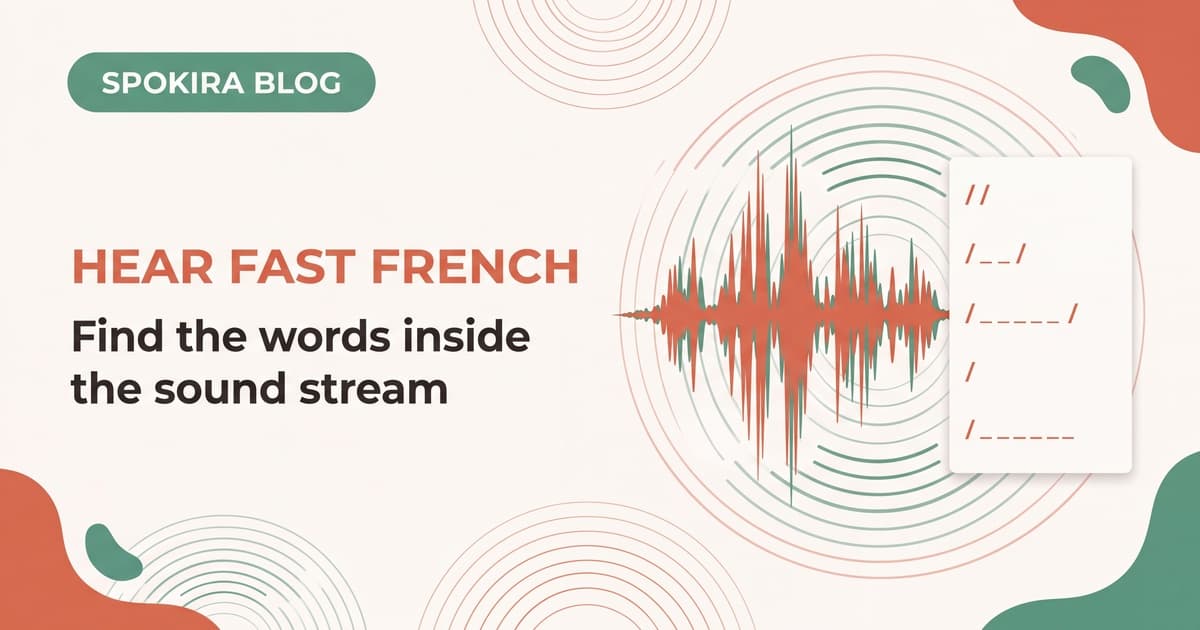
The sentence looks easy on the page: vous avez une minute? Then someone says it at normal speed and your ear receives something closer to one long ribbon of sound.
If you are wondering how to hear word boundaries in fast French, the fix is not to hunt for a pause between every word. French speakers often link sounds across the spaces you see in writing. Train your ear to mark short spoken groups, check those marks against a French transcript, and then listen again without the text.
This page gives you a five-minute boundary drill. It is narrower than a general guide to understanding spoken French when natives talk fast. The goal here is one skill: hearing where a useful word or phrase begins and ends.
Quick answer: how to hear word boundaries in fast French
Use a clip that is five to ten seconds long. Run these passes in order:
- Listen once for the situation and the likely message.
- Write slash marks where you think the spoken groups divide.
- Check the French transcript and circle one boundary that surprised you.
- Replay that boundary at normal speed, with one brief slowdown if needed.
- Hide the transcript and say what you heard, or answer the speaker.
Do not try to solve every sound in one sitting. A successful session might clarify only vous avez or petit ami. That small win is useful because it changes what your ear expects the next time the phrase appears.
Your first target
Choose one boundary per clip. Listen for it three times, say it twice, and then test yourself with the transcript hidden. Train your mouth as well as your ear.
Why are French word boundaries hard to hear?
Written French gives you a helpful visual signal: spaces. Spoken French gives you timing, pitch, syllables, and context. Those signals do not always line up with the spaces on the page.
Three things make the mismatch noticeable.
Sounds cross written spaces
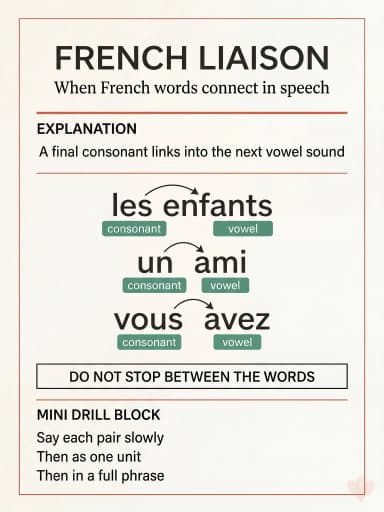
In vous avez, the normally silent final consonant of vous is pronounced before the vowel of avez. You may hear something like vou-za-vez, not two isolated dictionary forms.
In petit ami, the final t of petit is already a pronounced consonant. It can run into the next syllable, giving you pe-ti-ta-mi. That is enchaînement, not a new ta word. The French enchaînement guide covers the pronunciation rule in detail.
French rhythm groups attention around phrases
Listeners do not need a tiny silence after every word. They need enough information to identify a meaningful group, such as j'ai besoin de... or à la gare. A sentence can be continuous and still have audible shape.
Research on French boundaries points to timing and prosody rather than silence alone. In a perception study, A. C. M. Rietveld found that duration, pitch, and intensity could correlate with noun-adjective boundaries, with temporal structure the strongest cue in that experiment (Rietveld, 1980). A later corpus study by Nemoto, Adda-Decker, and Durand measured 13 hours of broadcast speech and reported recurring final-syllable duration and pitch patterns (Nemoto et al., 2010). These are tendencies, not a universal boundary detector, but they tell you where to direct your attention.
Your first guess may follow English habits
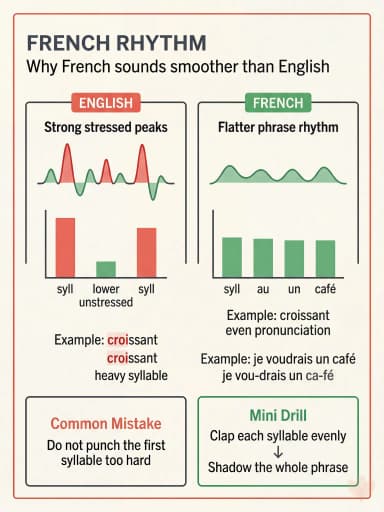
English learners often wait for a strong stressed syllable. French does not highlight words in exactly the same way. If you expect each important word to arrive with a loud beat, function words and linked syllables can feel invisible.
That does not mean French has no rhythm. It means the rhythm is organized differently. Listen for the end of a small phrase, the length of a final syllable, and the next word that makes the whole group plausible.
What is a word boundary in spoken French?
A word boundary is the point where one lexical item ends and another begins. In a transcript, a space shows it. In audio, the listener has to infer it from the sound stream.
The syllable boundary may be somewhere else. In petit ami, the final consonant of petit can become the onset of the next syllable, so the ear hears a smooth sequence even though the vocabulary boundary remains petit | ami. With liaison, a consonant that is normally silent appears before the next vowel, as in vous avez. The added sound makes the spoken edge less obvious, but it does not erase the two words.
This distinction changes your practice. Do not ask, “Where is the silence?” Ask two questions: “Which words could make this sound?” and “What sound pattern connects them?” The answer may involve a liaison, an enchaînement, a reduced function word, or ordinary phrase timing.
The non-native listener study by Dejean de la Bâtie and Bradley used liaison phrases such as excellent tableau and excellent acteur. Native listeners were essentially faultless, while non-native listeners often relied on incomplete acoustic-phonetic and lexical analysis (Applied Psycholinguistics). Your first rough slash marks are therefore expected to be imperfect. The drill gives you repeated chances to improve the analysis without asking you to understand an entire broadcast.
What cues should you listen for?
You do not need to hear all four cues at once. Use the table as a checklist, then choose one cue for your next replay.
| Cue | What you may notice | What to do |
|---|---|---|
| Phrase timing | A small lengthening near the end of a group | Draw a slash after the group, not after every syllable |
| Pitch movement | A rise or fall around a phrase edge | Replay the final syllable and the next word together |
| Linking | A consonant seems to move into the next syllable | Check for liaison or enchaînement in the transcript |
| Function words | de, que, vous, or il sounds very short | Keep the word in your written mark even if it is weak |
| Lexical fit | One possible division creates a familiar phrase | Test the phrase in context instead of trusting sound alone |
The lexical cue matters, but do not use context as an excuse to guess. A study of native and non-native French listeners in liaison contexts found that non-native listeners tended to rely on incomplete acoustic-phonetic and lexical analysis. The practical lesson is simple: use meaning to check your hearing, not to replace it.
How do you mark a French transcript?
Start with sound, then use spelling as a check. This prevents the page from doing all the listening for you.
Pass one: write what you think you heard
Take a line such as:
Vous avez une réservation?
After one listen, your notes might look like:
vouza / vun rezer...
That is fine. You are recording the shape your ear received, not submitting a dictation test.
Pass two: add phrase slashes
Listen again and try a larger division:
Vous avez / une réservation?
The first slash is not a claim that avez ends with a pause. It is a useful spoken group. If the phrase is still too fast, make the group smaller for one replay:
vous avez / une / réservation?
Then return to the more natural group. Your final goal is not to speak in chopped pieces.
Pass three: compare the transcript
Now look at the French words. Label the one thing that hid them. In this line, the s in vous may appear as a liaison before avez. The boundary is still between vous and avez, even though the consonant is heard at the start of the following syllable.
For a full rule map, use the guide to French connected speech rules. The University of Texas French phonetics materials are also useful for checking a liaison or elision label. You are borrowing one explanation, then going back to the audio.
Three boundary examples to practise
Example 1: vous avez
Written form: Vous avez le temps?
First target: hear vous | avez, not vouza as one unknown word.
Listen for the /z/ that appears between the words. Keep vous and avez as separate vocabulary items in your notes, even though the consonant links forward. This is the kind of liaison explained in the French liaison rules guide.
Example 2: petit ami
Written form: C'est son petit ami.
First target: hear petit | ami, not petita as a mystery word.
The final t of petit is part of the word's pronounced form in this context. It links to the following vowel. Tap the phrase as three groups: son / petit / ami. Then smooth it out until the spaces no longer create a hard stop.
Example 3: une autre
Written form: On peut essayer une autre option.
First target: find une | autre inside the longer group.
Do not begin with the whole sentence. Loop une autre until you can hear the boundary, then place it back into essayer une autre option. This bottom-up move is more manageable than repeatedly replaying a sentence you cannot yet segment.
The five-minute word-boundary drill
Set a timer. Use one native clip with a transcript. The audio can come from a Spokira situation pack, a short recording you trust, or a teacher-provided example.
- Listen for meaning, 30 seconds. Identify who is speaking, the setting, and the likely action. Ignore missing words.
- Mark two boundaries, 45 seconds. Write rough slashes from the audio alone. Do not pause every second.
- Check one surprise, 60 seconds. Reveal the French transcript. Circle the boundary that sounded most different from the spelling.
- Loop the smallest useful unit, 90 seconds. Replay two to five seconds. Keep the speed natural for most repetitions. Use a slight slowdown only to inspect timing.
- Shadow, 45 seconds. Repeat with the speaker, keeping the phrase connected. The one-clip French shadowing routine can extend this step.
- Hide and respond, 30 seconds. Say the phrase from memory, answer its question, or ask Vous pouvez répéter, s'il vous plaît?
Score the session with three questions:
- Did I find the target boundary without looking?
- Did I keep the words separate in meaning while allowing the sounds to link?
- Could I answer or reuse the phrase afterward?
Mistakes that keep fast French blurry
You transcribe the whole clip immediately
A complete transcript can become a reading exercise. Take one rough listen first. Let your ear make a prediction before the spelling corrects it.
You slow everything down
Slow audio is useful for inspection. It is not the final skill. Finish with natural-speed listening so your ear learns the target as it will occur in a conversation.
You treat liaison as a new word
The linked consonant can sound like the start of the next word. Keep the written boundary visible while you practise the sound. Once the phrase is familiar, the link will stop feeling like a surprise.
You choose a clip that is too long
Use one sentence, not a podcast episode. Five focused minutes on one boundary beats twenty unfocused minutes of replay.
Train your ear with real French clips
Spokira pairs native audio with short speaking reps, recording, and feedback, so you can hear the phrase and use it under pressure.
A seven-day progression
Keep the same routine, but change the boundary type.
- Day 1: one liaison, such as vous avez.
- Day 2: one enchaînement, such as petit ami.
- Day 3: a short function-word group, such as j'ai besoin de.
- Day 4: a question with a familiar response.
- Day 5: a clip at natural speed with no slowdown.
- Day 6: the same pattern in a new situation.
- Day 7: a blind test with the transcript hidden until the end.
Record one attempt on days one and seven. You are not looking for a perfect accent. Listen for whether your phrase groups are steadier and whether you can recover the words without waiting for a pause.
The real goal is usable listening
French speech does not need to arrive with visible spaces for you to understand it. Your ear needs a different map: phrase timing, likely word shapes, linked sounds, and enough context to test a hypothesis.
Work on one short boundary at a time. Mark it, check it, replay it, and then do something with the meaning. That is how a line that once sounded like noise becomes a phrase you can hear and say.