You recognize rendez-vous on a flashcard. You understand it when a French speaker says it. Then someone asks when you are free, and the word vanishes.
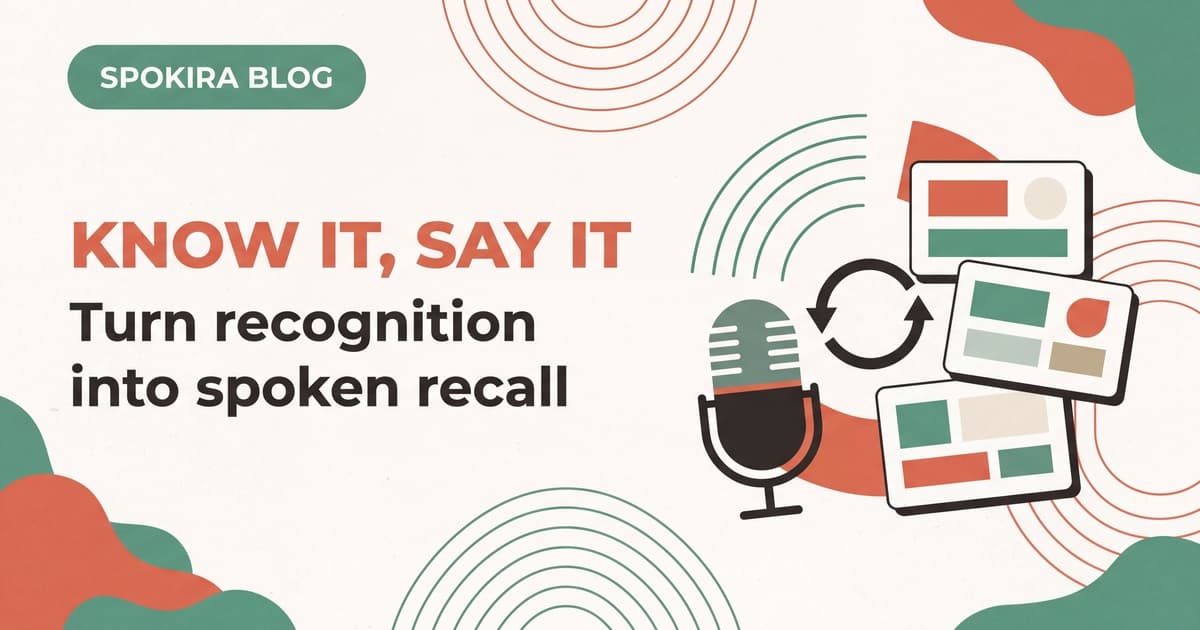
If you know the French word but can't remember it while speaking, your vocabulary is not necessarily missing. You may have trained recognition more often than retrieval. Recognition asks, “Have I seen this before?” Speaking asks, “Can I produce the right form, inside a useful sentence, right now?”
Those are different jobs. The answer is not to throw away every flashcard. It is to add a phrase-first retrieval ladder that takes a word from a visible answer to an independent spoken response.
This article shows you how with rendez-vous, a common word for an appointment or meeting. The same routine works for billet, horaires, réserver, or any word you understand but cannot reliably use.
If your difficulty is broader than one word, start with the guide to understanding French but not being able to speak. This article zooms in on the vocabulary route inside that larger problem.
Quick answer: why does a French word disappear when you speak?
The word feels known because you can recognize it. Speaking requires several extra links:
- connect the situation to the meaning;
- select the French form instead of the English label;
- fit the word into a sentence frame;
- pronounce it with enough speed to keep the turn alive;
- retrieve it again later, without the original card.
Single-word study often strengthens the first link. It does not automatically build all the others. In an open-access L2 vocabulary study, Yanagisawa compared receptive retrieval, productive retrieval, and simple repetition. Productive retrieval was significantly stronger on a productive knowledge test than the other conditions. That does not prove one exact routine will make your French fluent, but it supports a useful design choice: practise producing the form when production is your goal.
The smallest useful change
Keep the word, but stop ending practice when you recognize it. After you see or hear the answer, cover it and complete one spoken phrase from a situation cue.
Recognition, recall, and production are not the same
Imagine three tests for rendez-vous.
| Test | Prompt | Successful answer |
|---|---|---|
| Recognition | Choose the French word for “appointment” | Select rendez-vous |
| Meaning recall | See rendez-vous and explain it | Say “appointment or meeting” |
| Form recall | See “appointment” and say the French word | Produce rendez-vous |
| Spoken production | Ask a clinic for an appointment | Say Je voudrais prendre rendez-vous |
You can pass the first test and fail the last one without being inconsistent. Each test changes the direction, the amount of context, and the pressure on your speech system.
The helpful question is not “Do I know this word?” Ask instead, “Which version can I do, and which version breaks?” That diagnosis tells you what to practise next.
Why do you know the French word but can't remember it while speaking?
Speaking adds pressure that a card does not. You must select a word, place it in a grammatical frame, pronounce it, and continue listening for the other person's response. A word can be stored well enough for recognition and still be slow when the prompt is a live situation.
This is why “I knew it five minutes ago” is such a common learner experience. The earlier task supplied cues: the spelling, the translation, the card layout, or the previous example. Conversation removes most of them. Your memory is not being asked the same question twice. It is being asked to produce a form while attention is divided between meaning, sound, grammar, and turn-taking.
Treat the pause as a diagnosis. If you can complete Je voudrais prendre... but cannot answer “appointment” with rendez-vous, practise form retrieval. If you can say rendez-vous but cannot build the sentence, practise the frame. If you can do both in private but freeze in a role-play, add a timer or a follow-up question. Each failure points to a different rung.
A word needs a route, not only an entry
A dictionary entry has no job to do
The word rendez-vous by itself is an object in memory. In a conversation, it needs a job: book an appointment, confirm a time, cancel a meeting, or tell someone where you are going.
When you study the word in a useful frame, you store more than a translation. You store a beginning, a grammatical shape, and a likely next word. For example:
- prendre rendez-vous means to make an appointment;
- un rendez-vous médical gives you a concrete setting;
- J'ai un rendez-vous à dix heures gives the word a sentence rhythm.
You do not need to memorize every possible sentence. One dependable frame gives your mouth somewhere to start.
Translation adds a race you do not need
If your only prompt is the English word “appointment,” your brain may search for a French equivalent while the other person is already waiting. That search can be slow even when the word is stored.
Alternate the prompt types. Use a situation, a picture, a French definition, and an English cue. The aim is not to ban translation. It is to make French meaning and French situations strong enough that English is not the only doorway.
Easy review creates a false finish line
Flipping a card and thinking “I know that” feels successful. It is also a very light test. The answer was present a moment ago, so recognition did most of the work.
Retrieval practice introduces a small, useful difficulty. Nakata's study of repeated retrieval in L2 vocabulary compared one, three, five, and seven retrievals and tested learners after delays longer than two weeks. The higher-frequency conditions generally produced higher delayed scores than one or three retrievals, although controlling for time-on-task changed the interpretation. The practical takeaway is modest: give important words several chances to come back, and revisit them later instead of cramming them in one sitting. A Cambridge review of adult L2 vocabulary training also treats retrieval, repetition, and vocabulary training as related but distinct operations. The broader retrieval-practice literature reaches a similar conclusion about testing versus restudy, but a memory result is not a guarantee of conversational fluency (Karpicke and Roediger, 2008).
The phrase-first retrieval ladder
Use this ladder when a word is familiar but unreliable. Move down only after the current rung feels accurate enough.
Rung 1: recognize the word
See rendez-vous and connect it to an appointment or meeting. Say the meaning out loud once. This is a warm-up, not the finish.
Rung 2: retrieve the meaning
See rendez-vous without the translation. Explain it in simple English or French. If you hesitate, reveal the answer, then try again after ten seconds.
Rung 3: retrieve the form
Use the prompt “appointment” or a picture of a calendar. Say rendez-vous. Then say it again with the article: un rendez-vous.
Rung 4: complete a phrase frame
Read only the start:
Je voudrais prendre...
Complete it aloud: rendez-vous.
Now change the prompt:
Pour voir le médecin, je dois...
Say prendre rendez-vous. The second version checks whether you can choose the phrase from meaning, not simply echo the visible blank.
Rung 5: respond inside a situation
Imagine calling a clinic. The receptionist asks:
Vous appelez pour quelle raison?
Answer:
Je voudrais prendre rendez-vous avec le docteur Martin.
You do not need to invent a long roleplay. One prompt and one complete answer are enough to connect the word to a real speaking move.
Rung 6: delay and vary
Come back tomorrow. Change one detail:
Je voudrais prendre rendez-vous pour mardi matin.
Then change the function:
Je dois annuler mon rendez-vous.
Variation prevents your memory from tying the word to one frozen sentence.
A seven-minute French retrieval drill
Run this with one word or chunk. Keep the answer hidden whenever the step asks you to produce it.
- Hear it, 45 seconds. Listen to a native clip containing the word in a full phrase. Notice the rhythm, not just the spelling.
- Say the meaning, 30 seconds. Hide the translation and explain the phrase in your own words.
- Produce the form, 45 seconds. Use an English cue or situation prompt and say the French word.
- Build the frame, 60 seconds. Complete two sentence starts aloud. For rendez-vous: Je voudrais prendre... and J'ai un....
- Answer once, 90 seconds. Respond to one short question in French. Record this attempt if you can.
- Check and repair, 60 seconds. Compare your answer with the model. Fix one issue only: missing article, wrong preposition, pronunciation, or a long pause.
- Vary the scene, 60 seconds. Keep the target but change the time, person, or purpose.
- Return tomorrow, 30 seconds. Try the situation before looking at the original phrase.
This sequence resembles the broader French output retrieval drill, but the unit is deliberately small. You are diagnosing one word's route into speech, not completing a whole conversation.
If you want to extend the same idea into a timed scene, use the French conversation freeze retrieval drill after this vocabulary warm-up.
What if the word still will not come?
Do not turn one missing word into a dead stop. Keep the sentence moving with a frame or a repair line.
For rendez-vous, you could say:
- Je voudrais fixer une date avec le médecin.
- Je voudrais voir le médecin la semaine prochaine.
- Comment dit-on...? followed by a description.
The French paraphrase guide covers this skill in depth. Retrieval practice and communication repair belong together. One trains access to the target; the other stops a temporary gap from becoming a freeze.
If the blank keeps happening, lower the cue difficulty. Start with the full phrase, then remove one piece. A first-sound cue such as /ʁ.../ can be useful, but do not leave the cue in place forever. Fade it as soon as you can.
How should flashcards fit into speaking practice?
Flashcards can be useful for keeping a word available. Anki can help with retention, especially when the material is meaningful and reviewed over time. The limitation is the test you choose. A card that asks you to recognize rendez-vous is not the same as a card that asks you to use it in a sentence.
You can combine the methods without making your study system complicated:
- use a recognition card to refresh the meaning;
- add a reverse card that asks for the French form;
- finish with a spoken situation prompt;
- record one answer every few reviews;
- revisit the phrase after a delay.
The Anki versus shadowing comparison explains the division more fully. Anki is a memory tool. Shadowing and speaking reps train timing, sound, and production. Your bottleneck tells you which one deserves the next five minutes.
Turn recognition into a spoken response
Spokira gives you native clips, short situation prompts, recording, and clear feedback so useful French becomes easier to retrieve.
Measure the right kind of progress
Do not judge this work only by whether a word feels familiar. Track four simple signals:
- Latency: how long before the first French sound?
- Accuracy: did you choose the correct word and structure?
- Completeness: did you say a usable phrase, not just the noun?
- Delayed recall: can you do it tomorrow without reopening the card?
A word that comes back in four seconds today and two seconds next week is improving, even if it still needs a cue. A word that you recognize instantly but cannot place in a sentence needs a different practice step.
A simple weekly plan
Choose five high-value words or chunks from situations you actually expect to discuss. Work on one or two per day.
- Monday: recognition, meaning, and a full phrase model.
- Tuesday: form retrieval from English or a situation cue.
- Wednesday: two sentence frames.
- Thursday: one recorded answer.
- Friday: a changed detail or follow-up question.
- Saturday: blind retrieval with no written prompt.
- Sunday: delayed check and a decision: keep, simplify, or replace the word.
Keep a phrase if it helps you say something you genuinely need. Replace it if it is too rare or too hard to use. Vocabulary is not a museum collection. It is a set of tools you reach for while another person is waiting.
From “I know it” to “I can say it”
The frustrating moment is real, but it is informative. Recognition tells you the word has an entry in memory. The blank tells you the entry needs a stronger route into a sentence, a sound pattern, and a situation.
Keep the useful word. Add a frame. Retrieve it aloud. Change one detail. Come back after a delay. That small loop moves French vocabulary out of the card and toward the conversation.