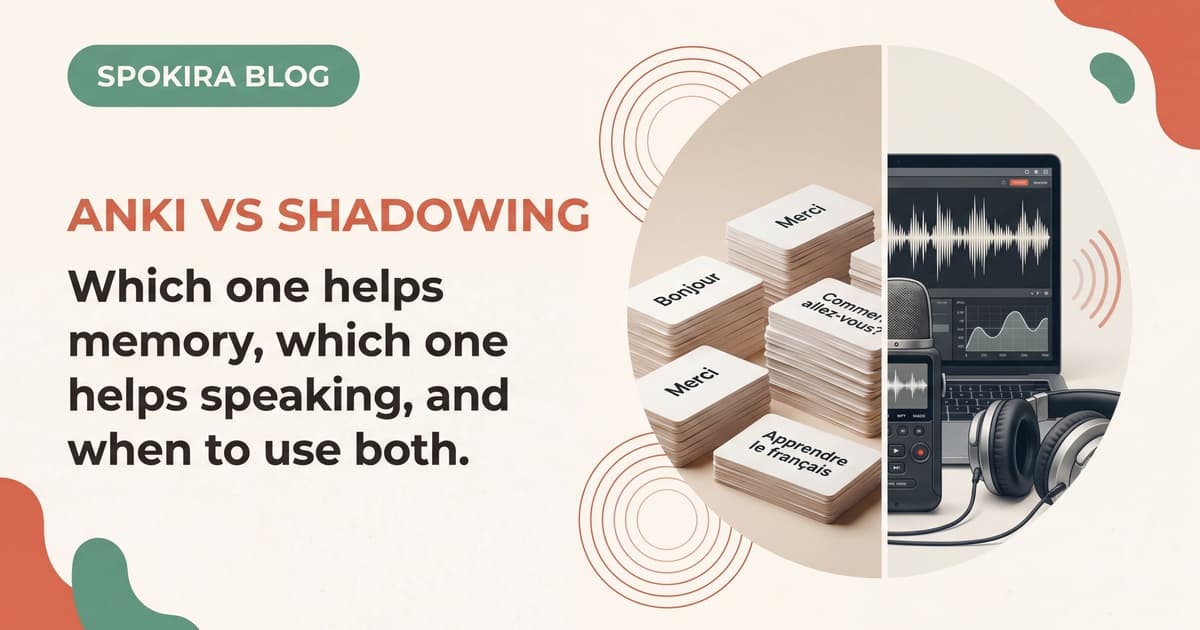
If you only have time for one French method, Anki and shadowing can feel like completely different bets.
Anki looks efficient. Shadowing looks active. Anki promises memory. Shadowing promises speech.
Both can help, but they help in different ways. That is why Anki vs shadowing for French is really a question about which bottleneck you are trying to fix.
Quick answer: Anki vs shadowing for French
Use Anki if your main problem is forgetting useful French words and phrases.
Use shadowing if your main problem is that you know the phrase but cannot say it smoothly, clearly, or naturally.
Anki is better for:
- memory
- review
- keeping phrases available
Shadowing is better for:
- pronunciation
- rhythm
- speech flow
- input-to-output transfer
This lines up with the broader research. Retrieval and distributed practice improve retention over time (Roediger & Karpicke, 2006; Cepeda et al., 2006). Pronunciation training and repetition on actual spoken output improve phonetic performance more directly (Yao et al., 2025).
So the answer is not really "which one is better?" It is "better for what?"
What Anki does for French
Anki is a spaced-repetition flashcard system.
It helps with:
- remembering high-frequency phrases
- reducing random forgetting
- keeping vocabulary review manageable over time
It does not directly train:
- mouth movement
- French rhythm
- pronunciation clarity
- speaking under pressure
That is why Anki often feels productive but does not always change how you sound.
If you want the broader Anki decision post first, use Should you use Anki to learn French?.
What shadowing does for French
Shadowing means listening to a native model and repeating immediately, close enough that you copy timing as well as words.
It helps with:
- pronunciation
- phrase timing
- prosody
- getting familiar lines out of your mouth faster
It is much better than flashcards when the problem is production rather than storage.
That is why shadowing matters so much for learners who understand French reasonably well but still feel stiff when speaking.
Why learners confuse these two methods
The confusion usually comes from one fact: both methods can involve the same phrase.
You might put Je voudrais un cafe into Anki.
You might also shadow Je voudrais un cafe ten times.
But the jobs are different.
Anki asks:
Can you remember this?
Shadowing asks:
Can you produce this in a more native-like way?
That is a major difference.
Use Anki when the problem is forgetting
Anki is the better choice when:
- you keep losing common phrases
- you want to preserve vocabulary from input
- your review is too random
- you need a system for repetition over time
If your French is already decently pronounceable but your memory is messy, Anki can do real work.
Use shadowing when the problem is speaking
Shadowing is the better choice when:
- you understand more than you can say
- your pronunciation sounds flat or English-timed
- you hesitate even on familiar phrases
- you need a bridge from input to output
This is why shadowing often beats Anki for intermediate self-learners whose main goal is actually speaking.
If that sounds like you, Why shadowing works for French is the next page.
When Anki is not enough
Anki is not enough when the phrase is technically in your memory, but still does not come out in conversation.
That usually means the problem is one of these:
- retrieval speed
- pronunciation stability
- pressure tolerance
For that, you need French retrieval drills, shadowing, or scenario speaking practice, not more flashcards.
When shadowing is not enough
Shadowing also has limits.
If you only shadow and never do memory work, some useful material may still fade. And if you only shadow with support, you may still fail when the transcript or audio disappears.
That is why a lot of learners do best with this order:
- collect useful phrases from input
- store the most useful ones in Anki
- shadow the important spoken ones
- retrieve them without support later
That stack is stronger than either method used alone.
Anki vs shadowing for French beginners
For beginners, the choice depends on the problem.
If you mainly need to remember the first wave of useful phrases, Anki can help.
If you mainly need to hear and copy how French should sound, shadowing helps earlier than many people think, as long as the material is simple enough.
Still, beginners usually should not make either one the entire system. They still need input.
Anki vs shadowing for French at A2-B1
For A2-B1 learners, shadowing usually becomes more important.
Why? Because by that stage, many learners are no longer mainly blocked by pure forgetting. They are blocked by:
- slow access
- unclear delivery
- weak rhythm
- hesitation
That is why in the broader methods ranking, shadowing sits above SRS for most intermediate learners.
A simple decision rule
Use this shortcut:
| If your main issue is... | Choose... |
|---|---|
| forgetting phrases | Anki |
| unclear pronunciation | shadowing |
| passive knowledge with weak output | shadowing |
| inconsistent memory from input | Anki |
| needing both retention and speaking transfer | both, in sequence |
Best way to combine them
If you want both methods without wasting time:
- keep Anki small and practical
- use shadowing on the phrases you actually want to say
- do not put everything into cards
- do not mistake flashcard success for speaking ability
That is the cleanest way to let Anki support speaking instead of replacing it.
Use Memory Work and Speaking Work for Different Jobs
Keep useful phrases alive with Anki, then turn them into clearer spoken French with shadowing and retrieval practice.
Final answer
If you have to choose one, choose the method that matches the real bottleneck.
If you are forgetting French, choose Anki. If you are failing to produce French, choose shadowing.
If you want the strongest long-term setup, use both, but let Anki handle memory and let shadowing handle speech.