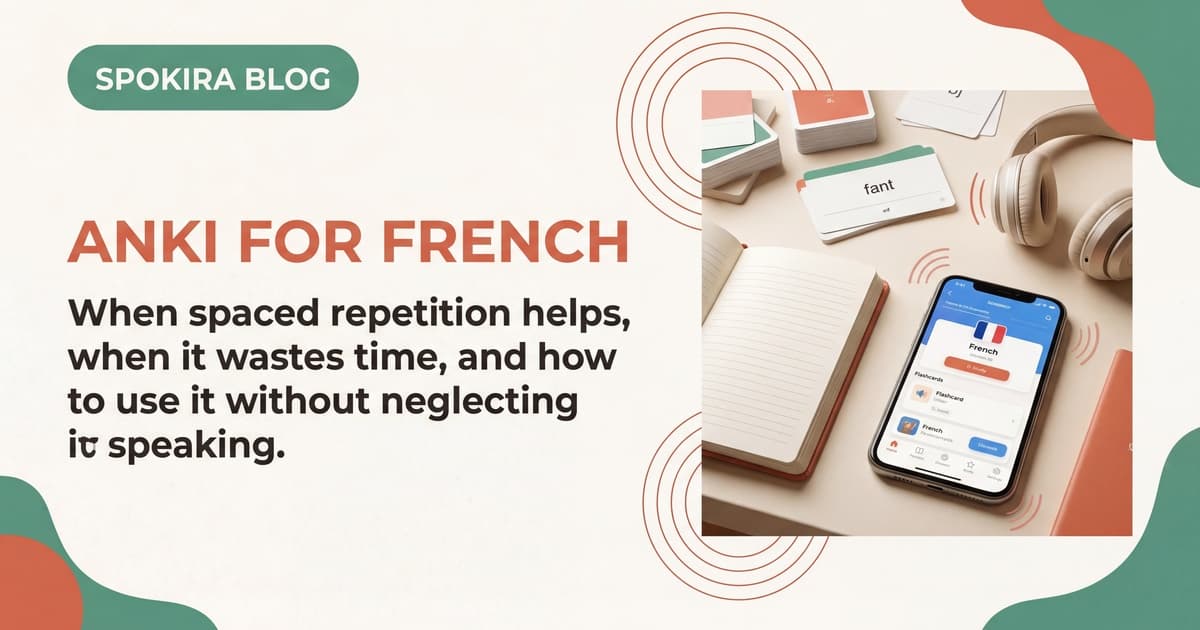
Yes, Anki can help you learn French. But it helps in a specific way.
Anki is good at helping you remember French. It is much less effective at helping you speak French clearly and automatically.
That distinction matters. A lot of learners either overrate Anki and try to make it their whole study system, or underrate it and dismiss it because flashcards feel boring. Both reactions miss the point.
If you want a short answer, here it is: use Anki to keep useful French available, but do not expect it to replace listening, shadowing, or speaking practice.
Quick answer: should you use Anki to learn French?
You should use Anki to learn French if:
- you keep forgetting common vocabulary or phrases
- you want a system for reviewing useful expressions over time
- you are pulling cards from input or speaking mistakes you actually care about
You should not rely on Anki as your main French method if:
- your main problem is pronunciation
- your main problem is freezing in conversation
- you spend more time organizing decks than using French
This makes sense if you look at the learning science behind it. Distributed practice reliably improves long-term retention compared with cramming (Cepeda et al., 2006), and retrieval helps later access more than extra restudy alone (Roediger & Karpicke, 2006). That is exactly the kind of job Anki is good at.
What Anki actually is
Anki is a flashcard app built around spaced repetition.
Instead of reviewing every card every day, the system changes the schedule based on how well you remembered the card:
- easy cards come back later
- hard cards come back sooner
- forgotten cards return quickly
That makes it more efficient than random review.
Officially, Anki describes itself as a program that makes remembering things easy through spaced repetition (AnkiWeb). That is the correct frame. It is a memory tool.
It is not:
- a conversation simulator
- a pronunciation trainer
- a substitute for using French in context
What Anki is best at for French
Anki is strongest when your French bottleneck is retention.
That usually means:
- you keep re-learning the same common words
- useful phrases disappear right when you need them
- your input is good, but the material is not sticking
For French, the best card types are usually:
- short phrase cards
- sentence cards from content you actually consume
- corrections from your own speaking practice
That is a much better use of Anki than memorizing huge lists of disconnected words.
What Anki is bad at
This is where a lot of learners get confused.
Anki can help you remember a phrase like Je voudrais un cafe.
It does not automatically help you:
- pronounce it naturally
- say it at conversation speed
- retrieve it under social pressure
- connect it smoothly to the next sentence
That is why Anki is not a speaking method by itself.
If your main issue is that you understand French but still sound hesitant, Anki is only part of the answer. You also need French shadowing practice, French retrieval practice drills, or structured French speaking practice.
The best way to use Anki for French
Use Anki as a support layer, not as the whole system.
The best workflow usually looks like this:
- get phrases from input, reading, or speaking mistakes
- put only the useful ones into Anki
- review them briefly and consistently
- use those phrases later in shadowing, retrieval, or conversation drills
That last step matters most.
If the phrase never leaves the flashcard, you are training recognition and recall in a narrow format, not real language use.
Good Anki cards for French
These usually work well:
- high-frequency phrases
- sentence cards with clear meaning
- common response patterns
- travel or work phrases you genuinely need
Examples:
Je voudrais reserver une table.Vous pouvez repeter, s'il vous plait?Je ne suis pas sur.
These usually work badly:
- rare literary words
- long grammar explanations
- random word lists with no context
- cards you added because they felt impressive, not useful
The most common Anki mistake
The biggest mistake is letting Anki become a full-time maintenance project.
That looks like:
- downloading giant decks
- spending hours editing formatting
- doing reviews but no listening or speaking
- feeling productive while your actual French stays flat
If that is happening, the issue is not Anki itself. It is scope.
Anki works best when it stays narrow and practical.
Should you use Anki to learn French as a beginner?
Beginners can use Anki, but only lightly.
A small phrase deck can help at the start. A giant deck usually creates more stress than progress.
Most beginners do better with:
- more comprehensible input
- a small number of useful cards
- early speaking support once they can follow short phrases
If you are already deciding between methods, best French learning methods for adults and French learning methods ranked for A2-B1 place Anki in the wider study stack.
What Anki should be paired with
The strongest pairings are:
- Anki + comprehensible input
- Anki + shadowing
- Anki + retrieval practice
That works because each method does a different job:
- input builds familiarity
- Anki preserves useful material
- shadowing improves sound and rhythm
- retrieval practice improves access under pressure
Use Memory Work to Support Speaking, Not Replace It
Keep useful French phrases alive with Anki, then turn them into spoken output with guided shadowing and retrieval practice.
Final answer
Yes, you should use Anki to learn French if your goal is to remember useful material better.
No, you should not expect Anki to solve pronunciation, fluency, or conversation on its own.
Treat it as a memory tool inside a bigger French system, and it becomes useful. Treat it as the whole system, and it usually becomes a bottleneck.