The best French learning methods for adults are not the ones that feel the most academic. They are the ones that move you toward the specific result you want.
If your goal is to understand French better, you need a lot of input. If your goal is to remember more vocabulary, you need retrieval and spacing. If your goal is to sound clearer and respond faster, you need repeated spoken output.
That is where many adult learners lose time. They mix all methods together without knowing what each one is good for, then wonder why they still feel stuck.
This guide breaks the main methods into plain categories: what helps comprehension, what helps recall, what helps pronunciation, and what helps real speaking. If you already know your main bottleneck is speaking, start with French speaking practice. If your question is whether video-heavy learning is enough, read Can you learn French with videos alone?.
Best French learning methods for adults: quick answer
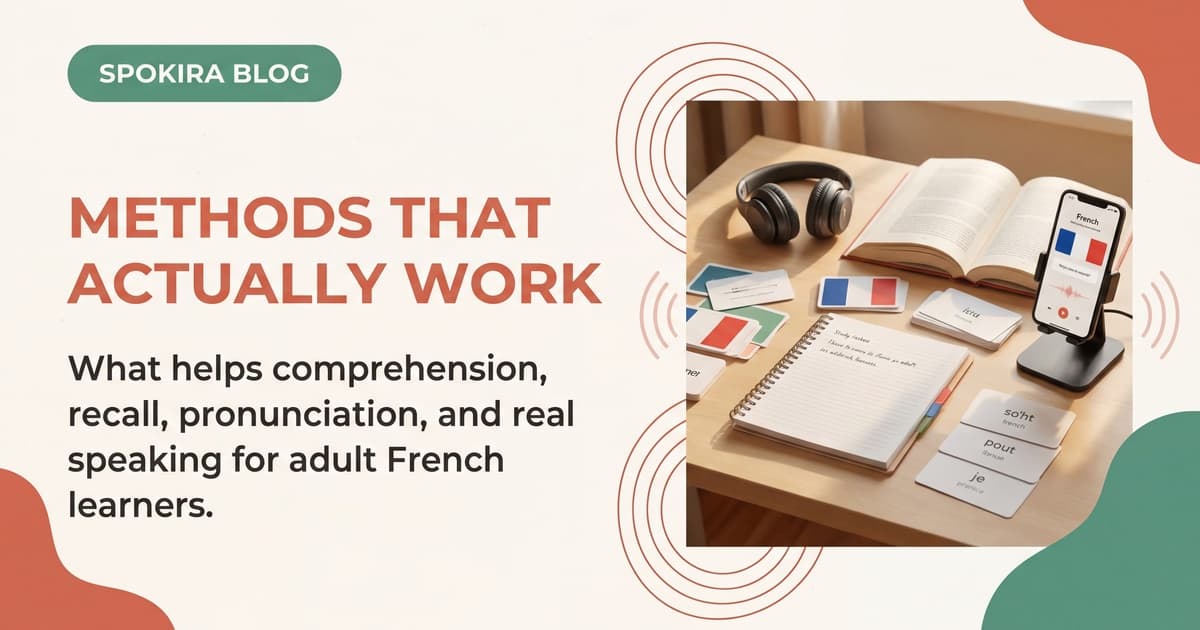
For most adults learning French on their own, the strongest stack looks like this:
- comprehensible input for understanding
- spaced review for memory
- shadowing for pronunciation and rhythm
- retrieval practice for faster recall
- conversation or scenario drills for transfer
Stephen Krashen's 2020 "Optimal Input" summary argues that acquisition comes from understanding what we hear and read, not from forcing output first (Krashen, 2020). That matters because adults often underinvest in exposure.
But adults also need a bridge from input to performance. The 1999 Cambridge study often cited in output-hypothesis discussions found that producing language can help learners notice gaps in what they know (Izumi et al., 1999). Retrieval and spacing research points in the same practical direction: recalling information and revisiting it over time leads to better durable access than extra review alone (Roediger & Karpicke, 2006; Cepeda et al., 2006).
So the best answer is not one method. It is a small method stack with a clear job for each part.
Method 1: comprehensible input for building your internal French model
Comprehensible input means language you can mostly understand, even if some of it is slightly above your current level.
For adults, this usually includes:
- learner podcasts
- subtitled YouTube or Netflix clips
- graded reading
- easy native content with enough context
This method is best for:
- building listening range
- noticing sentence patterns
- picking up vocabulary in context
- reducing the feeling that spoken French is just noise
It is weaker for:
- speaking under pressure
- pronunciation repair
- fast recall without support
That is why input-heavy tools like video apps can be useful, but they do not solve every bottleneck. If you want that comparison directly, see FluentU vs Spokira.
Method 2: spaced repetition for memory, not fluency
Spaced repetition is one of the most useful adult-learning tools because it makes forgetting less random. You review material at increasing intervals instead of cramming it all at once.
If you have heard people mention Anki, this is usually what they mean. Anki is a flashcard app built around spaced repetition. Instead of reviewing every card every day, the system shows you cards less often when you remember them and more often when you keep missing them.
That is why people like it for French. It helps stop useful words and phrases from disappearing right after you learn them.
That is useful for:
- high-frequency vocabulary
- phrase review
- verb forms you keep losing
- sentence mining from content you actually consume
The key limitation is simple: SRS improves access to knowledge, but it does not automatically make your spoken French sound natural.
Use spaced repetition for storage. Do not expect it to train your mouth.
The best Anki-style use cases for French are usually:
- short phrases you keep meeting in input
- sentence cards from podcasts, reading, or videos
- corrections from speaking practice that you want to remember
The worst use cases are usually:
- giant decks full of rare vocabulary
- isolated words with no context
- spending more time organizing cards than using French
If your French problem is forgetting common phrases, Anki can help a lot. If your French problem is that you understand French but still sound hesitant out loud, shadowing and retrieval practice usually matter more.
If you use flashcards, adults usually do better with:
- phrases over isolated words
- high-frequency items over random trivia
- short daily reviews over huge backlog sessions
Method 3: shadowing for pronunciation, timing, and flow
Shadowing means listening and repeating right away, close enough to the model that you copy rhythm as well as words.
For adult learners, this is one of the fastest ways to work on:
- French rhythm
- liaison and linking
- vowel accuracy
- smoother delivery under sentence speed
It is especially useful when your French is correct on paper but stiff out loud.
A 2025 pronunciation-training meta-analysis reported a large positive overall effect across 65 studies and 2,793 learners, which supports the value of explicit pronunciation work rather than assuming it will fix itself through exposure alone (Yao et al., 2025).
If this is your main gap, go deeper with Why shadowing works for French.
Method 4: retrieval practice for turning recognition into speech
Adults often mistake recognition for mastery.
You see a French line, understand it, and think you know it. Then someone asks you the same thing in real life and your answer arrives five seconds late or not at all.
That is where retrieval practice matters. Instead of rereading or replaying the same material passively, you try to produce it from memory.
This helps with:
- speaking speed
- automatic recall
- anti-freeze training
- noticing what is still unstable
It works well for adults because adult learners often have more passive knowledge than they realize. The problem is not always ignorance. It is access under pressure.
Use the French output retrieval drill if that sounds familiar.
Method 5: conversation or task-based drills for transfer
At some point, French has to leave the drill and enter a use case.
That does not mean you need open-ended conversation from day one. Adults often do better with narrow tasks first:
- ordering coffee
- introducing yourself
- asking for directions
- clarifying a booking
- handling a simple work exchange
This is one reason CEFR speaking descriptors are useful. The 2020 Companion Volume frames lower and intermediate speaking levels around functional, real-life communication, not theoretical grammar coverage (Council of Europe, 2020).
Conversation and scenario drills are best for:
- pressure tolerance
- turn-taking
- switching from prepared to semi-prepared speech
- learning to recover when you blank
They are weaker when used alone without earlier form-building work.
What most adults should stop doing
A lot of adult French learners waste time on methods that feel productive but do not match their bottleneck.
Common examples:
- doing more grammar when the real problem is slow retrieval
- watching more videos when the real problem is no spoken practice
- collecting more vocabulary when the real problem is poor pronunciation control
- trying open conversation too early when the real problem is unstable base phrases
The fix is not to abandon those methods forever. It is to assign them the right job.
A practical weekly stack for adults
If you want one simple system, use this:
| Method | Frequency | Job |
|---|---|---|
| Comprehensible input | daily | build listening and phrase familiarity |
| SRS review | 4-6x/week | keep useful vocabulary available |
| Shadowing | daily or near-daily | train pronunciation and rhythm |
| Retrieval practice | 3-5x/week | speed up spoken recall |
| Conversation/task transfer | 1-3x/week | test carryover into real speech |
That stack works especially well for adults because it respects limited time. You do not need two-hour sessions. You need methods that do different jobs clearly and repeat often.
Turn French Methods Into Daily Speaking Progress
Use guided shadowing and retrieval loops to turn French input and vocabulary study into speech you can actually produce.
So what is the best French learning method for adults?
If I had to reduce it to one sentence, it would be this:
Adults learn French best when they combine input, memory, and output instead of expecting one method to do all three jobs.
Use input to build the system. Use spacing to keep it available. Use shadowing and retrieval to make it speakable. Then use real scenarios to check whether it transfers.
That is usually enough to stop drifting and start improving on purpose.