The hardest French words to pronounce are rarely hard because they are long. They are hard because they pile two or three unfamiliar jobs into one word: a back-of-mouth R, a nasal vowel, rounded lips, a consonant cluster, or letters you must ignore.
That is good news. You do not need a museum of intimidating words. You need to spot the pattern, train it in a useful word, then carry it into a phrase you might actually say. This guide groups difficult French words by the problem inside them, so écureuil can teach you something that also helps with rue, peur, and feuille.
The IPA below is a broad reference for contemporary French from France, not a demand that every French speaker sound identical. French pronunciation varies by region and person. The point is clear, repeatable speech, not an imitation contest. For the wider system, start with this French pronunciation guide for English speakers.
Hardest French words to pronounce: a quick answer
The hardest French words to pronounce are usually words that combine one of these transferable problems:
| Problem | Useful practice words | First thing to fix |
|---|---|---|
| French R | rare, restaurant, serrurerie | Move the friction to the back of the mouth; do not use English r. |
| Nasal vowels | pain, parfum, emprunter | Make one nasal vowel, not a vowel followed by n or m. |
| U, OU, and EU | rue, roue, peu, peur, écureuil | Keep the lips rounded while changing where the tongue sits. |
| Clusters and glides | train, prendre, grenouille, pneu | Keep the word compact; do not add an English-style extra vowel. |
| Silent endings | beaucoup, parler, œufs, ils parlent | Say the sound, not every written letter. |
Pick one row, say the words slowly three times, then use one in a short sentence. That progression matters more than trying to “win” a list.
Why are the hardest French words to pronounce harder than they look?
French spelling carries information that is not always spoken. A final letter may be silent, a pair of vowel letters may represent one sound, and a familiar-looking r asks your mouth for a completely different movement.
The linguistic picture is also less fixed than beginner charts suggest. In their French IPA illustration, Cécile Fougeron and Caroline Smith describe a uvular French rhotic whose realization varies with speaker and context, and they note that some nasal-vowel contrasts are not maintained by every speaker (Cambridge University Press). So use IPA as a map, then listen to the variety of French you want to speak.
English-friendly cues are only launch pads. “Say ee with rounded lips” can help you find French /y/; it is not a substitute for hearing a native speaker. Keep a target recording nearby when you practise.
1. French R words: stop reaching for English r
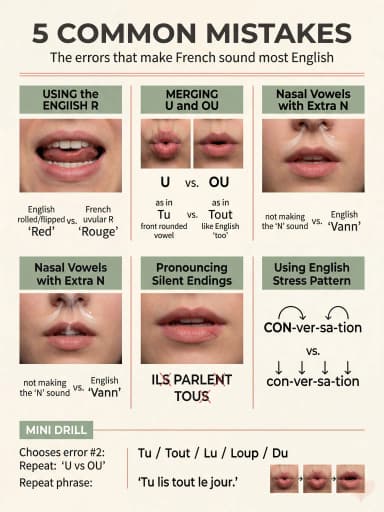
For many English speakers, the French R is the moment a word turns into a traffic jam. Standard French commonly uses a sound made far back in the mouth, with light friction. It is not the English r, and it should not feel like a dramatic throat clear.
Words that train the French R
| Word | Broad IPA | What makes it difficult | Practical cue |
|---|---|---|---|
| rare (rare) | /ʁaʁ/ | The R appears twice, on both sides of a vowel. | Keep each R light. Let the a stay open between them. |
| restaurant (restaurant) | /ʁɛs.tɔ.ʁɑ̃/ | Two Rs plus a nasal ending. | Build it as res + to + ran, then join it. |
| serrurerie (locksmith’s shop) | /sɛ.ʁyʁ.ʁi/ | Three Rs and French u in the same word. | Do not attack all three Rs. Make three small, relaxed contacts. |
Say rare as a loop: ra - ra - rare. If the sound turns into an English r, reset with a breathy, quiet friction at the back of the tongue. If it turns harsh, use less air.
Then put it to work:
C'est rare., “That is rare.”Un restaurant, s'il vous plaît., “A restaurant, please.”Je cherche une serrurerie., “I am looking for a locksmith.”
The University of Texas describes French /R/ as back-of-mouth friction and places the tongue tip behind the lower teeth, a useful physical contrast with the English sound (UT Austin’s French R lesson). For a full progression from mouth setup to sentences, use the French R daily drill.
Thirty-second drill: alternate ra - rue - ro five times, then say rare, rue, restaurant once each without looking. The goal is continuity, not volume.
2. Nasal-vowel words: do not add a final n
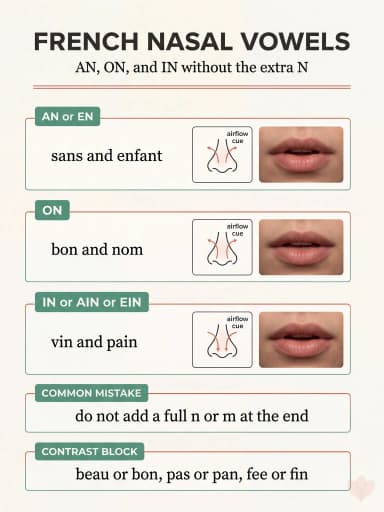
Nasal vowels make ordinary French words feel slippery because English speakers often hear a vowel plus a final consonant. In French, the n or m after the vowel often signals nasality instead. If you close your tongue or lips for a clear final n or m, you change the sound.
Words that train nasal vowels
| Word | Broad IPA | Pattern | What to avoid |
|---|---|---|---|
| pain (bread) | /pɛ̃/ | ai + n gives a nasal vowel. | “pay-n” |
| parfum (perfume) | /paʁ.fœ̃/ | French R plus nasal /œ̃/; many speakers merge this toward /ɛ̃/. | A full final m |
| emprunter (to borrow) | /ɑ̃.pʁœ̃.te/ | Two nasal vowels with an R cluster between them. | Splitting it into em-prahn-ter |
| bonjour (hello) | /bɔ̃.ʒuʁ/ | A common word with on and final R. | “bon-n-jore” |
Keep the vowel open while air also escapes through the nose. Your mouth does not need to close at the end of pain. Let the sound fade instead.
French teaching materials at UT Austin make the same contrast plainly: English may nasalize a vowel before n or m, but the consonant remains; in French, the following nasal consonant is not pronounced in these vowel patterns (UT Austin’s nasal-vowel lesson).
Thirty-second drill: say beau / bon, then peau / pain, then pain / parfum / bonjour. Touch a finger under your nose only as a reminder to keep airflow going. Do not pinch your nose or force it.
If this remains fuzzy, stop adding new words. Spend a few days with nasal-vowel minimal pairs until you can hear and say the contrast before adding speed.
3. U, OU, and EU words: same lips, different tongue position
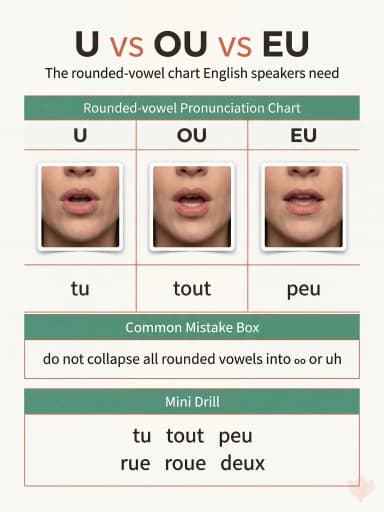
These are some of the hardest French words to pronounce because English does not give you the same rounded-vowel map. The spelling does not help much either: u, ou, and eu look related, but they do different jobs.
The three targets in one glance
| Spelling family | IPA | Starter cue | Word to use in a sentence |
|---|---|---|---|
u | /y/ | Say “ee” while keeping your lips rounded. | rue /ʁy/, street |
ou | /u/ | Keep the lip rounding; pull the tongue farther back. | roue /ʁu/, wheel |
eu / œu | /ø/ or /œ/ | Rounded lips with a mid-front vowel; /ø/ is usually closer and /œ/ more open. | peu /pø/, little; peur /pœʁ/, fear |
UT Austin’s vowel lesson uses the same useful contrast: /y/ has rounded lips with a front tongue position, while /u/ keeps the rounding and moves the tongue back. It also warns English speakers not to let French vowels slide into a second sound (UT Austin’s /i/ /y/ /u/ lesson).
The famous test word écureuil (squirrel) is difficult because it stacks /y/, French R, /œ/, and a final /j/ glide: /e.ky.ʁœj/. Do not make it your first target. Train the pieces first:
rue / roue, hold the lip shape, change only tongue position.peu / peur, listen for the more open vowel in peur.é-cu-reuil, three compact beats, with the last ending like “uh-y” said quickly, not an audible finall.
A better test than an English spelling cue
Record La rue est longue and La roue est longue. If your two key words sound identical, return to rue / roue before practising the whole sentence.
For a dedicated contrast routine, use French U vs OU practice. It is easier to fix a two-word contrast than to chase écureuil at full speed.
4. Consonant clusters and glides: keep the word compact
Some French words become difficult when an English speaker inserts a small extra vowel between consonants or stretches a glide into two syllables. The word may be short on the page but crowded in the mouth.
Cluster words worth learning
| Word | Broad IPA | What is happening | Repair |
|---|---|---|---|
| train (train) | /tʁɛ̃/ | /tʁ/ starts as one cluster, then moves straight to a nasal vowel. | Say t then release directly into a light R. Do not make tuh-rain. |
| prendre (to take) | /pʁɑ̃dʁ/ | R appears after both p and d; the middle vowel is nasal. | Practise pran first, then add the final dr. |
| pneu (tyre) | /pnø/ | /pn/ is compact, followed by eu. | Avoid puh-neu; keep the p and n touching. |
| grenouille (frog) | /ɡʁə.nuj/ | Opening R cluster and final /j/ glide. | Use two beats: gre - nouille, with the last glide quick. |
The word grenouille is not a party trick. It gives you a useful /ɡʁ/ opening and a final /j/ glide like the one at the end of fille or feuille. French semi-vowels turn certain vowel sequences into a compact glide rather than an extra syllable; that is why grenouille ends in /nuj/, not nou-ill-uh (French semi-vowels explained).
Thirty-second drill: clap once per beat: train (one), prendre (two), pneu (one), gre-nouille (two). If you need more claps than that, you have probably inserted a vowel.
Now move the words into realistic chunks:
Le train part à trois heures., “The train leaves at three.”Je voudrais prendre un café., “I would like to have a coffee.”Le pneu est crevé., “The tyre is flat.”
Clusters feel easier once the phrase has rhythm. Read them as chunks, not as a line of individual letters.
Practise the word inside the situation
Spokira uses short native-speaker clips, recording, and targeted feedback so hard sounds become café, travel, and everyday phrases you can say on time.
5. Silent endings: trust sound more than spelling
French becomes much easier when you stop assuming every final letter deserves its own sound. That does not mean endings are random. It means you need a reliable starting rule, then the common exceptions for words you use.
High-value silent-ending examples
| Written word | Broad IPA | What you say | What you skip |
|---|---|---|---|
| beaucoup (a lot) | /bo.ku/ | bo-koo | final p |
| parler (to speak) | /paʁ.le/ | par-lay | final r in -er |
| œufs (eggs) | /ø/ | one rounded vowel | f and s |
| ils parlent (they speak) | /il paʁl/ | eel parl | verb ending -ent |
| petit (small) | /pə.ti/ | puh-tee | final t |
CaReFuL, the classroom reminder for final C, R, F, and L, is a useful first filter, but it is not a promise. UT Austin presents it exactly that way: those final consonants are often pronounced, with exceptions such as infinitive -er endings (UT Austin’s syllable lesson).
Try this contrast aloud: parler /paʁ.le/ versus parle /paʁl/. The letters look close, but the sound and grammar change. That is why a word-by-word reading habit gets in the way.
Thirty-second drill: say beaucoup parler petit, then make the useful chunk Je parle beaucoup. Keep the final e of parle silent and do not release the final p of beaucoup.
For more exceptions and connected-speech cases, use the French silent final consonants guide, then connect it with French connected speech rules. A final consonant can stay silent in one context and surface in liaison in another, so learn the phrase, not just the isolated word.
A five-minute routine for hard French words that actually transfers
Use this when a word stops you in real conversation. It keeps the “hardest French words” problem small enough to repeat.
- Name the pattern. Is the problem R, a nasal vowel, a rounded vowel, a cluster, or a silent ending? Pick only one primary target.
- Make three slow reps. Use the IPA and a native recording. Keep the word short and relaxed.
- Contrast it. Pair it with a nearby word: rue / roue, beau / bon, parle / parler.
- Put it in one phrase. Say something you might need:
Je prends le train,C'est peu cher, orJe parle français. - Say it without reading. Look away, retrieve the phrase, and record one take.
If the sound falls apart in step 5, that is useful information. Go back one level. Do not add ten more difficult words. A stable rue / roue contrast is more valuable than a heroic but unreliable écureuil.
The point is not to collect hard words
The hardest French words to pronounce become manageable when you stop treating them as unique monsters. Restaurant is French R plus a nasal vowel. Écureuil is rounded vowels, R, and a glide. Prendre is a cluster with a nasal vowel. Each one is a small map of sounds you will meet again.
Pick the pattern that costs you the most clarity, practise it for five minutes, then use it in a phrase you can picture yourself saying. That is how you move from “I know this word” to “I can actually say it.”
If you want a simple loop of native audio, recording, and pronunciation feedback, practise speaking French with Spokira. Keep the target narrow, repeat it in context, and let the tricky words become ordinary ones.