If you have ever finished a lesson streak and still frozen in a real conversation, you are not the problem. Your training loop is.
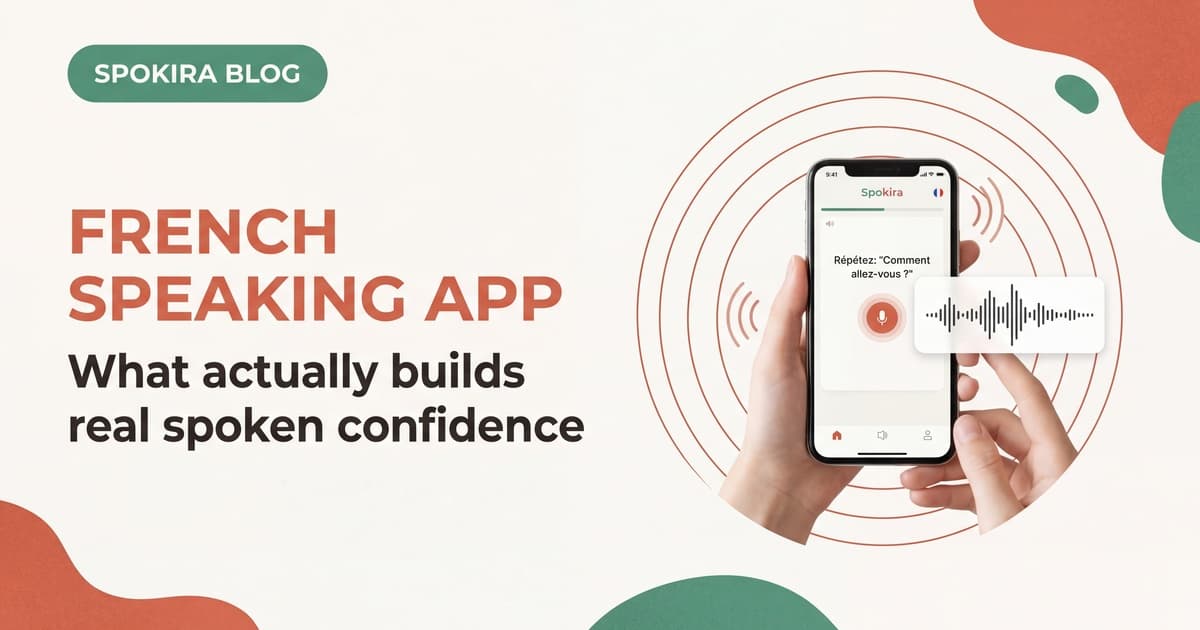
Many apps are good at recognition. Fewer are good at spoken retrieval under pressure. That gap is exactly why choosing the right french speaking app matters more than choosing the prettiest interface.
This guide is for learners who want real output, not just tap-through progress bars. You will get:
- A clear rubric for evaluating any French speaking app
- The 7 features that actually improve spoken performance
- A 7-day trial protocol so you can test apps with evidence
- A decision matrix for A2-B1 learners
For the claims in this article, we checked primary sources on March 12, 2026: the Council of Europe CEFR Companion Volume (2020), Karpicke and Roediger's retrieval-practice findings in PNAS (2008), and Cepeda et al.'s spacing meta-analysis in Psychological Bulletin (2006).
If you are actively comparing options right now, start with our practical comparison page for speaking-focused tools, then use this article to stress-test your shortlist.
Quick answer: what makes a French speaking app actually effective?
A strong French speaking app does four things consistently:
- Forces spoken output early, not after long passive lessons
- Gives specific feedback on pronunciation and rhythm
- Repeats high-frequency speaking scenarios with spaced retrieval
- Tracks speaking performance, not only lesson completion
This aligns with how language use is described in the CEFR Companion Volume (Council of Europe, 2020): communicative performance and interaction are central, not isolated rule recall.
It also aligns with learning science: retrieval practice tends to outperform repeated restudy for durable learning (PNAS, 2008), and spaced practice improves long-term retention versus massed repetition (Psychological Bulletin, 2006).
One-Line Rule
If an app lets you stay silent for most of the session, it is not a serious speaking app.
Why most "French speaking app" experiences fail in real conversations
Most products are optimized for habit retention, not speech transfer. A French speaking app should be evaluated on speaking outcomes, not streak optics.
You open the app, complete a lesson, and see progress. But you did not train the hardest part: retrieving and producing language in real time.
That is why learners often report the same pain point: "I understand more than I can say."
The issue is usually one of training design:
- too much multiple-choice recognition,
- too little timed spoken output,
- not enough correction loops,
- and weak scenario transfer.
If this sounds familiar, you are not behind. You just need a different practice architecture.
Start by reviewing your baseline routine in French Speaking Practice: The Complete Guide for A2-B1 Learners, then compare your app's behavior against the rubric below.
The 7-feature rubric: how to evaluate any French speaking app
Use this as your buyer's checklist. Score each feature from 0 to 2:
- 0 = missing
- 1 = present but weak/inconsistent
- 2 = strong and reliable
Maximum score: 14.
When a French speaking app scores below 9, most learners see weak transfer from lesson activity to spontaneous conversation.
1. Output-first design
Does the app make you speak in the first few minutes?
Good signals:
- short prompts you must answer aloud,
- call-and-response drills,
- timed recall tasks.
Weak signal:
- long passive lessons before any speaking turn.
2. Pronunciation feedback quality
Does the app tell you what to fix, or only that something is "wrong"?
Good signals:
- phoneme-level or syllable-level cues,
- rhythm or stress guidance,
- specific retry suggestions.
Weak signal:
- generic pass/fail badges with no target.
For context on what to fix first as an English speaker, use French Pronunciation for English Speakers and 5 Common French Pronunciation Mistakes.
3. Retrieval pressure
Does the app force recall without full text support?
Good signals:
- cue cards without full scripts,
- delayed repetition,
- roleplay turns where you must respond.
This is the core mechanism behind better retention in retrieval-based practice (Karpicke & Roediger, 2008).
4. Spacing and review logic
Does the app intelligently resurface weak lines and sounds?
Good signals:
- review queues based on your misses,
- recurring speaking prompts over days,
- reminders tied to weak performance.
Weak signal:
- one-and-done lessons with no targeted recycling.
Spacing is not optional if you want durable transfer (Cepeda et al., 2006).
5. Scenario realism
Does the app train actual situations you will face?
Good signals:
- café ordering,
- directions,
- clarifying misunderstandings,
- introducing yourself under time pressure.
Weak signal:
- isolated vocabulary with no interactive context.
If you need scenario drills now, pair your app work with French shadowing foundations and this one-clip rep method.
6. Progress metrics that reflect speaking skill
Does progress mean "I can say this" or just "I opened this lesson"?
Good signals:
- speaking speed and clarity trends,
- retry counts by sound pattern,
- completion scores for no-text takes.
Weak signal:
- XP points only.
7. Friction and consistency
Can you realistically use it 5-10 minutes daily?
Good signals:
- fast startup,
- low setup overhead,
- short, repeatable sessions.
A perfect app used twice a month loses to a good app used daily.
Comparison table: tap-through apps vs speaking-first apps
| Dimension | Tap-through lesson app | Speaking-first French app |
|---|---|---|
| Primary interaction | Reading + tapping | Speaking + responding |
| Core success metric | Streak/lesson completion | Spoken clarity + retrieval |
| Pronunciation support | Basic or optional | Central feedback loop |
| Error correction | Often generic | Specific and actionable |
| Review model | Content progression | Weak-point resurfacing |
| Transfer to conversation | Often slow | Faster if practiced daily |
| Best for | Early exposure and habit start | Active speaking gains |
This does not mean tap-through apps are useless. They can help with early vocabulary and consistency. But if your goal is to speak, you need output-heavy sessions in your weekly mix.
A 7-day test protocol before you commit to any app
Do not choose a French speaking app based on marketing claims. Run this short trial and judge behavior.
Day 1: baseline recording
Record a 45-60 second response on one familiar topic (introduce yourself, describe your day, or order at a café).
Score yourself from 0-2 in five categories:
- Clarity
- Rhythm
- Retrieval speed
- Repair after mistakes
- Confidence under time pressure
Keep this as your baseline clip.
Days 2-3: output and feedback audit
Run 10-15 minutes per day in the app.
Track:
- minutes spent speaking vs tapping,
- number of specific corrections,
- whether retries improved on second attempt.
If speaking time is under 50 percent, the app may not be speaking-first.
Days 4-5: retrieval stress test
Use only cue prompts where possible. Avoid full transcripts.
Track:
- average pause length before responses,
- number of stalls,
- whether prompts become easier across repeats.
For extra retrieval drills, add Stop freezing mid-sentence: retrieval drill.
Day 6: transfer test
Apply one trained scenario in free speaking (without the app's exact script).
Example: if you practiced café lines, run a new variation with changed details (drink, size, add-ons, payment question).
If you only perform with the exact script, transfer is still weak.
Day 7: compare baseline vs current
Record the same prompt as Day 1 and compare:
- fewer long pauses,
- clearer pronunciation,
- smoother rhythm,
- better self-repair.
If the difference is minimal, change app or change protocol. Do not wait months for "maybe."
Want speaking feedback that goes beyond streaks?
Train with short daily speaking drills, get pronunciation-level feedback, and track real output progress in one place.
What to avoid when choosing a French speaking practice app
Red flag 1: conversation mode is mostly scripted reading
If you can succeed by reading text aloud with little recall, speaking transfer will be limited.
Red flag 2: feedback says "incorrect" without explanation
You need direction: sound target, stress issue, or rhythm breakdown. Generic correctness is not coaching.
Red flag 3: no weak-point recycling
Without spaced review, each lesson becomes disposable. Durable speaking requires structured revisit loops.
Red flag 4: progress is gamified but non-diagnostic
Points are fine, but they should map to speaking outcomes.
Red flag 5: daily session design is too heavy
If it takes 20 steps to start speaking, consistency drops.
A practical stack that works for A2-B1 learners
Instead of searching for a "perfect" French speaking app, build a simple weekly stack:
- Core speaking app (daily 5-10 min)
- Shadowing block (3x/week, 10-20 min)
- Weekly recording review (2 takes + correction pass)
This gives you recognition, retrieval, and motor training together.
A concrete example week:
- Monday: app speaking drills + one no-text recording
- Tuesday: app drills + one-clip shadowing block
- Wednesday: app drills + scenario variation
- Thursday: app drills + retrieval-only prompts
- Friday: app drills + shadowing
- Saturday: short review session + weak-sound correction
- Sunday: baseline-style recording and score comparison
For confidence and review mechanics, use Record yourself in French without cringing.
Decision matrix: which app profile fits your current bottleneck?
Use your bottleneck, not hype, to choose.
| Your bottleneck | Best app profile | What to demand in week 1 |
|---|---|---|
| You understand but freeze when speaking | Retrieval-heavy prompt app | Cue-only drills and timed responses |
| You speak but sound unclear | Pronunciation-feedback app | Specific correction loops on weak sounds |
| You can do lessons but not conversations | Scenario roleplay app | Real-world dialogues with variation |
| You start strong then quit | Low-friction app with short sessions | Fast start, 5-minute repeatable units |
If your main pain point is accent clarity, prioritize apps with repeatable phoneme/rhythm feedback and build around pronunciation foundations for English speakers.
If your main pain point is retrieval speed, prioritize prompt-based speaking loops and layer in shadowing reps that force output timing.
How to track progress for 30 days (without overcomplicating it)
Keep one lightweight tracker so you can separate real gains from "it feels better today."
Use three weekly metrics:
- No-text speaking sample length before first long pause
- Retry count needed to produce one clear take
- Self-rated clarity score (0-10) on the same prompt family
A practical target for many A2-B1 learners is:
- week 1: reduce major stalls in one familiar scenario,
- week 2: keep pace while changing details,
- week 3: handle two linked prompts back to back,
- week 4: deliver a 60-90 second no-text answer with controlled rhythm.
Keep prompts stable enough to compare apples to apples. If you switch topics every day, trend data becomes noisy.
Use one anchor prompt all month, such as:
- "Introduce yourself and your weekly routine,"
- "Order at a café and ask one follow-up question,"
- "Explain a travel plan and clarify one misunderstanding."
Record once per week, then run a short review:
- What improved automatically?
- Where did pauses return?
- Which sound or chunk broke under speed?
Then route the next week of app sessions around that bottleneck. This is how you make any French speaking app more effective: not by doing more content, but by tightening the feedback loop.
FAQ: French speaking apps and real speaking progress
Can a French speaking app replace conversations with humans?
Not fully. Apps are strongest as high-frequency practice infrastructure. Human conversation is still essential for spontaneity and social nuance.
The practical model is both: app for daily reps, humans for transfer.
How long before I notice speaking improvements?
With daily output-focused sessions, many learners notice clearer retrieval and fewer long pauses within 2-4 weeks. Accent changes usually take longer and depend on correction quality plus repetition volume.
Is AI feedback enough for pronunciation?
It can be very useful if the feedback is specific and repeatable. You still need your own recording and comparison loop so you can hear improvement over time.
Do I need to stop using vocabulary or grammar apps?
No. Keep them if they help consistency. Just do not confuse recognition progress with speaking progress. Add a speaking-first layer to your routine.
Final takeaways: choose for output, not for optics
If your goal is to actually speak French, your French speaking app should look less like a quiz platform and more like a training loop:
- prompt,
- respond,
- correct,
- repeat,
- transfer.
When evaluating a french speaking app, the winning question is simple: "Did this session make my spoken output faster, clearer, and more automatic?"
If yes, keep it.
If not, switch the tool or switch the protocol.
Your confidence grows when your reps become specific, short, and daily.
If you want one place to practice, get feedback, and build a consistent speaking habit, you can start a free workflow today at Spokira trial.