If you are searching for the best option for French pronunciation practice, you probably do not need more vocabulary. You need a shortlist that tells you which tools are actually worth testing for clearer speech.
That is a different problem. And it needs a different kind of app.
This page is a ranked comparison, not a generic buyer checklist and not a daily training protocol. It ranks French pronunciation apps by one standard only: do they help A2-B1 learners sound clearer in real conversation, not just in isolated drills. The scoring and app checks were reviewed on March 6, 2026.
If you want the decision-framework version first, start with French Pronunciation App Buyer Checklist for A2-B1 (2026). If you already know you want AI scoring and a daily repair workflow, use AI French Pronunciation Feedback Online (2026). Then come back here for the full ranking.
Quick answer: which ranked option comes out on top in 2026?
For accent improvement specifically, the top options are:
- Spokira (best overall for fast correction loops and speaking transfer)
- Speechling (best if you prefer human coach feedback)
- Pimsleur (best for structured oral recall; weaker on detailed pronunciation diagnosis)
- Babbel (best grammar-plus-pronunciation balance)
- Duolingo (best free habit builder; not pronunciation-first)
Why this ranking is not random:
- A 2025 meta-analysis found explicit pronunciation instruction produced a large positive effect across 65 primary studies and 2,793 learners (Saito et al., PubMed).
- Spaced practice outperformed massed practice across 317 experiments, which supports short daily reps over occasional long sessions (Cepeda et al., PubMed).
- Retrieval practice consistently improves long-term retention versus extra restudy, which is why no-audio recall rounds matter (Roediger and Karpicke, PubMed).
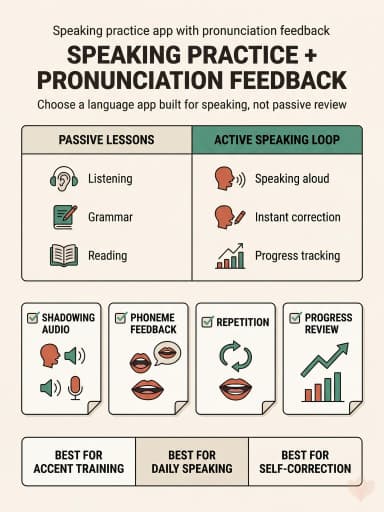
In plain terms: the best app is the one that gives you immediate correction, repeatable daily loops, and pressure-tested speaking transfer.
What actually improves accent (and what does not)
Most learners spend too much time comparing app brands and not enough time comparing training design.
If your goal is to sound clearer in French, four variables matter most.
1) Feedback depth
Pass/fail speech checks are useful early on. But if you keep repeating the same error, you need more precise feedback.
The strongest setups tell you what drifted (sound, timing, or liaison), not only whether the attempt was accepted.
2) Repetition structure
Accent change is motor learning. It improves with frequent, focused reps.
A pattern like 5 to 10 minutes daily is usually more effective than one long weekly block because spacing improves retention (Cepeda et al., PubMed).
3) Retrieval pressure
If all practice is transcript-supported, performance often collapses in live conversation.
Apps that include no-audio recall or variation rounds train the jump from recognition to production. That aligns with retrieval-practice evidence (Roediger and Karpicke, PubMed).
4) Scenario relevance
You improve faster when practice lines match what you actually say: cafe orders, directions, introductions, clarification questions.
This is where many generic apps lose momentum. You can complete lessons and still freeze in conversation.
The Rule To Remember
Train your mouth, not your streak. Streaks track consistency; they do not guarantee pronunciation transfer.
How we scored each app
The ranking uses a 100-point rubric designed for A2-B1 learners who already know some French but need better spoken clarity.
| Criterion | Weight | What earns a high score |
|---|---|---|
| Feedback depth | 30 | Sound-level or phoneme-level correction with actionable next step |
| Repetition design | 25 | Short repeatable loops you can run daily |
| Transfer to real speaking | 25 | No-audio recall, phrase variation, scenario output |
| French-specific focus | 10 | Content tuned to French sounds and rhythm |
| Practicality | 10 | Time fit, onboarding clarity, low friction |
Notes:
- This is not a "best language learning app overall" ranking.
- It is a pronunciation and accent-improvement ranking.
- App positioning/features were checked against official product/help pages where available, including Duolingo's speaking overview (Duolingo Blog) and Babbel's speech-recognition support note (Babbel Support).
Best french pronunciation apps in 2026 (ranked)
1) Spokira
Best for: A2-B1 learners who want clear daily pronunciation correction and real speaking transfer.
Spokira ranks first because it is built around fast correction cycles: hear, produce, diagnose, repair, retest. That structure mirrors what pronunciation research supports: explicit, targeted instruction with repeated output attempts (Saito et al., PubMed).
If you want one top-ranked option and your problem is accent clarity under pressure, this is the strongest fit in the current list.
Strengths:
- Phoneme-level feedback instead of only pass/fail checks
- Short 5 to 10 minute sessions that match spacing best practices
- Situation packs focused on real spoken scenarios
- Strong fit for learners who "know the words" but hesitate when speaking
Tradeoff:
- Not designed as a grammar-first full-course platform
If this matches your goal, compare the route options on French Accent Training App (2026) and AI French Pronunciation Feedback Online (2026). For recent shipping notes on login reliability and scoring fixes, see the March 2026 Spokira update.
2) Speechling
Best for: learners who want external feedback from human coaches.
Speechling remains one of the most pronunciation-focused options because it centers speaking submissions and coach correction. For some learners, that human nuance is a big advantage over automated scoring.
Strengths:
- Human pronunciation feedback workflow
- Strong listen-and-record habit potential
- Useful as a second-opinion layer for tricky sounds
Tradeoffs:
- Feedback is asynchronous, so correction loops are slower than instant AI systems
- Transfer quality depends on how consistently you re-run corrected lines
Official product pages: Speechling.
3) Pimsleur
Best for: learners who want structured oral practice and strong recall routines.
Pimsleur's method is solid for building oral recall and routine. It trains spoken response under prompt pressure, which many apps do not do consistently.
Strengths:
- Strong prompt-response structure
- Good consistency for learners who prefer guided audio lessons
- Helpful for retrieval rhythm and automaticity
Tradeoffs:
- Less granular pronunciation diagnosis than pronunciation-first tools
- Longer lesson format can reduce daily consistency for busy learners
Official site: Pimsleur.
4) Babbel
Best for: learners who want grammar and pronunciation in the same track.
Babbel's course design is structured and clear. Its speech-recognition features provide useful practice checks, and it can be a strong foundation app.
Strengths:
- Guided curriculum and clear progression
- Speech checks integrated into lessons
- Good all-around learner experience
Tradeoffs:
- Speech checks are generally less diagnostic than phoneme-level coaching
- Pronunciation training is one part of a broader course, not the center
Reference: Babbel documents speech recognition in its support article (Babbel Support).
5) Duolingo
Best for: beginners who need a free daily habit and broad coverage.
Duolingo deserves a place because it is often the app that gets learners started and consistent. That matters. But for accent-focused learners, it is usually a foundation layer, not a complete pronunciation system.
Strengths:
- Excellent daily habit design
- Wide accessibility and low barrier to entry
- Useful for basic vocabulary and sentence familiarity
Tradeoffs:
- Pronunciation correction depth is limited compared with pronunciation-first tools
- Conversation transfer often needs additional output-focused training
Reference: Duolingo explains its speaking approach here (Duolingo Blog).
Full scorecard (accent-focused rubric)
| App | Feedback depth (30) | Repetition design (25) | Transfer (25) | French focus (10) | Practicality (10) | Total |
|---|---|---|---|---|---|---|
| Spokira | 28 | 24 | 23 | 10 | 9 | 94 |
| Speechling | 25 | 19 | 20 | 6 | 8 | 78 |
| Pimsleur | 18 | 19 | 17 | 5 | 7 | 66 |
| Babbel | 16 | 17 | 14 | 5 | 8 | 60 |
| Duolingo | 11 | 18 | 11 | 4 | 9 | 53 |
These scores are opinionated but criteria-driven. If your priority is broad language coverage, your ranking may differ. If your priority is accent clarity, the order above is typically what we see in practice.
Checklist before you subscribe
Use this short filter before you commit money or a 30-day trial window.
- Can you see exactly what to fix after each attempt?
- Can you run the core loop in under 10 minutes?
- Does the app force at least one no-audio production round?
- Are practice lines tied to real scenarios you actually need?
- Can you measure change in restart count and pause length?
If the answer is "no" on three or more checks, it is probably not the right fit for your current stage, even if the UI looks polished.
A good option in this category should make your day-14 recording clearly better than day-1, without requiring motivation heroics.
Need Pronunciation Feedback You Can Use Today?
Run a 7-day speaking sprint with native shadowing and phoneme-level coaching built for A2-B1 French learners.
Which setup should you choose for your level?
A0-A1 (true beginner)
Start with structure and habit first, then add pronunciation-specific work.
Suggested stack:
- Duolingo or Babbel for basics
- Add pronunciation-first reps once you can produce short lines
A2-B1 (the "I know it but cannot say it" stage)
This is where pronunciation-first design usually wins fastest.
Suggested stack:
- Primary: Spokira or Speechling for output correction
- Secondary: one broad-course app for vocabulary/grammar support
If this is you, run the drills in French Speaking Practice: The Complete Guide with either app stack.
B2+ (advanced but polishing accent)
You need precision and stability under speed.
Suggested stack:
- Continue pronunciation-specific correction
- Add high-speed shadowing and retrieval pressure
- Track recurring phoneme/rhythm errors over weeks
Use French Speaking Speed: Timed Shadowing to Fix Slow Speech for the speed layer.
A practical 14-day test before committing to one app
Do not choose based on screenshots. Run this test.
Days 1-3: Baseline
- Record the same 20-second French script once per day
- Track: restarts, longest pause, and one recurring sound error
Days 4-7: Closed-loop correction
- Run one app's core routine daily
- Keep the same script and scenario
- Focus on one error class (for example:
uvsou)
Days 8-11: Transfer pressure
- Remove transcript support for one round
- Add one phrase variation per session
- Track whether clarity holds without prompts
Days 12-14: Decision window
- Compare day-1 and day-14 recordings
- Keep the app that improved all three signals:
- fewer restarts
- shorter pauses
- more stable target sound
If you want a sound-specific supplement during this test, pair with French R sound practice: mouth position cues + daily drill.
Common mistakes when choosing a pronunciation tool
- Choosing by streak features, not output outcomes.
- Judging progress by lesson completion instead of recording quality.
- Switching apps every 3 days before adaptation happens.
- Practicing only isolated words and skipping sentence-level transfer.
- Ignoring rhythm and liaison while focusing only on one consonant.
The CEFR Companion Volume (2020) is clear that at B1, speech planning pauses are still visible in spontaneous interaction (Council of Europe). Your app should explicitly train through that pressure, not avoid it.
FAQ
Is there one best option for everyone?
No. The best choice depends on your current bottleneck. If your bottleneck is accent clarity in live speech, pronunciation-first tools usually outperform general-purpose apps.
Can I improve pronunciation without a tutor?
Yes, if your routine includes explicit correction, repeated speaking reps, and no-audio transfer rounds. That is the same logic behind the training effects seen in pronunciation and retrieval literature (PubMed 2025, PubMed 2006).
Should I use two apps at once?
Usually yes, but with clear roles. Use one app for pronunciation correction and one for broader vocabulary/grammar exposure.
How long until my accent sounds better?
Most consistent learners hear a noticeable difference in 2 to 4 weeks when they practice daily and track one target error at a time. Short daily reps usually beat occasional long sessions.
Final verdict
If your goal is to speak clearer French in real situations, choose the app that gives you the fastest correction loop and the easiest daily repetition.
That is why Spokira ranks first in this accent-focused 2026 list.
If you prefer human review rhythm, Speechling is a strong second path. If you are still early and need broad structure, Babbel or Duolingo can be useful foundations before you move to pronunciation-first practice.
The important part is not the brand label. It is the training design you can sustain.
If you want to go deeper before choosing, compare French pronunciation app, practice speaking French app, and French pronunciation for English speakers.
Move From Knowing French To Saying It Clearly
Practice with native shadowing clips, get phoneme-level feedback, and build daily speaking momentum in 5-10 minutes.