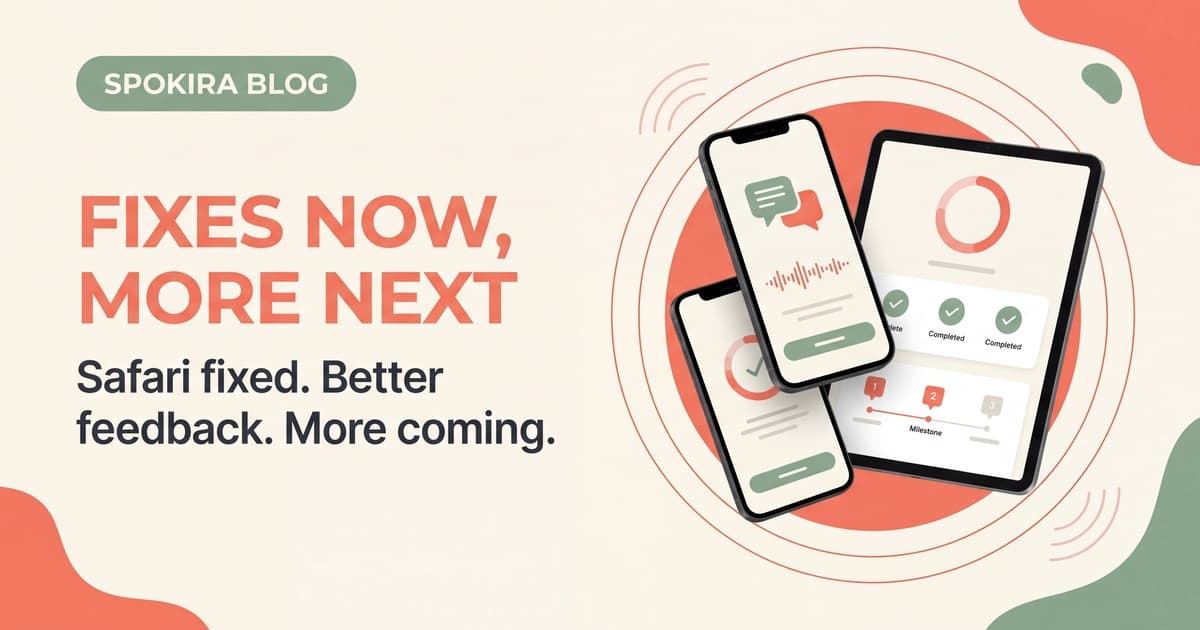
This Spokira product update covers three practical changes:
- Safari sign-in is fixed
- the pronunciation engine is less strict in cases where it should have accepted correct speech
- more packs, milestones, and broader speaking coverage are on the way
The short version is simple: getting into the app is more reliable, pronunciation feedback is fairer on close-enough attempts, and the next round of speaking content is already in flight. We wanted one page that explains what changed, why it mattered, and what to expect next.
Quick answer: what changed in this March 2026 Spokira product update?
Three things changed in this March 2026 Spokira product update. First, Safari sign-in is now more reliable after we tightened the redirect/session flow. Second, pronunciation scoring is less likely to reject valid near-target attempts on sensitive French sounds. Third, we are expanding packs and milestones so the product covers more real speaking situations with clearer progress markers.
Why we are writing this update down publicly
Product updates are useful when they reduce uncertainty, not when they read like celebration posts.
This one matters because each change touches a place where learner trust can break:
- sign-in has to work on the browsers people actually use
- pronunciation feedback has to feel fair enough to learn from
- the learning path has to keep expanding beyond the first few wins
That is the standard behind the changes below.
1. Safari sign-in is fixed
For a stretch of time, signing in with Google on Safari was unreliable on Spokira.
That sounds small when written in one line, but it is not a cosmetic bug. If authentication breaks, the rest of the product might as well not exist.
The issue came down to how Safari handles cookies and redirects during sign-in. Some users would lose their session halfway through, get sent to the wrong page, or loop back to the start without ever reaching the app.
WebKit's own Intelligent Tracking Prevention guidance shows why Safari can behave differently around cross-site tracking and storage boundaries (WebKit). We rebuilt the parts of the flow that were breaking, tightened the redirect logic, and re-checked the final path so the session survives the handoff more consistently.
Safari sign-in now works the way it should have from the start.
2. We fixed a pronunciation-engine issue that was too strict
We also fixed a bug in the pronunciation engine that could reject speech that should have passed.
The clearest version of the problem showed up around French nasal sounds, including words like Bonjour. In some cases, the engine was hearing a close-enough pronunciation and still being too strict about it.
That is a bad experience for a language learner. If you say something correctly, or close enough for the level and setting, the product should help you move forward. It should not make you feel stuck in place because the scoring logic is too rigid.
We tightened that part of the system so it is better at handling those edge cases. In plain language: the pronunciation engine should now do a better job of recognizing valid attempts instead of incorrectly blocking progress.
If the feedback is not trustworthy, the product is harder to learn from.
That matters even more on high-friction contrasts such as the nasal-vowel patterns covered in our AN/EN/ON/IN practice guide. Learners can handle hard feedback. What they cannot use is feedback that feels arbitrary.
3. More packs, milestones, situations, and goals are coming
Fixes are necessary, but they are not the whole story.
We are also continuing to expand the platform with:
- more packs
- more milestones
- broader coverage of real speaking situations
- clearer goals inside the product
The goal is not just more content. It is better coverage of the situations learners actually care about, and a clearer sense of progress while using Spokira.
We want Spokira to help whether you are trying to get through your first practice session, stop freezing in conversation, or build a routine that actually lasts.
The structure will stay aligned with the speaking workflow behind pages like French Speaking Practice Plan: 7-Day A2-B1 Routine: short loops, focused correction, and visible progress.
What changes for learners right now?
| Area | Before | Now |
|---|---|---|
| Safari sign-in | Some users could loop or lose session state | Redirect/session flow is more reliable |
| Pronunciation scoring | Some near-target attempts were rejected too aggressively | Acceptance logic is less strict on valid close calls |
| Content roadmap | Strong foundation, but narrower scenario coverage | More packs, milestones, and clearer goals in progress |
For users returning after a frustrating first try, that means a smoother start and less second-guessing about whether a correction is fair.
What ties these three things together
The Safari fix, the pronunciation-engine fix, and the upcoming packs and milestones are all part of the same standard.
We want Spokira to be easy to enter, fair while you use it, and genuinely useful over time.
That means sign-in has to work. Feedback has to make sense. And the learning path has to keep growing.
That direction also fits the current discoverability environment. Google's current AI search guidance still rewards pages that are clear, trustworthy, and structured around direct answers (Google Search Central), while OpenAI's publisher guidance makes the same basic point from the crawler side: the pages that stay usable and indexable are the pages that can keep earning citations and visits (OpenAI Help Center). The product standard is similar: reliability first, then depth.
If you want the full product context, start with how Spokira works, review pricing, then compare this update against the current buyer guides for best apps to practice speaking French and best French pronunciation apps. If you are ready to test the current build directly, use the free trial.
Try Spokira again
If Safari sign-in failed on you before, or if you have not checked the app in a while, now is a good time to come back.
Thanks for sticking with us
Some of this work is visible. Some of it is not.
But it all matters.
We are going to keep improving the platform and making it better for everyone to use. And we are going to keep shipping more of what actually helps people speak with more confidence.