If you are searching for the best app to practice speaking French, you are probably in the same place most A2-B1 learners hit: you understand more than you can actually say out loud.
You know grammar. You recognize words. But when a real person asks a simple question, your response is slow, flat, or stuck.
More lessons usually do not fix that. Repeated speaking under a little pressure does.
This guide compares French speaking apps for A2-B1 learners through one practical lens: shadowing loops vs conversation-bot practice. Product checks and sources were reviewed on March 7, 2026.
For the quick buyer checklist version first, use Practice-Speaking French App Buyer Checklist. Then come back here for the full ranking.
Quick answer: what is the best app to practice speaking French at A2-B1?
If your main goal is speaking more clearly and answering faster, start here:
- Spokira
- Speechling
- Pimsleur
- Babbel
- Duolingo
Why this ranking looks the way it does:
- The Council of Europe CEFR Companion Volume defines A2-B1 speaking outcomes around handling predictable interactions and communicating main points with increasing independence (Council of Europe).
- A 2025 meta-analysis of explicit pronunciation instruction reported strong overall gains across 65 studies and 2,793 learners, supporting targeted feedback over passive exposure (Saito et al., PubMed).
- Spacing and retrieval effects remain robust in learning science: distributed practice and recall testing improve long-term retention compared with massed review or extra restudy (Cepeda et al., PubMed; Roediger & Karpicke, PubMed).
In plain terms, the winning app is the one that gets you speaking every day, corrects the mistakes that matter, and eventually takes the transcript away.
If you are still deciding, choose by bottleneck:
- unclear pronunciation: choose a shadowing-first app
- frequent freezing: choose a conversation-bot app
- mixed profile: choose a hybrid app and alternate drill types
Shadowing vs conversation bots: what each method actually trains
Most app comparisons go wrong because they compare brands instead of what the drills actually train.
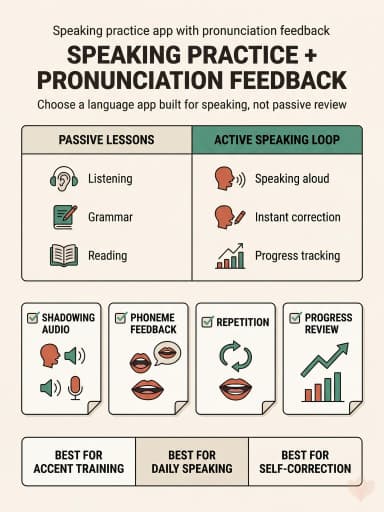
Shadowing-first apps train articulation and rhythm
Shadowing means hearing a short line and repeating it right away, then running it again until the timing, stress, and sound placement stop feeling off.
For A2-B1 learners, shadowing is efficient for:
- pronunciation consistency
- linking and rhythm
- reducing "translation lag"
- moving from textbook cadence to spoken cadence
It works best when the app tells you what to fix and lets you try again quickly. It works much worse when you are just parroting audio and hoping for the best.
If you want the broader DIY stack around this method, including subtitle players, repeat tools, recorders, and review apps, use best shadowing tools for French.
Conversation-bot apps train retrieval under uncertainty
Conversation bots simulate open-ended turns. You have to pick the words yourself, without a script sitting in front of you.
For A2-B1 learners, conversation bots are useful for:
- response speed
- tolerance for uncertainty
- topic switching
- spontaneous sentence building
The downside is that they can let fuzzy pronunciation slide unless the product also gives explicit audio feedback.
Hybrid systems usually win
For most learners, the strongest setup is not either/or. It is a sequence:
- shadowing for sound and timing
- guided recall without transcript
- conversation simulation with variation
That progression aligns with what spaced and retrieval-based learning research supports: build form first, then retrieve under pressure.
Fast Decision Rule
Choose shadowing-first if your speech sounds unclear. Choose conversation-bot-first if you already sound clear but freeze in live dialogue.
How we scored the best French speaking practice apps
We used a 100-point rubric aimed at A2-B1 learners who care about real speaking gains, not just ticking off lessons.
| Criterion | Weight | High-score signal |
|---|---|---|
| Speaking transfer | 30 | Output moves from drills to real conversation |
| Feedback quality | 25 | Useful correction on sound, timing, or clarity |
| Daily consistency fit | 20 | Sessions are short enough to repeat daily |
| Retrieval pressure | 15 | Script-free or low-support speaking rounds |
| A2-B1 suitability | 10 | Content is not too basic or too advanced |
A few notes on scope:
- This is a speaking-practice ranking, not a complete grammar-course ranking.
- Product descriptions were checked against official pages where available, including Duolingo's speaking-skill overview (Duolingo Blog), Babbel's speech-recognition support note (Babbel Support), and core product sites for Speechling and Pimsleur.
Best app to practice speaking French options (A2-B1) in 2026
1) Spokira
Best for: learners who want fast pronunciation correction plus speaking transfer drills.
Spokira ranks first because it is built around short correction cycles rather than long passive lessons: listen, produce, diagnose, repair, retest.
Where it is strongest:
- phoneme-level correction cues for French-specific problems
- short practice loops compatible with daily spacing
- scenario packs that turn isolated lines into conversation moves
- transition from shadowing to retrieval-based speaking rounds
Tradeoff:
- less focused on broad grammar progression than full-course apps
If that sounds like your bottleneck, start with French Pronunciation App and French Accent Training App, then use the weekly structure in French Speaking Practice Guide. For recent product-level fixes around sign-in and pronunciation scoring, see the March 2026 Spokira update.
2) Speechling
Best for: learners who want coach-corrected shadowing and asynchronous accountability.
Speechling is still one of the clearest shadowing-first options because repeated speaking submissions and feedback are the whole point.
Where it is strongest:
- speaking production is central, not optional
- strong habit loop for listen-record-repeat
- useful for learners who benefit from external accountability
Tradeoffs:
- feedback timing is asynchronous
- less immediate than instant AI correction loops
Official product reference: Speechling.
3) Pimsleur
Best for: learners who need structured oral recall and routine.
Pimsleur's audio-first prompt-response format still works well for making speech more automatic. It is especially useful for learners who spend too much time reading and not enough time answering out loud.
Where it is strongest:
- guided oral response cadence
- repeatable routine that supports consistency
- good for reducing hesitation on high-frequency phrases
Tradeoffs:
- less granular pronunciation diagnosis
- longer lesson format can be harder for busy daily scheduling
Official product reference: Pimsleur.
4) Babbel
Best for: learners who want a balanced course with built-in speaking checks.
Babbel mixes structured lessons with speech-recognition practice. For many A2 learners, that makes it a practical bridge between beginner coursework and more active speaking.
Where it is strongest:
- guided progression and clear lesson structure
- integrated speaking checks
- strong for learners who want grammar and speaking in one app
Tradeoffs:
- speaking feedback is less diagnostic than pronunciation-first tools
- conversation transfer still needs extra unscripted practice
Reference: Babbel's own support documentation on speech recognition (Babbel Support).
5) Duolingo
Best for: learners who need a reliable daily habit and low-friction practice.
Duolingo is still very good at keeping people consistent. It includes speaking practice and, for some users, AI conversation modes, but it still works primarily as a broad language-learning platform rather than a speaking specialist.
Where it is strongest:
- high daily adherence
- low barrier to regular engagement
- useful first layer before dedicated speaking drills
Tradeoffs:
- speaking depth varies by language/course features
- accent correction is generally less targeted than pronunciation-first systems
Reference: Duolingo's explanation of speaking-skill coverage and progression (Duolingo Blog).
Direct comparisons if you are down to two tools
If the shortlist still feels too broad, use the head-to-head pages instead of guessing from feature grids:
- Spokira vs Busuu for community correction versus guided speaking loops
- Spokira vs Babbel for structured lessons versus speaking-first practice
- Spokira vs Duolingo for habit-building versus deeper speaking transfer
- Spokira vs FluentU for video input versus output-first drills
- Spokira vs Mondly for scripted missions versus repeatable speaking reps
- Spokira vs Parle for accent-coach workflows versus repeatable correction cycles
- Spokira vs Pimsleur for audio-course structure versus guided retrieval
- Spokira vs Shadowing.app for method depth inside shadowing-first practice
- Spokira vs Speak.com for open AI roleplay versus guided retrieval reps
- Spokira vs Speechling for coach feedback versus instant correction loops
- Spokira vs Talkpal for conversation-bot breadth versus structured speaking transfer
Which style should you pick: shadowing or conversation bots?
If you are torn between app types, use this A2-B1 decision matrix.
| Your bottleneck | Better first method | Why |
|---|---|---|
| You sound unclear | Shadowing-first | Builds articulation and timing before free speaking |
| You freeze in conversation | Conversation-bot-first | Trains retrieval and response speed |
| You hesitate with familiar phrases | Hybrid | Fix sound, then push unscripted output |
| You lose consistency | Shadowing micro-sessions | Easier daily adherence than long open tasks |
| You plateau after apps | Hybrid with scenario drills | Adds context and transfer pressure |
For many learners, the highest-return plan is:
- 6-8 minutes shadowing
- 3-4 minutes no-transcript recall
- 4-6 minutes open conversation prompts
This plan also aligns with evidence on distributed practice and retrieval-based retention.
How to choose the best app to practice speaking French for your profile
If two apps look roughly equal, use this filter before you subscribe.
1) Match your bottleneck first
Ask one question first: what actually breaks when you speak?
- If listeners ask you to repeat yourself, your first need is sound clarity.
- If you sound clear in drills but freeze in dialogue, your first need is retrieval pressure.
- If both happen, split your week across both modes.
Many learners lose weeks by choosing the most popular app instead of the one that matches their real bottleneck. What works for one learner can be a slow detour for another.
2) Check session shape, not feature count
A long feature list is not a training plan. What you need is a loop you can actually run almost every day in under 20 minutes.
Minimum useful loop:
- one short imitation block
- one correction block
- one script-free output block
If the product makes that loop awkward, consistency usually dies first.
3) Verify transfer signals
Any app can feel good while you are inside the lesson. Transfer is what happens afterward. Run a weekly transfer test:
- speak for 60 seconds on one familiar topic
- no transcript, no pause
- compare recordings week over week
The right app should improve response speed, not just make you feel better during practice.
4) Price against usage reality
A cheaper app you use daily can beat a premium app you keep avoiding. Before you buy an annual plan, test usage for 14 days and calculate the real cost per finished speaking session.
5) Decide your stack in one sentence
Use this sentence template:
"My best app to practice speaking French is X for daily drills, plus Y once or twice a week for transfer pressure."
That one sentence keeps your stack intentional and cuts down on random app-hopping.
30-day test to find your best app to practice speaking French
Do not trust your first impression on day one. Use a simple 30-day test and keep the same measurement points throughout.
Week 1: baseline and setup
- pick one primary app
- set a fixed daily time
- record baseline samples:
- pronunciation sample (30-45 seconds)
- unscripted response sample (60 seconds)
Week 2: consistency check
Goal: hit at least five speaking sessions.
If you miss more than two sessions, the app is probably too heavy for your real schedule. The best one is the one you can keep using.
Week 3: transfer pressure
Add two unscripted speaking tasks with new prompts. If your speech falls apart as soon as the prompt changes, you need more retrieval rounds and less transcript-supported repetition.
Week 4: decision week
Keep the same prompts as week 1 and compare:
- pause length
- correction count
- speech continuity
- self-rated clarity
At day 30, either keep, stack, or replace:
- keep if speed and clarity improved
- stack if clarity improved but spontaneity did not
- replace if usage stayed low or transfer did not improve
That process turns "Which is the best app to practice speaking French?" from a vague feeling into a measurable decision.
A2-B1 weekly speaking plan (using any app stack)
You do not need the "perfect" app. You need a loop you will repeat.
Day structure (15-20 minutes)
- Shadowing set (6 minutes): 4-6 lines, repeated with correction focus.
- Retrieval set (5 minutes): same meanings, no transcript.
- Variation set (5 minutes): switch tense/person/context.
- Speed pass (2-4 minutes): timed responses.
Weekly rhythm
- Mon-Wed-Fri: clarity and pronunciation focus
- Tue-Thu: conversation-bot or open-response focus
- Sat: mixed simulation day
- Sun: short review + one recorded self-check
For drill templates, use French Output Retrieval Drill and French Conversation Freeze Drill.
Want Faster Speaking Gains Than Random App Hopping?
Use a proven shadowing-to-retrieval loop with AI pronunciation feedback built for A2-B1 French learners.
Common mistakes when choosing a French speaking app
Mistake 1: choosing by features, not training loop
Bad picks usually happen when learners compare features instead of asking, "Will I actually repeat this loop every day under mild pressure?"
Mistake 2: using only transcript-supported practice
If every session shows text, recall does not get trained enough. Keep at least one no-text segment in every session.
Mistake 3: skipping pronunciation diagnosis
If feedback is only right or wrong, stubborn sound errors can survive for months. Add one tool that tells you what is off.
Mistake 4: changing apps too often
Frequent switching kills adaptation. Keep one primary app for four weeks before judging results.
Mistake 5: no transfer test
If you never test your speech outside the app, you have no clean way to measure progress. Use a 60-second weekly self-recording and compare clarity and response speed over time.
Final verdict: best app to practice speaking French for A2-B1
If your goal is real speaking improvement, not just maintaining a streak, prioritize apps by training design:
- Best overall: Spokira
- Best shadowing with coach feedback: Speechling
- Best structured oral recall: Pimsleur
- Best balanced course with speaking checks: Babbel
- Best daily habit layer: Duolingo
For most A2-B1 learners, the best strategy is still hybrid: shadowing for sound, retrieval for memory, conversation simulation for fluency under pressure.
Pick one stack, run it consistently for four weeks, and track something measurable: response time, clarity, and how long you can keep a conversation going before you freeze.
If you want the implementation path, begin with Practice Speaking French App, then add French Speaking Speed Shadowing Routine as your weekly benchmark drill.