French Alphabet Sound Guide
A compact French alphabet sound guide with easy cues for every letter; use the page table for IPA.
Share this visual
Share the page URL so the visual earns links, saves, and citations.
Embed snippet links back to the canonical visual page.
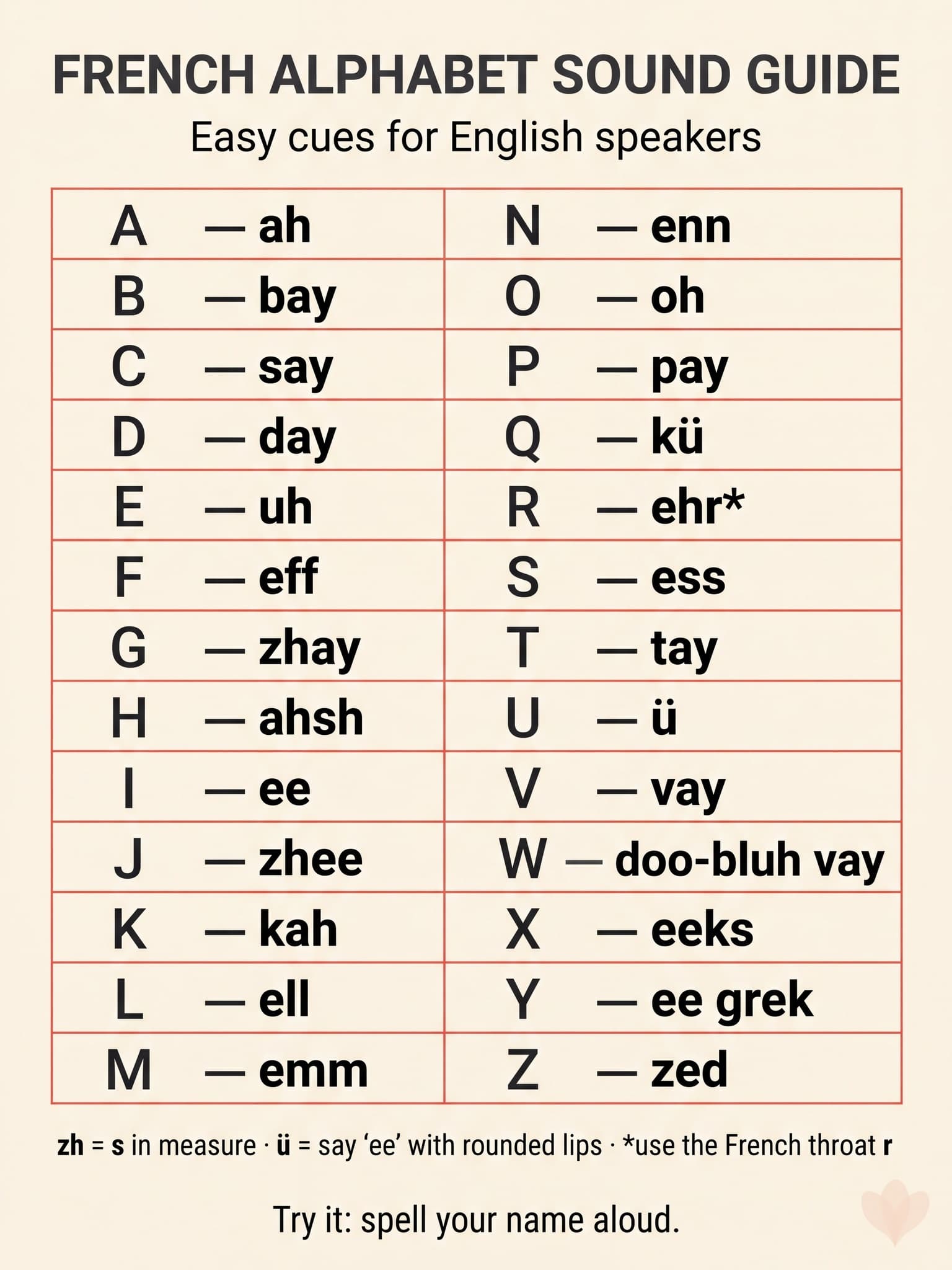
French and English use the same 26 basic letter shapes, but many letter names are different. That matters whenever you spell a name, email address, street, booking code, or train platform. The easy sound guide below is a speaking shortcut, not a replacement for a native model or IPA.
French letter names: A to Z
| Letter | Easy sound guide | French name (IPA) |
|---|---|---|
| A | ah | /a/ |
| B | bay | /be/ |
| C | say | /se/ |
| D | day | /de/ |
| E | uh | /ə/ |
| F | eff | /ɛf/ |
| G | zhay | /ʒe/ |
| H | ahsh | /aʃ/ |
| I | ee | /i/ |
| J | zhee | /ʒi/ |
| K | kah | /ka/ |
| L | ell | /ɛl/ |
| M | emm | /ɛm/ |
| N | enn | /ɛn/ |
| O | oh | /o/ |
| P | pay | /pe/ |
| Q | kü | /ky/ |
| R | ehr* | /ɛʁ/ |
| S | ess | /ɛs/ |
| T | tay | /te/ |
| U | ü | /y/ |
| V | vay | /ve/ |
| W | doo-bluh vay | /dublə ve/ |
| X | eeks | /iks/ |
| Y | ee grek | /iɡʁɛk/ |
| Z | zed | /zɛd/ |
The easy sound guide is deliberately approximate: it gives English speakers a first target, while IPA records the intended sound more precisely. Neither is a recording. Listen to a native model before treating a familiar-looking spelling as an English sound. The International Phonetic Association's interactive chart explains the symbols and provides reference audio for individual sounds.
The letter names English speakers usually confuse
- G and J:
Gis/ʒe/;Jis/ʒi/. Both start with the French sound in jour, not the English sound in go. - E and U:
Eis a short/ə/;Uis/y/, the rounded-front vowel also heard in tu. They are not English “ee” and “you.” - Q:
Qis/ky/, not English “cue.” Keep the lips rounded for the final vowel. - R:
Ris/ɛʁ/. The letter name ends with the Frenchr, so avoid turning it into an Englishr. - W and Y:
Wis double vé;Yis i grec. Learn them as full French names rather than translating the English names.
Accents and special letters
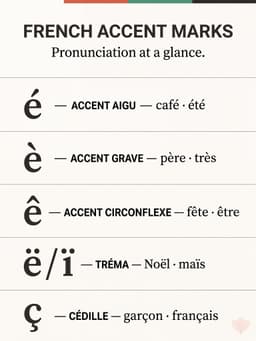
Accents change the written letter, but you still name the base letter when spelling. For example, é is commonly called e accent aigu and ç is c cédille. In everyday spelling, say the letter first, then add the mark only when the other person needs it.
The same principle applies to a hyphen, apostrophe, or space: spell the letters at a steady pace, then add the punctuation. A chart helps you remember the names, but the listening model tells you how they sit in real speech.
Two-minute listening and spelling drill
- Listen once to a native speaker saying the alphabet. Point to each letter; do not repeat yet.
- Replay it in three chunks:
A–I,J–R, thenS–Z. Echo each chunk without forcing English letter names onto it. - Spell one useful item: your surname, email username, or a French place name. Pause briefly between letters, not after every sound.
- Record one pass, compare it with the model, and isolate only the one or two names that drifted.
Why the chart is useful
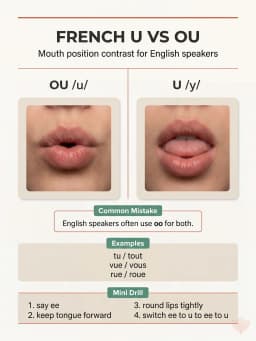
Letter names are a practical pronunciation task, not just a beginner recital. French learners use them when a name, code, email address, or reservation needs to be clarified. French has a sound system with contrasts English speakers may not expect; see French sounds versus English for the larger picture and the French U vs OU mouth-position guide for the rounded vowel in Q and U.
Where to go next
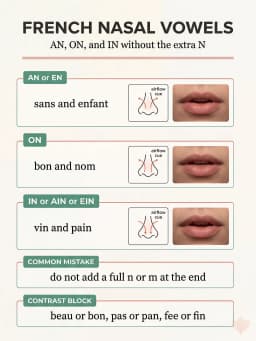
Use the French pronunciation diagram for English speakers to focus on the sound families behind the harder letter names. For a practice routine that turns listening into spoken control, read does reading French aloud improve pronunciation?.
Practice Inside Spokira
Practice French letter names with native audio in Spokira, then spell a real name or address aloud.