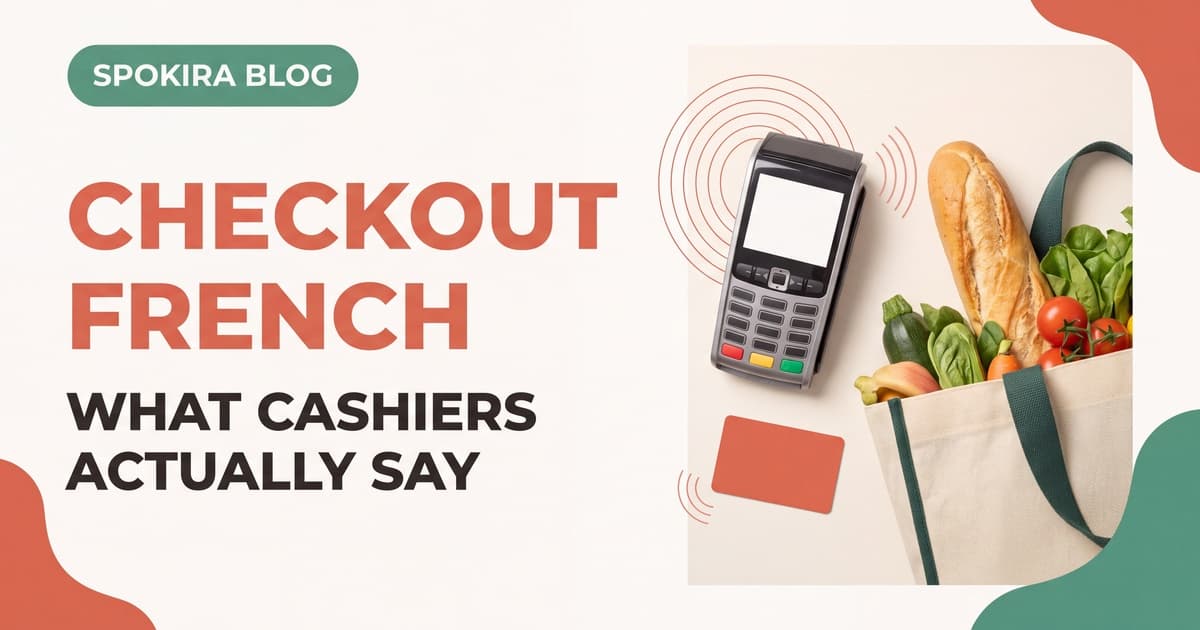
A French supermarket checkout is a tiny listening test with groceries rolling toward you. The cashier asks something short. You catch carte, say yes, and discover they meant the loyalty card rather than your bank card. Then comes ticket, a number, a payment terminal, and a queue behind you.
The good news is that the exchange is predictable. You do not need a speech. You need to recognize five topics: greeting, loyalty card, bag, payment, and receipt. The wording can change by store and speaker, but a handful of short replies will carry you through almost any staffed checkout in France.
This guide teaches the full neutral versions, the clipped lines you may actually hear, and the safest customer answer for each one.
Quick answer: what will you hear at a French supermarket checkout?
At a French supermarket checkout, expect some version of Bonjour, Vous avez la carte de fidélité?, Vous voulez un sac?, the total, a payment question, and Vous voulez le ticket? The order varies. A cashier may shorten the question to two or three words because the context is obvious.
| Cashier may say | What it means | Easy reply |
|---|---|---|
| Bonjour. | Hello. | Bonjour. |
| Vous avez la carte de fidélité? | Do you have the loyalty card? | Non, je ne l'ai pas. |
| Un sac? | A bag? | Non merci, j'ai le mien. |
| Ça vous fait 24 euros 60. | Your total is €24.60. | Par carte, s'il vous plaît. |
| Vous réglez comment? | How are you paying? | Par carte. / En espèces. |
| Vous voulez le ticket? | Would you like the receipt? | Oui, je veux bien. / Non merci. |
| Bonne journée. | Have a good day. | Merci, vous aussi. |
You may hear only La carte?, Un sac?, or Le ticket? These are not rude fragments in context. They are efficient checkout questions. Answer the topic, not the missing grammar.
How should you greet and address the cashier?
Use bonjour and vous. That is the useful default with an employee you do not know. You do not need Madame or Monsieur every time, and you do not need to create small talk when the queue is moving.
Cashier: Bonjour. You: Bonjour.
That two-word exchange sets the right register. At the end, merci, bonne journée is warm and ordinary.
Full forms versus checkout forms
French courses often teach complete inversion or est-ce que questions. A cashier is more likely to use normal spoken intonation:
- Full and natural: Est-ce que vous avez la carte de fidélité?
- More common and compact: Vous avez la carte de fidélité?
- Clipped by context: La carte de fidélité?
All three point to the same object. Listen for the content word: carte, sac, ticket, or espèces. The rest may be quiet or arrive while you are packing.
If you want to make your own requests sound polite without becoming formal, review how to use s'il vous plaît naturally.
What do cashiers say about bags and loyalty cards?
Bags and loyalty cards often arrive first, sometimes before the cashier scans your second item. The question order is not fixed. Some stores ask about the loyalty card on a screen; others ask aloud or wait for you to present it.
The bag question
You may hear:
- Vous voulez un sac?
- Vous avez besoin d'un sac?
- Il vous faut un sac?
- Un sac?
Natural replies:
- Non merci, j'ai le mien. = No thanks, I have my own.
- Oui, un sac, s'il vous plaît. = Yes, one bag, please.
- Deux sacs, s'il vous plaît. = Two bags, please.
- Non merci, ça ira. = No thanks, I'm fine.
Do not assume a bag is free or automatically provided. France has prohibited ordinary single-use plastic checkout bags since 2016, with a limited exception for qualifying compostable biosourced bags. The Ministry of Economy's current single-use plastic guidance explains the rule. Stores may sell reusable paper, plastic, or fabric bags, and practices differ.
The practical move is simple: bring a reusable bag, or ask Un sac, s'il vous plaît before you have a pile of loose groceries.
The loyalty-card question
The cashier may say:
- Vous avez la carte de fidélité?
- Vous avez la carte du magasin?
- Votre carte de fidélité?
- the store name plus la carte, such as La carte [store]?
Your bank card is la carte bancaire. The store loyalty card is la carte de fidélité. When you hear only la carte? early in the transaction, before the total appears, the cashier probably means loyalty. Context does the work.
Useful replies:
Oui, la voilà. Yes, here it is.
Non, je ne l'ai pas. No, I don't have it.
Non merci. No thanks.
If you have the app but cannot find the barcode, say Attendez, je l'ai sur mon téléphone or, more briefly, Une seconde, je l'ai sur l'appli.
How do totals and payment sound in French?
The cashier may simply announce the number. You might hear Ça fait..., Ça vous fait..., or the amount followed by s'il vous plaît. All mean that it is time to pay.
Ça vous fait vingt-quatre euros soixante. Your total is €24.60.
Quarante-deux euros dix, s'il vous plaît. €42.10, please.
French speakers often say the cents directly after euros without adding centimes. Train the whole price as one sound chunk instead of waiting for a word meaning “cents.”
Payment questions you may hear
- Vous réglez comment? = How are you paying?
- Vous payez comment? = How are you paying?
- Par carte? = By card?
- Carte ou espèces? = Card or cash?
- En sans contact? = Contactless?
Your replies can be very short:
- Par carte, s'il vous plaît.
- En espèces.
- En sans contact, si possible.
- Je peux payer par carte?
The everyday phrase is payer par carte, not “payer avec une carte de crédit” unless the card type matters. In France, carte bleue is still understood, but carte bancaire and simply carte are clearer general terms.
Why payment can vary by store
Do not treat one successful contactless purchase as a national promise. The Ministry of Economy's January 2026 payment guidance says merchants may refuse cards or set a minimum card amount if customers are informed. Cash is accepted in principle, with defined exceptions.
Large supermarkets generally make accepted methods visible, but a small shop can have different conditions. If you are unsure, ask Vous prenez la carte? before the goods are rung up.
What the terminal or cashier may say next
- Vous pouvez insérer votre carte. = You can insert your card.
- Posez votre carte ici. = Place your card here.
- Tapez votre code. = Enter your PIN.
- C'est passé. = It went through.
- Ça n'est pas passé. / C'est refusé. = It did not go through. / It was declined.
- Vous pouvez retirer votre carte. = You can remove your card.
If contactless fails, the useful line is Je vais l'insérer. If the terminal declines the card, try Je peux réessayer? or Je vais payer avec une autre carte.
Listen for the stage, not every word
Before the total, carte usually means a loyalty card. After the total, it usually means your payment card. The moment in the transaction is a listening clue.
Why does the cashier ask whether you want a receipt?
Since 1 August 2023, a standard receipt in France is generally printed or given on the customer's request, not automatically. The receipt has not been abolished. You can still ask for it, and some legally defined situations remain exceptions.
The DGCCRF's official receipt FAQ says the customer should request the receipt at the time of purchase. It also uses Souhaitez-vous un ticket? as an example of the single question a professional may ask about the receipt choice.
That policy is why a contemporary checkout dialogue often includes:
- Vous voulez le ticket?
- Avec le ticket?
- Le ticket?
- Vous souhaitez le ticket?
- Ticket papier ou par mail?
Natural receipt replies
Oui, s'il vous plaît. Yes, please.
Oui, je veux bien. Yes, please / Yes, that would be good.
Non merci. No thanks.
Je peux avoir le ticket, s'il vous plaît? May I have the receipt, please?
At a supermarket checkout, ticket or ticket de caisse is the normal word to recognize. Reçu exists, but translating English “receipt” word for word can make learners miss the word that appears in the real question.
Ask for the ticket if you may need proof of purchase, want to check promotions, or need it for a store exit gate. The official policy has exceptions, so a ticket may still print without the cashier asking. Store software and workflow also vary.
A realistic French supermarket checkout dialogue
Here is a compact staffed-checkout exchange. The cashier is not unfriendly; they are scanning items while asking routine questions.
Cashier: Bonjour. Vous avez la carte de fidélité? You: Bonjour. Non, je ne l'ai pas. Cashier: Un sac? You: Non merci, j'ai le mien. Cashier: Ça vous fait vingt-sept euros quarante-trois. You: Par carte, s'il vous plaît. Cashier: Vous pouvez y aller. You: C'est bon? Cashier: Oui, c'est passé. Vous voulez le ticket? You: Oui, je veux bien. Merci. Cashier: Tenez. Bonne journée. You: Merci, vous aussi. Au revoir.
Vous pouvez y aller literally means “you can go ahead.” At the terminal, it usually means you can tap, insert, or otherwise begin the payment. Watch the cashier's gesture and the terminal screen.
If you miss the question
Do not guess yes or no at random. Use one repair line:
Pardon? Sorry?
Vous pouvez répéter, s'il vous plaît? Could you repeat that, please?
Vous parlez de la carte de fidélité? Do you mean the loyalty card?
Le ticket? Oui, s'il vous plaît. The receipt? Yes, please.
Repeating the key noun as a question is fast and natural. La carte de fidélité? Non, je ne l'ai pas. buys you a second and confirms the topic.
A five-minute checkout listening drill
Reading the phrases once will not make them available with people waiting behind you. Train the sequence as a small speaking routine.
Minute 1: recognize the topic words
Say these five words in random order: bonjour, fidélité, sac, carte, ticket. Point to an imaginary object for each. You are building a fast meaning cue, not giving a vocabulary recital.
Minutes 2 and 3: answer without a full sentence
Have a partner or voice recorder ask the questions in a mixed order. Reply immediately:
- La carte de fidélité? → Non, je ne l'ai pas.
- Un sac? → Non merci, j'ai le mien.
- Vous réglez comment? → Par carte.
- Le ticket? → Oui, je veux bien.
Minute 4: add one misunderstanding
Interrupt the script with Pardon? Then listen again and answer. Real confidence is not hearing everything perfectly. It is knowing how to recover without abandoning French.
Minute 5: close cleanly
Finish every repetition with Merci, bonne journée. Au revoir. If you want more choices by time and register, use the guide to saying goodbye in French.
This is the same retrieval-under-pressure approach used in our French speaking practice guide: short prompt, spoken reply, correction, repeat.
Ready to practice the checkout reply?
Practice short real-life French exchanges with native audio, recording, and clear feedback before the queue is behind you.
Frequently asked checkout questions
Is carte a loyalty card or a bank card?
Use timing. Before the total, la carte? commonly means the store loyalty card. At payment, par carte? means a bank card. If you are unsure, ask La carte de fidélité?
Should I say en liquide or en espèces?
Both are understood for cash. En espèces is the neutral label you will see in payment guidance. En liquide is common in conversation. A one-word answer, espèces, is enough at the register.
Do I pack my own groceries?
In many French supermarkets, customers pack their own items at staffed checkouts, but layouts and service differ. Start packing as items arrive and keep listening. Avoid treating it as a rigid national etiquette rule.
What if I do not have a loyalty card?
Say Non, je ne l'ai pas or simply Non merci. You do not owe an explanation and do not need to join the program during the transaction.
What does ça ira mean here?
In response to a bag or receipt offer, non merci, ça ira means “no thanks, I'm fine.” It is a flexible refusal, but name the object if there is any risk of confusion.
Your whole checkout script can fit in six lines
You do not need fifty French supermarket checkout phrases. Keep these ready:
- Bonjour.
- Non, je n'ai pas la carte de fidélité.
- Non merci, j'ai mon sac.
- Par carte, s'il vous plaît.
- Oui, je veux bien le ticket.
- Merci, bonne journée. Au revoir.
Swap the yes and no answers to match the day. If you have just solved another aisle mystery, such as why much of the milk in France is not refrigerated, carry that small win to the register. Listen for the topic word, answer briefly, and keep packing.
For everything that happens before the till, use the French supermarkets guide for foreign shoppers. If a package date or storage line is the problem, the guide to French food labels and expiration dates gives you a repeatable five-step scan.