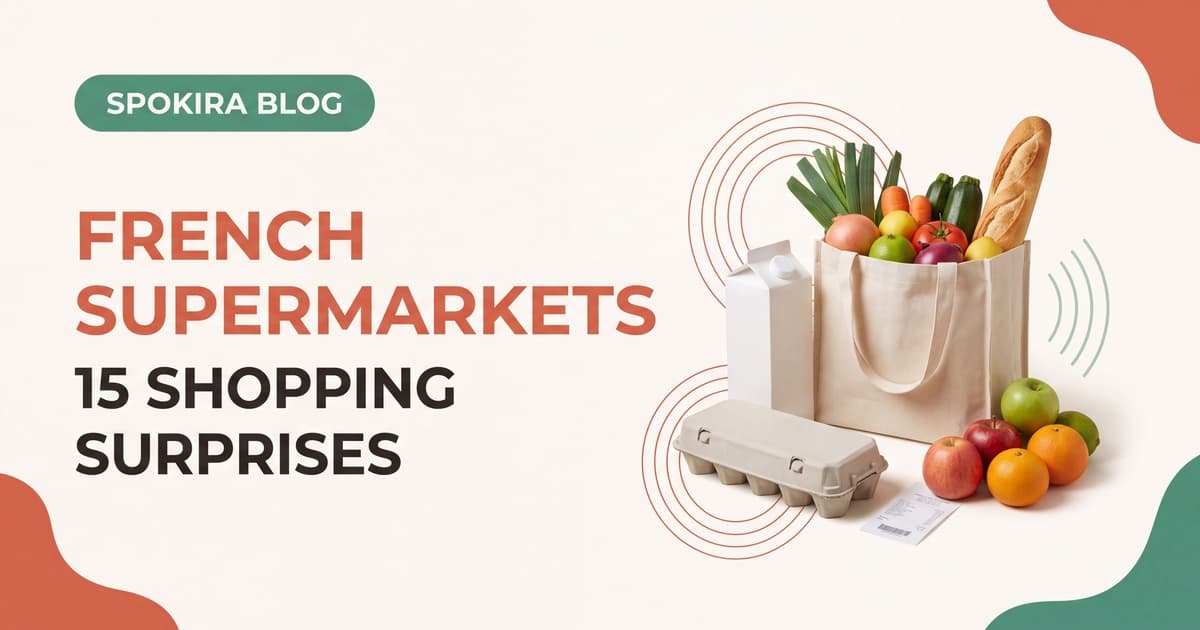
French supermarkets are easy to use once you know which details deserve a second look. The eggs may be on an ordinary shelf. The milk you want may not be in the fridge. A trolley may refuse to move until you feed it a coin. Then, at the till, four short questions can arrive before you have opened your bag.
None of this means there is one rigid set of “French supermarket etiquette.” Chains, shop sizes, regions, and individual branches differ. This guide separates common habits from actual label or retail rules, so you can shop without turning one store visit into a national theory.
This is the hub for our five-part French Supermarkets Explained series. Use it for the full tour, then follow the focused guides when eggs, milk, labels, or checkout French need a closer look.
Quick answer: what is different about French supermarkets?
The most noticeable differences are practical. Many shops display Class A eggs and UHT milk outside the fridge. You may need to weigh loose produce, unlock a trolley, bring bags, and pack quickly. Food dates use two phrases with different meanings, labels carry unfamiliar marks, and medicines are bought from a pharmacy rather than an ordinary supermarket aisle.
Here are the 15 surprises at a glance:
- Eggs are often outside the refrigerator.
- Most long-life milk sits on an ambient shelf.
- “Use by” and “best before” look similar in French but do different jobs.
- Nutri-Score does not appear on every product.
- AOP, IGP, bio, and Label Rouge do not mean the same thing.
- The unit price can tell you more than the pack price.
- Some loose produce must be weighed before checkout.
- Many trolleys need a coin or token.
- Reusable bags are part of the routine.
- You usually pack your own groceries.
- Checkout questions come quickly.
- Medicines are bought at a pharmacy.
- Sunday opening varies.
- Wine and beer are normal supermarket aisles.
- An épicerie, supermarché, and hypermarché offer very different trips.
French supermarkets explained: cold-shelf surprises
1. Eggs are often outside the refrigerator
Look near baking products, breakfast food, or an end of an aisle before assuming the shop is out of eggs. In mainstream metropolitan French supermarkets, fresh shell eggs are commonly displayed at a stable ambient temperature.
The useful explanation is not “French eggs never need refrigeration.” The retail supply chain limits chilling before sale, while cartons advise shoppers to chill eggs after purchase. Washing rules, temperature stability, and home storage all matter. Our full guide to why eggs are not refrigerated in France explains the current EU rule and what to do when you get home.
What to do: buy an intact carton, follow its storage instruction, and avoid moving eggs repeatedly between warm and cold places.
2. Most long-life milk sits on an ambient shelf
If you search only the refrigerator, you may find small bottles of fresh milk and miss the wall of cartons elsewhere. A large share of everyday milk is lait UHT: milk treated at ultra-high temperature and sealed for storage before opening.
That does not make all milk shelf-stable. The package decides. Fresh pasteurized milk stays chilled, and an opened UHT carton belongs in the fridge for the period stated on its label. The deeper guide to why milk is not refrigerated in France shows you how to distinguish UHT, pasteurisé, entier, demi-écrémé, and écrémé.
What to do: check the ambient aisle first, then read the after-opening instruction rather than relying on the carton shape.
3. The date wording changes the meaning
Two long phrases can look like bureaucratic variations of the same warning. They are not.
- À consommer jusqu'au... is a use-by date for highly perishable food. Treat it as a safety limit and follow the stated storage conditions.
- À consommer de préférence avant... is a best-before date. An intact product may lose quality after that date without automatically becoming unsafe.
The French consumer authority DGCCRF explains the required label fields and this DLC/DDM distinction. Once a package is open, its separate “after opening” instruction matters too.
Our focused guide to French food labels and expiration dates gives you a shelf-side decoding routine.
Do not translate only the date
Read the words before it. Jusqu'au and de préférence avant tell you whether the printed date is a safety deadline or a quality marker.
French supermarkets explained: labels and prices
4. Nutri-Score is voluntary
The colored A-to-E Nutri-Score appears on many packages, but its absence does not mean a product failed or avoided an inspection. DGCCRF describes it as a voluntary addition to the mandatory nutrition declaration.
Use it as a quick comparison tool within a similar category, not as a complete verdict on your basket. A breakfast cereal marked B and an olive oil marked C are different foods used in different amounts. Ingredients, allergens, portion habits, and your own dietary needs still matter.
What to do: use Nutri-Score to narrow a choice, then turn the package over when the decision matters.
5. Quality and origin logos do different jobs
A French shelf can look like a stamp collection. AOP, IGP, the EU organic leaf, French AB, and Label Rouge each refer to a defined scheme, but they do not certify the same thing.
- AOP ties production stages to a defined geographical area and recognized know-how.
- IGP identifies a link between a product and a place, with at least one production stage in that area.
- Bio/organic refers to certified production rules.
- Label Rouge identifies characteristics associated with a higher quality level than comparable standard products.
Do not collapse these marks into “premium.” One may tell you about origin, another production, and another specified quality characteristics. Marketing phrases such as traditionnel or naturel are not automatically equivalent to an official scheme.
What to do: decide what you care about first: geographical link, production method, ingredients, price, or taste.
6. The unit price is often the best comparison
Two packets can have nearly identical shelf prices and very different quantities. Look for prix au kilo or prix au litre in smaller type on the shelf label.
French price information must be visible in euros and include tax. For most prepacked foods, shoppers must also be shown a price per unit of measure, with limited technical exceptions. The DGCCRF price guide, updated in May 2026, is the useful authority here.
This is especially helpful when one brand sells 750 grams, another 900 grams, and a promotion sign pulls your eye toward the smaller pack.
What to do: compare the large price for your budget and the small unit price for value.
How the shop itself works
7. Some loose produce must be weighed before checkout
There is no single workflow. In one shop, you choose fruit, place it in a bag, select the item on a scale, and attach the printed label. In another, the cashier or self-checkout scale weighs it for you.
The unpleasant version is discovering the first system only after your apples reach the scanner. Before leaving the produce section, look for shared scales, product numbers, or a sign with words such as à peser.
If you are unsure, ask: Je dois les peser ici? (“Do I need to weigh them here?”)
What to do: pause for five seconds and copy what another shopper does. Store signs beat any general travel rule.
8. Many trolleys need a coin or token
Rows of nested chariots often use a refundable lock. Insert the required coin or a trolley token, release the chain, and recover your deposit when you reconnect the trolley.
The exact coin and system vary, and smaller city shops may use baskets instead. A reusable token on your key ring is useful if you rarely carry cash.
Useful words:
- un chariot or un caddie: a trolley
- un panier: a basket
- un jeton: a token
- une pièce: a coin
What to do: keep a one-euro coin or token accessible rather than buried under your shopping.
9. Reusable bags are part of the routine
Do not expect a free stack of thin bags at the till. Shops normally expect you to bring bags, reuse a shopping trolley bag, or buy a sturdier option there.
This changes the rhythm of the trip. A folded tote belongs in your coat or day bag, not in the suitcase back at the hotel. For a large shop, two open bags are easier to fill than one carefully folded bag you start wrestling with after payment.
The cashier may ask Vous avez un sac? (“Do you have a bag?”) or Vous voulez un sac? (“Would you like a bag?”). Answer Oui, s'il vous plaît if you need to buy one, or Non merci, j'en ai un if you brought one.
What to do: place your bags where you can reach them before your items are scanned.
10. You usually pack your own groceries
At a normal supermarket till, plan to move to the packing end and fill your own bags. The cashier scans; you keep the belt clear. The pace can feel abrupt when you are also listening for questions and finding a payment card.
There is no prize for frantic bagging. Put heavy items first on the belt, group cold products together, and leave delicate produce until the end. If the queue is busy, load the trolley after scanning and organize everything at a packing shelf, when the shop provides one.
What to do: open your bags before the first item reaches the scanner and keep your payment method ready.
11. Checkout French arrives in a fast sequence
The words are ordinary. The speed is the surprise. A cashier may ask about a loyalty card, bags, a receipt, or how you want to pay while you are still catching the total. You can practice spoken French for this kind of real-life exchange before the queue.
Four common prompts cover much of the encounter:
| You may hear | Meaning | Short answer |
|---|---|---|
| Vous avez la carte du magasin? | Do you have the store card? | Non merci. |
| Vous voulez un sac? | Would you like a bag? | Oui, s'il vous plaît. |
| Vous voulez le ticket? | Would you like the receipt? | Oui, merci. |
| Par carte? | Paying by card? | Oui. |
Exact wording and receipt systems vary. Some stores offer a digital receipt or ask you to choose on the payment terminal. The best preparation is to rehearse the exchange as one spoken sequence. Our guide to what French supermarket cashiers actually say gives you the full dialogue and repair lines.
Ready to practice the exchange before your next shop?
Practice the conversation before the queue
Shadow short, real-life French exchanges and record your answer until the words arrive without translation.
Planning surprises beyond the checkout
12. Medicines are a pharmacy purchase
A supermarket may sell toothpaste, bandages, skincare, supplements, or herbal products. That does not make it an American-style drugstore aisle. French law reserves retail sale and public dispensing of medicines to pharmacists, subject to specific statutory exceptions. Article L4211-1 of the French Public Health Code is the underlying rule.
Look for a green cross and the word pharmacie when you need a medicine. Even non-prescription medicines are pharmacy purchases. A pharmacist may ask about symptoms, other treatment, age, or who will take the product.
What to do: do not spend twenty minutes searching the supermarket. Search for the nearest pharmacie and ask the pharmacist.
13. Sunday opening cannot be assumed
Some food shops open on Sunday morning. Some branches close. Others use reduced hours, and local or seasonal arrangements can change what you find.
The safest rule is not “France closes on Sundays.” It is “check the exact branch.” A map listing can also be stale, so look at the retailer's own page and any notice at the entrance, especially before a holiday.
Useful question: Vous êtes ouverts dimanche? (“Are you open on Sunday?”)
What to do: make the big shop earlier and treat Sunday availability as branch-specific.
14. Wine and beer are ordinary grocery aisles
Visitors from places with separate alcohol shops may be surprised by a long wine section beside normal groceries. Large supermarkets can organize bottles by region, appellation, color, or price. Smaller shops may offer a compact local selection.
The casual shelf location does not remove the rules around alcohol sales. Staff can request age evidence, and store or local restrictions may affect when alcohol is sold. If you do not drink, alcohol-free choices are usually marked sans alcool.
What to do: use shelf labels as a map. Rouge, blanc, rosé, brut, and the region name are more useful than trying to recognize every producer.
15. Store format changes the whole trip
The word “supermarket” hides several shopping experiences:
- An épicerie is a small grocery shop, useful for a few items.
- A supérette is a compact self-service food store, common in towns and city neighborhoods.
- A supermarché handles a normal weekly food shop.
- A hypermarché is a large, often out-of-town store with food and extensive non-food departments.
- A drive usually means online ordering with collection, not a drive-through where you order at a window.
These are useful expectations, not guarantees about every sign above a door. A city branch of a national chain may carry far less than its suburban sibling.
What to do: choose the format for the job. Convenience shops save time; hypermarkets offer range; a neighborhood market may be better for a few fresh items.
Your first French supermarket trip: a calm five-minute plan
Before you leave, check the branch hours and put a bag plus trolley coin in your pocket. In the produce section, look for a scale before moving on. Compare unit prices rather than promotion colors alone. For eggs, milk, and dates, read the storage words on the actual package.
At checkout, have three answers ready: Non merci for a loyalty card you do not have, J'ai un sac if you brought a bag, and Par carte for card payment. If a question gets past you, say Pardon, vous pouvez répéter plus lentement?
That is enough. You do not need to imitate every local habit on day one. You need a small routine that leaves enough attention to listen and respond.
For the rest of your trip, use the same kind of short preparation for cafés, transport, directions, and hotels. In a supermarket, as everywhere else, a rehearsed sentence is more useful than a page of vocabulary you have never said aloud.