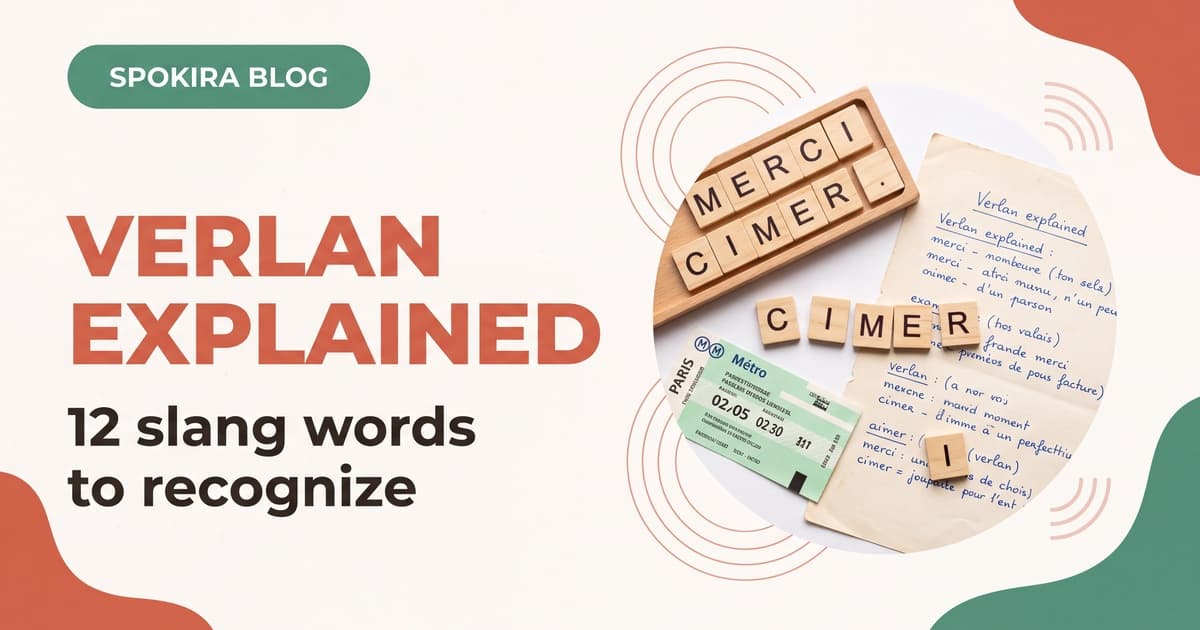
Verlan is French slang built by flipping or reshaping the sounds of a word. You do not need to speak it to learn French well. You do need to recognize a few forms, because they show up in songs, subtitles, group chats, comedy, and fast casual conversation.
If meuf, chelou, or relou has made a sentence disappear on you, the problem is not your grammar. Your brain is looking for the textbook word while the speaker is using a sound-based code. This guide gives you a practical listening list, plus the important part most slang lists skip: when to leave a word in your recognition vocabulary.
Quick answer: what is verlan?
- It comes from à l'envers, “backwards.”
- The simple pattern is a reversal of syllables or sound chunks, but real forms often change spelling and add or lose sounds.
- It is not a separate language or a rule you can apply safely to every French word.
- Learn it to understand people, then copy only words you have heard used naturally in your own social circle.
The CNRTL definition of verlan describes it as lexical coding through syllable inversion and related alterations, and dates the term verlan itself to 1968. That is a useful definition, but it should not tempt you into treating each form like a math problem. Speech, fashion, region, and community decide what sounds current.
How verlan works in real French
Start with a word such as femme. In everyday written French it is still femme. In casual speech you may hear meuf, a form learners often meet long before they can decode it. The CNRTL entry for femme is a good reminder that the base word remains ordinary French; verlan changes the social signal, not the underlying grammar.
The more useful habit is this: when a familiar-looking sentence contains one unknown short word, keep listening. Is it standing where a noun, adjective, or reaction would go? Does the scene give you a likely meaning? Then replay the line and check it. That is far more reliable than trying to invent verlan on the spot.
Recognition beats performance
If a word carries identity, age, or local context, understanding it is already a win. You do not need to borrow it to prove that you understand real French.
Verlan explained: 12 words worth recognizing
1. Meuf ← femme
Meaning: woman, girl, girlfriend, depending on context.
C'est une meuf de ma fac. She's a woman from my university.
This is probably the first verlan word many learners encounter. It is casual. A woman may use it about herself or friends; an outsider using it about a stranger can sound needlessly familiar. In a shop, workplace, or formal introduction, use femme, madame, or the person’s name instead.
2. Ouf ← fou
Meaning: crazy, wild, amazing, intense.
Le concert était ouf. The concert was wild/amazing.
Context does the work here. A person can be ouf in a negative sense, while an event can be ouf in an enthusiastic one. Hear it as an emotional amplifier, not as a neat one-word English translation.
3. Chelou ← louche
Meaning: suspicious, sketchy, weird.
Ce message est un peu chelou. That message is a bit sketchy.
The base adjective louche already means shady or suspicious; CNRTL’s entry gives the underlying sense. Chelou is a relaxed spoken label. It works well as listening vocabulary because it often signals a speaker’s attitude toward a person, message, or situation.
4. Relou ← lourd
Meaning: annoying, exhausting, a bit much.
Il insiste encore? C'est relou. He's pushing it again? That's annoying.
French lourd can mean heavy in the literal sense, but socially it can describe someone who will not let a joke, request, or flirtation go. Relou sharpens that casual complaint. Do not use it for a boss, client, or stranger unless you want the bluntness.
5. Teuf ← fête
Meaning: party.
On va à une teuf samedi. We're going to a party on Saturday.
You may see this in messages and hear it in student or nightlife contexts. It is easy to understand and easy to avoid. Fête works everywhere, which makes it the better active word for a learner.
6. Keum ← mec
Meaning: guy, bloke.
Tu connais ce keum? Do you know that guy?
This is more marked than mec, which is already casual. Treat it as a listening clue in films, banter, or rap rather than a replacement for homme, monsieur, or mec.
7. Zarbi ← bizarre
Meaning: strange, odd.
Son excuse est vraiment zarbi. His excuse is really odd.
It has a playful sound, which is exactly why it can be hard to judge from a dictionary alone. It is safest as recognition vocabulary. If you want a neutral adjective, say bizarre or étrange.
8. Ripou ← pourri
Meaning: corrupt, rotten, lousy.
Un flic ripou dans le film. A corrupt cop in the film.
You will often meet this in crime stories and media references. It is memorable because its meaning has narrowed toward corruption. Do not assume every flipped word works that cleanly.
9. Rebeu ← beur ← arabe
Meaning: a term connected to people of North African/Arab background in France.
This is the clearest case for “understand, do not casually deploy.” Identity words belong to people and communities, not a tourist’s slang checklist. If the context requires neutral language, say exactly what you mean, such as d'origine algérienne when it is relevant and known.
10. Vénère ← énervé
Meaning: angry, worked up.
J'étais trop vénère après le retard. I was so annoyed about the delay.
It is expressive and informal. Notice that énervé can also mean irritated or agitated, so a flat dictionary equivalent such as “angry” may miss the heat level. Save it for comprehension until you have heard how your friends use it.
11. Tromé ← métro
Meaning: metro, in a playful or niche form.
This item earns its place because it teaches restraint. You may encounter it, but it is much less dependable than meuf or ouf. A listicle should not pretend every recognizable verlan form is a word you need. Use métro.
12. Laisse béton ← laisse tomber
Meaning: forget it; drop it.
This is a classic cultural reference more than a phrase to lead with. The CNRTL definition even cites it as an example of the “backwards” game. It is useful because it shows that verlan can reshape a whole expression, not only a two-syllable noun.
Why you should not manufacture verlan
The tempting move is to reverse a word and hope. Do not. Verlan is sound-based, not spelling-based, and the forms that survive are social conventions. A clever invention may be understood as a joke, or it may simply make the listener work too hard.
There is also a register issue. Slang can create closeness between people who share a context. It can create distance when it comes from someone who has only met it on a vocabulary app. Your French will sound more natural if you use ordinary, flexible words well: bizarre, fatigant, fête, mec, ça m'énerve.
For a wider look at the gap between lesson French and street-level listening, read classroom French vs real French. If what you need is a natural way to react without forcing slang, start with French reaction phrases that sound natural.
A five-minute verlan listening drill
- Pick two words from the list, such as meuf and chelou.
- Read the ordinary word, then the verlan form aloud: femme, meuf; louche, chelou.
- Say one plain sentence with the ordinary word: Cette situation est louche.
- Listen for the verlan form in a clip with French subtitles. Do not hunt through hours of video; use a short scene and replay it.
- Record yourself saying the neutral sentence first. Only copy the slang line if you understand the scene and register.
That sequence trains an important real-world skill: moving from “I missed one word” to “I can still follow the conversation.” French speaking practice for A2-B1 learners and shadowing practice can help you turn short clips into repeatable speaking work.
Train your ear for real French
Shadow short native phrases, record yourself, and get clear feedback on what to repeat next.
The useful goal: notice the word, keep the conversation
Verlan is not a badge of fluency. It is one part of a much larger spoken French landscape. Learn the handful that keep appearing, respect the context around identity and slang, and keep your active vocabulary neutral enough to travel anywhere.
When you hear Cette histoire est chelou, you do not need to answer with a perfect slang phrase. You only need to catch the point: something feels off. That is a real listening win, and it leaves you free to respond in French you can say confidently.
What verlan tells you about the conversation
Verlan is rarely the only informal feature in a sentence. It often arrives with ouais, dropped ne, a faster rhythm, or a relaxed greeting. That does not mean the whole conversation is inaccessible. It gives you useful information about the register: this is probably peer-to-peer, spontaneous, and less formal than a classroom dialogue.
Pay attention to what happens around the unfamiliar word. In C'est trop relou, j'ai raté le métro, the phrase j'ai raté le métro carries the factual message even if relou is new. In Sa réponse était chelou, non?, the question tag non? and the noun réponse narrow the possible meaning. Listening is not a test where every word has to be known before you can understand the line.
That is also why subtitles can be useful when you use them well. Watch a short French clip once without pausing. Write the one word that blocked you. Watch it again with French subtitles, not English subtitles, and identify the base word. Then listen once more without reading. You are training recognition, not collecting slang.
A register map: where these words do and do not belong
| Situation | Best choice | Why |
|---|---|---|
| Texting a close friend who uses the word | Recognition first, then mirror cautiously | Shared context tells you whether it fits |
| Watching a series, video, or comedy clip | Learn it passively | The speaker may be performing a character or era |
| Ordering, asking directions, or speaking to staff | Use standard French | Neutral vocabulary is clearer and safer |
| Class, interview, or workplace meeting | Use standard French unless your group already uses the slang | You do not need slang to sound natural |
| Talking about identity or a community you do not belong to | Understand the reference; do not borrow it casually | The social meaning matters as much as the dictionary meaning |
You will notice that “avoid” does not mean “be afraid.” A warm, ordinary C'est bizarre is more useful than a perfectly timed C'est zarbi you are not comfortable saying. Natural French is built from clear choices repeated in real situations.
Three mistakes learners make with verlan
Treating it as a pronunciation trick
Reversing the letters of a word will not reliably produce verlan. Chelou is not a spelling exercise based on louche; it is an established spoken form. Use a dictionary, subtitles, or a native-speaker example to check a word before adding it to a personal list.
Using a word without its tone
Some words are playful, some dismissive, and some can be rude in the wrong setting. The safest question is not “What does this translate to?” but “What is the speaker doing with it here?” Complaining? Joking? Showing surprise? Quoting a friend? That observation gives you the missing tone.
Making slang your proof of progress
You can have a very good conversation in French without using a single verlan form. Your progress shows when you can follow the point, ask a follow-up question, and say what you mean. A useful response to C'est relou is simply Ah oui, je comprends. Qu'est-ce qui s'est passé? That keeps the conversation moving.
Questions learners ask about verlan
Is verlan rude?
Not automatically. It is informal, and individual words carry different levels of bluntness. The situation decides whether it sounds friendly, silly, dismissive, or out of place. Standard French is never a wrong fallback.
Should beginners learn verlan?
Beginners can learn the most common forms as listening vocabulary. Do not put them ahead of the phrases you need to introduce yourself, ask for help, or keep a conversation going. Recognition pays off early; active use can wait.
Is every French slang word verlan?
No. French slang includes borrowed words, regional expressions, old argot, youth language, and ordinary words used in a new way. Wesh, for example, is not a simple syllable reversal. Calling every casual word “verlan” hides the variety of spoken French.