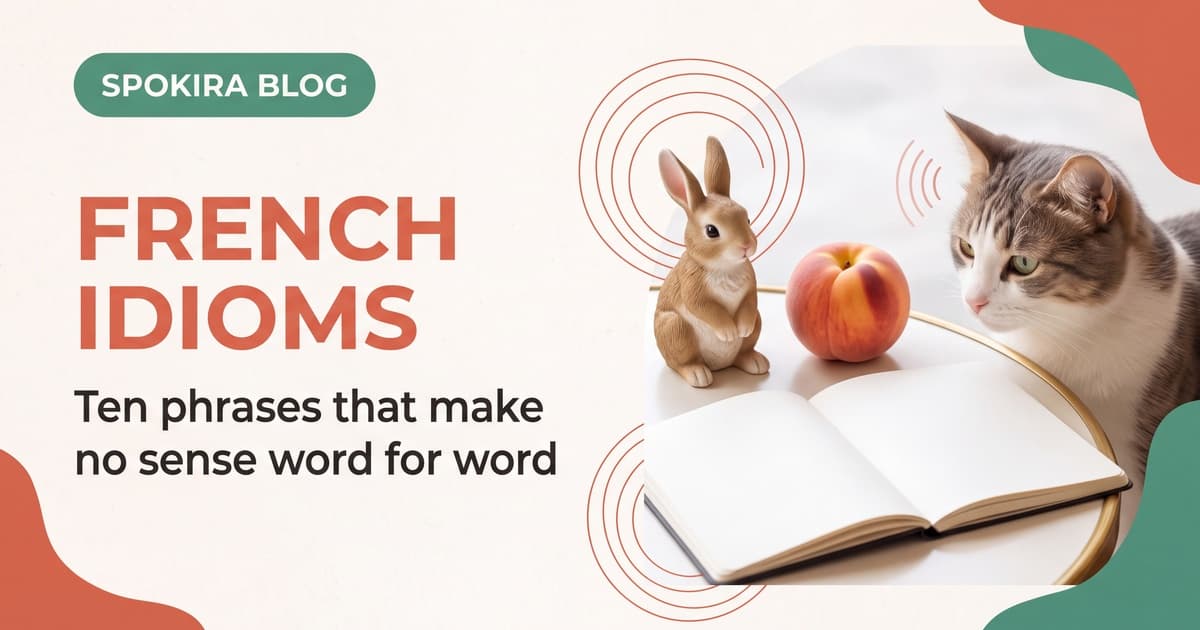
French idioms translated literally are often funny, occasionally baffling, and rarely useful if you try to decode every word in real time. A rabbit appears at an empty date. A cockroach becomes a bad mood. Someone who has had enough gives their tongue to a cat.
The point is not to memorise a museum of quirky phrases. It is to recognize a few expressions French speakers use as ready-made chunks, then borrow the ones that suit your own voice. CNRTL notes that linguistic expressions figées are fixed expressions; that is why their meaning does not reliably add up word by word (CNRTL, figé).
Start by understanding them. Then say one out loud in a complete sentence. That is how an idiom stops being trivia and starts becoming something you can use.
French idioms translated literally: a quick rule before you use them
An idiom can sound warm and natural when you know the situation. It can also sound oddly theatrical if you drop it into a formal email or repeat it after hearing it once on television. The safest approach is simple:
- use the expression after you have heard it in context;
- copy the register, not only the words;
- keep the rest of the sentence plain; and
- do not force an English idiom into French when a direct French sentence is clearer.
The Académie française dictionary portal is useful when you want to check a phrase, its history, or its register. For speaking practice, though, a short sentence is more useful than a long dictionary note.
1. Poser un lapin, to stand someone up
Literal translation: to put down a rabbit. What it means: not to show up for an agreed meeting.
Il m'a posé un lapin hier soir. He stood me up last night.
This is a familiar expression, so keep it for friends, dates, or casual plans. It is not the phrase for a formal complaint about a missed professional meeting. The Académie's dictionary records poser un lapin à quelqu'un with the meaning "not to come to an appointment" (Académie française via CNRTL).
Try the softer version if you are not sure what happened: Je crois qu'il m'a posé un lapin. "I think he stood me up."
2. Avoir le cafard, to feel blue
Literal translation: to have the cockroach. What it means: to feel down, gloomy, or a bit depressed.
J'ai le cafard depuis ce matin. I've been feeling low since this morning.
It is more conversational than a clinical description of mental health. Use it for an ordinary slump after a bad week, grey weather, or homesickness. If someone tells you they have le cafard, a natural response is Ah mince, qu'est-ce qui se passe? rather than trying to solve the problem immediately.
3. Tomber dans les pommes, to faint
Literal translation: to fall into the apples. What it means: to pass out or faint.
Avec la chaleur, j'ai failli tomber dans les pommes. With the heat, I nearly fainted.
This is vivid and informal. It works well in conversation, especially when the situation was dramatic enough to tell as a story. In an emergency, skip the idiom and be direct: Elle s'est évanouie. Call for help if needed; clarity matters more than colour.
4. Donner sa langue au chat, to give up on a guess
Literal translation: to give your tongue to the cat. What it means: to admit you cannot find the answer, usually in a game or riddle.
Je donne ma langue au chat. C'était quoi? I give up. What was it?
This is one of the friendliest French idioms for learners because it is useful immediately. You might hear a word you cannot remember, play a quiz with friends, or get stuck in class. Say it with a smile. It signals curiosity, not defeat.
5. Coûter les yeux de la tête, to cost a fortune
Literal translation: to cost the eyes of the head. What it means: to be extremely expensive.
Ce billet de train m'a coûté les yeux de la tête. That train ticket cost me a fortune.
This works for hotel rooms, repairs, tickets, or a restaurant bill. It has the same light exaggeration as "an arm and a leg" in English. Use it after the purchase, not when you are asking a shopkeeper about the price. A joke is safer with friends than with the person selling you the thing.
6. Avoir un chat dans la gorge, to have a frog in your throat
Literal translation: to have a cat in the throat. What it means: to have a hoarse voice or need to clear your throat.
Pardon, j'ai un chat dans la gorge. Sorry, I have a frog in my throat.
This is a useful little bridge between English and French: both languages put an animal in the throat, just not the same animal. Say it before a phone call, presentation, or recording if your voice catches. It is informal, harmless, and easy to remember.
7. Avoir la pêche, to be full of energy
Literal translation: to have the peach. What it means: to feel energetic, cheerful, and ready to go.
Tu as la pêche aujourd'hui! You're full of energy today!
Use it with people you know. It is friendly and upbeat, but not the safest line for a first meeting with a manager or client. If you want a neutral alternative, say Tu as l'air en forme, "you look well / in good form."
8. Être dans la lune, to have your head in the clouds
Literal translation: to be in the moon. What it means: to be distracted or daydreaming.
Excuse-moi, j'étais dans la lune. Tu peux répéter? Sorry, I was daydreaming. Can you repeat that?
This is gentler than accusing someone of not listening. It can even be a useful repair phrase when your French disappears for a second. Pair it with a request: Tu peux répéter plus lentement? That keeps the conversation moving instead of making the lapse the whole story.
9. Mettre les pieds dans le plat, to put your foot in it
Literal translation: to put your feet in the dish. What it means: to say something tactless, often by raising an awkward subject.
J'ai mis les pieds dans le plat en demandant pourquoi ils s'étaient séparés. I put my foot in it by asking why they had split up.
The English equivalent is close, but the French image is more chaotic: both feet, directly in the serving dish. Use it after a social misstep and follow it with a plain apology if anyone was hurt. The idiom explains the mistake; it does not undo it.
10. Raconter des salades, to tell tall tales
Literal translation: to tell salads. What it means: to make things up or tell unlikely stories.
Arrête de raconter des salades! Stop making things up!
Tone decides whether this is playful or sharp. With a friend who is clearly exaggerating, it can be teasing. With a stranger, colleague, or child who is genuinely upset, it can sound dismissive. A lighter option is Tu plaisantes?; "Are you kidding?"
Learn the whole reaction
Do not memorise only avoir le cafard. Memorise a tiny exchange: J'ai le cafard aujourd'hui., Ah mince. Tu veux en parler? Idioms become useful when your next line is ready too.
How to use French idioms translated literally without sounding rehearsed
French idioms are best learned as scenes, not as flashcards with strange pictures. Pick two that fit moments you actually have. Maybe you are often tired, you miss details in conversations, or you complain about train prices. Build a mini-dialogue around that moment.
Here is a five-minute speaking drill:
- Read one French sentence aloud slowly.
- Cover the English and explain the situation in your own words.
- Record the sentence once at normal speed.
- Add one follow-up line: a question, an apology, or a reaction.
- Repeat later that day without looking.
For être dans la lune, the full response could be: Pardon, j'étais dans la lune. Tu peux répéter la dernière phrase? That is far more useful than knowing that "moon" is hiding in an idiom.
If direct translation keeps catching you out, read why "that makes sense" needs different French phrases. And if you want reactions that buy you a second to think, keep these natural French reaction phrases nearby.
When should you avoid an idiom?
Avoid it when precision matters more than charm. Medical appointments, safety instructions, job interviews, formal requests, and conflict are poor places to experiment with a new figurative phrase. Plain French is not boring French. It is often the most confident choice.
Also remember that idioms travel unevenly. A phrase can be common in France, less common elsewhere in the French-speaking world, or simply feel dated to a particular speaker. If someone does not react, do not panic. Paraphrase and continue.
Three ways learners make idioms harder than they need to be
The first trap is translating an English idiom and hoping French has built the same metaphor. Sometimes it has. English and French both have a throat animal, for example. Often it has not. If you want to say "I am feeling low," learn j'ai le cafard as one sound-and-meaning unit. Do not begin with the English sentence and hunt for a French cockroach.
The second trap is overusing the new phrase. One idiom in a real story can make your French lively. Three in two minutes can make it sound like you are performing a phrasebook. Let the expression earn its place. Say ce billet a coûté les yeux de la tête after an unexpectedly expensive ticket, not simply because money came up.
The third trap is learning the expression without its grammar. Notice the small pieces that make it usable: poser un lapin à quelqu'un, avoir le cafard, tomber dans les pommes. Say the pronoun too. Il m'a posé un lapin is a complete, natural memory hook; lapin alone is only a rabbit.
Mini conversations to steal
Here are four compact exchanges. Read each role aloud, then replace one detail with something from your own life.
A missed plan
Tu as vu Léa hier? Non, elle m'a posé un lapin.
A rough morning
Ça va? Tu as l'air fatigué. Bof, j'ai un peu le cafard aujourd'hui.
A riddle
Alors, tu as trouvé? Non, je donne ma langue au chat.
A price shock
Tu as pris le train au dernier moment? Oui, ça m'a coûté les yeux de la tête.
These exchanges are deliberately short. A learner who can deliver one clean line and understand the reply is in a much better position than a learner who knows the origin story of twenty expressions.
Do French speakers use idioms all the time?
No. Ordinary conversation contains plenty of plain language: je suis fatigué, c'est cher, je ne sais pas, il n'est pas venu. Idioms add colour when the context fits; they are not a fluency test. A simple sentence said with good timing is usually more natural than an idiom you are not comfortable saying.
That is good news for speaking practice. You can learn the direct version first, then attach one idiom as an optional upgrade. For example, start with je suis un peu triste. Later, when you hear and like it, add j'ai le cafard. Your French gets richer without becoming fragile.
Make one expression yours
You do not need ten new idioms this week. Choose one that you can imagine using by Friday. Say it in a complete sentence. Hear it in a conversation. Then use it when the moment genuinely fits.
That is the useful side of funny French expressions: they let you sound less translated and more present. For more practice turning recognition into speech, see how to keep talking when your mind goes blank, then train short, natural responses in Spokira.
Know the words. Say them on time.
Practice short French responses with native audio and pronunciation feedback, so useful phrases are there when the conversation moves.